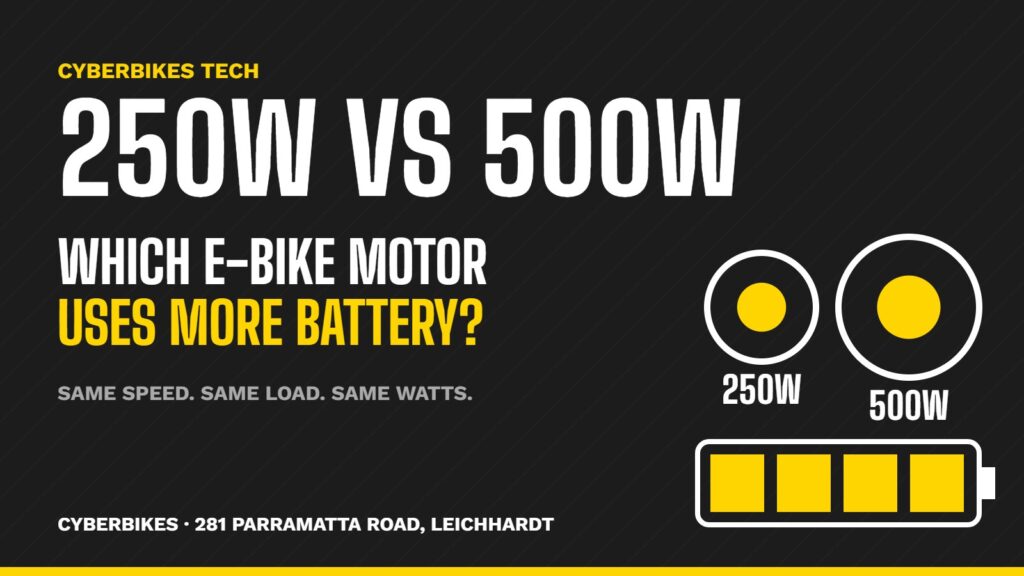
At the same speed, weight and assist level, a 500W e-bike motor does not use meaningfully more battery than a 250W one. Range is set by how much power you actually draw, not the number printed on the motor. A 500W setup only drains the battery faster when you use the extra power it allows: harder launches, faster climbs, more throttle-like assist.
That surprises a lot of riders who walk into Cyberbikes in Leichhardt, especially now NSW allows up to 500 W. So let’s settle the 250W vs 500W e-bike motor question properly: what the rating really means, where your battery’s energy goes, whether a bigger motor is more efficient, and what it all means for range on a Sydney commute. The engineering here comes from ebikes.ca (Grin Technologies), the Canadian e-bike lab behind the best-known motor simulator on the web, plus basic physics you can check yourself.
What does a 250W or 500W motor rating actually mean?
Less than you’d think. Grin’s article on the futility of motor power ratings makes the point bluntly: there is no standard, consistent way to put a single watts figure on an e-bike motor, and the same motor can legitimately be sold as 250W, 500W or 1000W depending on how the maker chooses to rate it.
That’s because a motor isn’t like a 60W light bulb. It doesn’t have a fixed power draw. What it actually delivers depends on three things:
- Battery voltage (V), which mostly sets how fast the motor can spin.
- Controller current limit (A), which caps how hard it can push. Electrical power is simply watts = volts × amps, so a 48V battery feeding 15 A is 720 W going in.
- The load: your speed, weight, the hill and the wind.
Grin even demonstrates that you could swap in a much smaller or much larger motor with the same controller and battery and the output wouldn’t change much. The rating is really a statement about how much power the motor can handle continuously before it overheats, not how much it will pull from your battery on the way to work. We’ve covered the difference between continuous and peak e-bike watts separately if you want to go deeper on that label.
Is a 500W e-bike legal in NSW?
Yes, for now. According to Transport for NSW, an e-bike can have a maximum continuous rated power of 500 W, with pedal assistance cutting out at 25 km/h and throttle-only power cutting out at 6 km/h. From 1 March 2029 the limit drops to 250 W and bikes must be EN 15194 certified. Bikes that exceed the limits are illegal even if the power or speed is restricted by an app, switch or code.
Does a 500W e-bike motor drain the battery faster than a 250W motor?
Only if you ride it harder. Grin’s pedal-assist guide puts the whole range debate in one line: the range you get has nothing to do with the control system and everything to do with the average amount of power you draw. The same logic applies to the motor label.
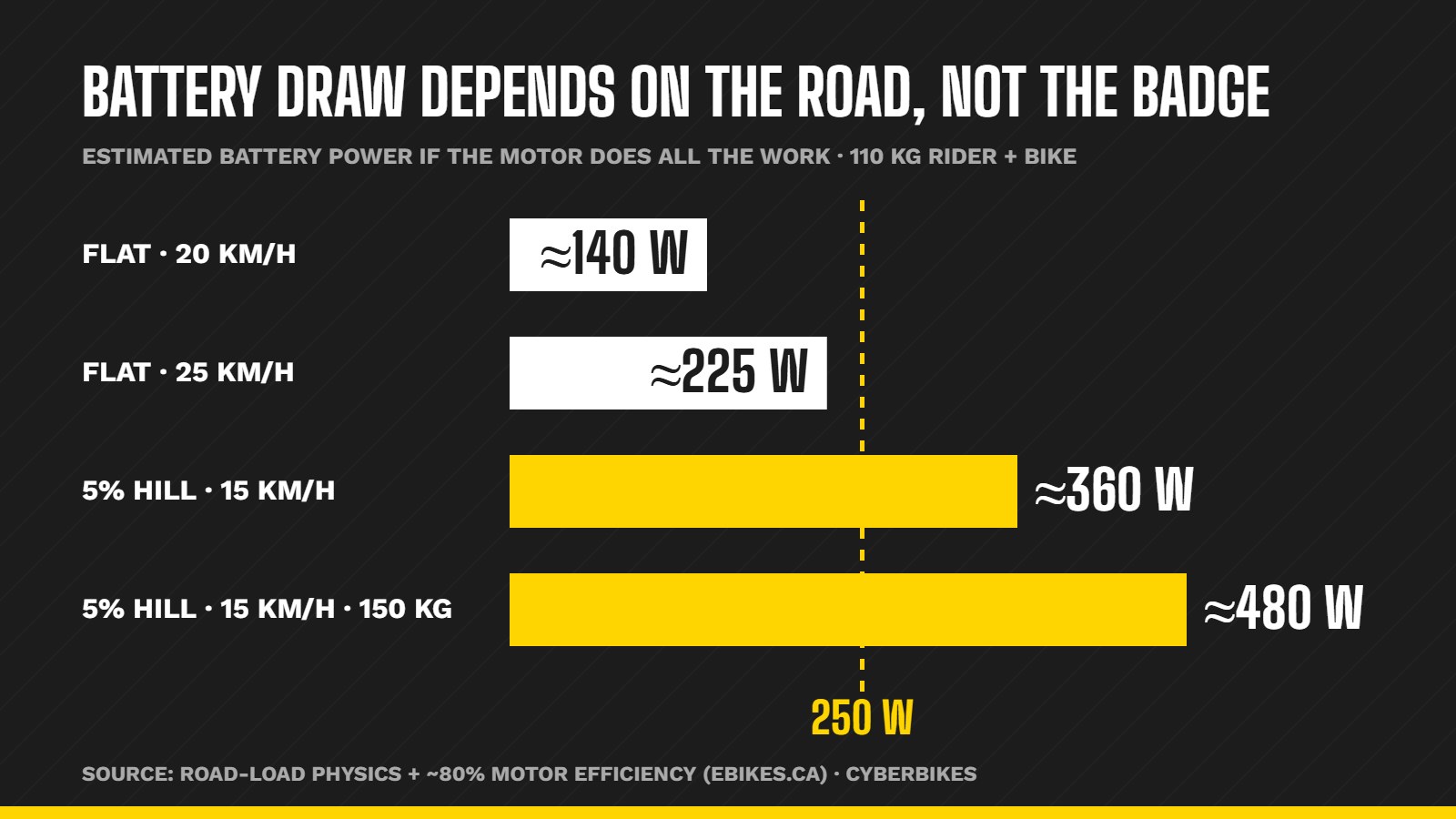
Here’s the physics. To hold a speed, the bike has to push against three forces: tyre rolling resistance, air drag, and gravity on hills. The power needed is force × speed, and that number is the same whether the motor is badged 250W or 500W. Using standard road-load formulas for a 110 kg rider-plus-bike, upright position and good tyres (our own illustrative estimate, not a lab measurement):
| Riding situation | Power at the wheel | Battery power if the motor does it all (~80% efficient) | Energy use |
|---|---|---|---|
| Flat road, 20 km/h | ≈ 110 W | ≈ 140 W | ≈ 7 Wh/km |
| Flat road, 25 km/h | ≈ 180 W | ≈ 225 W | ≈ 9 Wh/km |
| 5% hill, 15 km/h | ≈ 290 W | ≈ 360 W | ≈ 24 Wh/km |
| 5% hill, 15 km/h, 150 kg loaded | ≈ 380 W | ≈ 480 W | ≈ 32 Wh/km |
Two things jump out. On the flat at the legal 25 km/h, the bike needs under 250 W at the wheel, so a 250W and a 500W motor are doing exactly the same job and drawing roughly the same energy. The difference only shows on hills and with cargo, where the demand climbs past 250 W. A 500W system lets you hold speed there, and that extra speed costs extra watt-hours. A 250W system slows down, asks more of your legs, and uses less battery per kilometre as a result.
So why do some 500W e-bikes get shorter range?
Because they’re usually set up to deliver more: a higher controller current, punchier assist levels, and riders who (understandably) use it. Grin’s simulator notes make the same point about efficiency itself: a fast, powerful setup running at 80% efficiency may still draw more power than a gentler one. Higher speed means more air drag, and air drag grows with the square of speed, so the power needed to push through it grows even faster.
Is a bigger e-bike motor more efficient?
Sometimes, and it depends on where you ride. There are two opposing effects:
- Copper heating (I²R losses) favours the bigger motor on hills. Current flowing through the windings makes heat in proportion to current squared. Grin explains that doubling the current to double the torque produces four times the heat. A physically larger motor with more copper can produce the same torque with less heat, so it wastes less energy on a long, slow climb. A small motor pushed hard up a steep street is working in its least efficient zone.
- Drag and weight can favour the smaller motor on the flat. Grin’s hub motor guide notes that direct-drive hubs carry cogging drag of roughly 0.3 to 1 Nm that you’re always overcoming, even when the motor is off, and that geared hubs typically weigh about 50% less than an equivalently powerful direct-drive motor. At light cruising loads, that drag and extra mass can cancel out the bigger motor’s copper advantage.
Grin also notes that a permanent-magnet motor is typically happiest at about 80% of its unloaded speed, roughly 80% efficiency, with efficiency falling as the motor is dragged down to lower speeds under load. That’s the real efficiency story: the motor that suits your hills and your speed beats the one with the bigger badge. For how motors, sensors and controllers fit together, see our guide to how e-bike motors, sensors and controllers actually work.
How much range do you get from a 1200 Wh battery?
Battery capacity is watt-hours = volts × amp-hours. The Cyberbikes Centauro runs a 48V 25Ah Samsung battery, which is 1200 Wh, paired with a 250W continuous rear hub motor, according to the Centauro product page. Divide capacity by consumption and you get range:
- 8 Wh/km (flat commute, you pedal steadily): about 150 km
- 12 Wh/km (mixed Inner West riding): about 100 km
- 20 Wh/km (hilly, higher assist): about 60 km
- 30 Wh/km (steep, loaded, little pedalling): about 40 km
That’s straight arithmetic on the full rated capacity, so treat it as a ceiling: cold mornings, an ageing battery and keeping a reserve all bring it down. Notice what moves the number: the terrain and how hard you ride. The motor’s badge barely appears. Our definitive guide to e-bike batteries and range explains watt-hours, cell ageing and charging in full.
250W vs 500W: which suits a Sydney rider?
For most commuters, a well-set-up 250W motor with a big battery is the smarter buy. It’s legal now and it’s the standard NSW is heading to in 2029. On the flat at 25 km/h it does exactly what a 500W motor does. The trade-off is on the steep stuff: the steeper Inner West streets, where a 250W bike asks you to shift down and pedal. That’s the moment a 500W system feels stronger, and it’s the moment it drinks more battery.
- Choose on battery Wh first: capacity decides range far more than motor watts.
- Ask for the controller current: amps × volts tells you how hard the motor can actually push.
- Use your gears on hills: keeping the motor spinning near its efficient speed cuts heat and saves watt-hours.
- Check it’s NSW-legal: 500 W continuous today, 250 W and EN 15194 from 2029, assist to 25 km/h.
We talk about why a watt figure ended up in the law in this short from our channel:
Frequently Asked Questions
Does a 500W e-bike motor use more battery than a 250W motor?
Not at the same speed and load. Range depends on the average power you draw, not the motor rating. A 500W motor only uses more battery when you use its extra power to climb faster, accelerate harder or ride with more assist.
Is a 250W e-bike motor enough for Sydney hills?
Yes for most riders, as long as you use your gears and pedal. On the flat at 25 km/h a bike needs under 250 W at the wheel. On steep hills a 250W bike climbs more slowly and asks more of your legs, but uses less battery per kilometre.
What is the e-bike power limit in NSW?
Transport for NSW allows a maximum continuous rated power of 500 W, with pedal assist to 25 km/h and throttle-only power to 6 km/h. From 1 March 2029 the limit becomes 250 W with EN 15194 certification. Bikes over the limits are illegal even if software-restricted.
Ride a 1200 Wh Centauro without the big upfront cost
Want the range without paying for it all at once? Cyberbikes’ rent-to-own plan starts from $99.99 a week, with weekly payments instead of one big upfront price. Check the full specs on the Cyberbikes Centauro e-bike page, then drop into our Leichhardt shop at 281 Parramatta Road to ride one up a real Inner West hill.
#ebike #ebikeSydney #ebikebattery #ebikerange #250W #ebiketech #CyberbikesCentauro #renttoown #Leichhardt #InnerWest #Cyberbikes