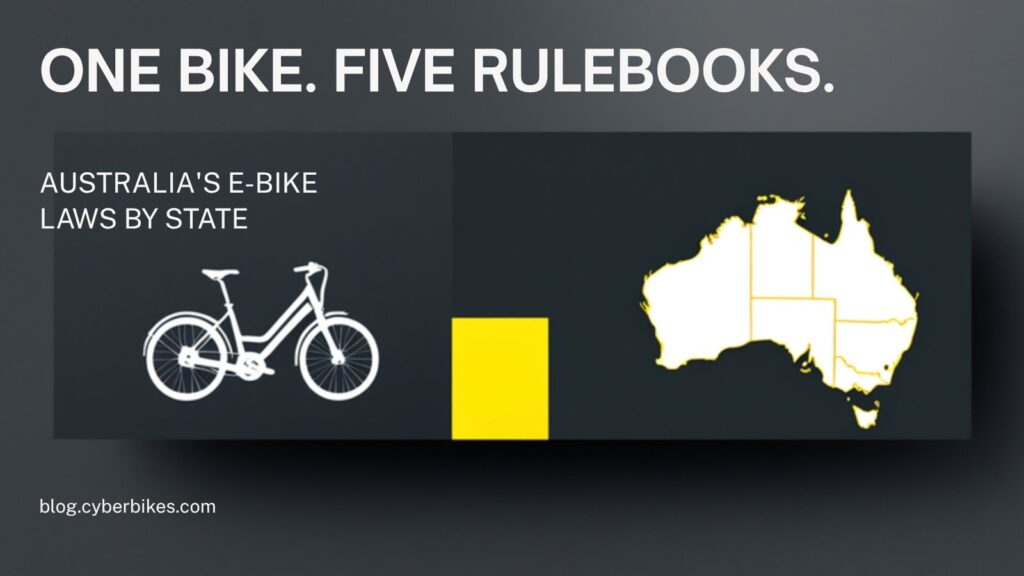
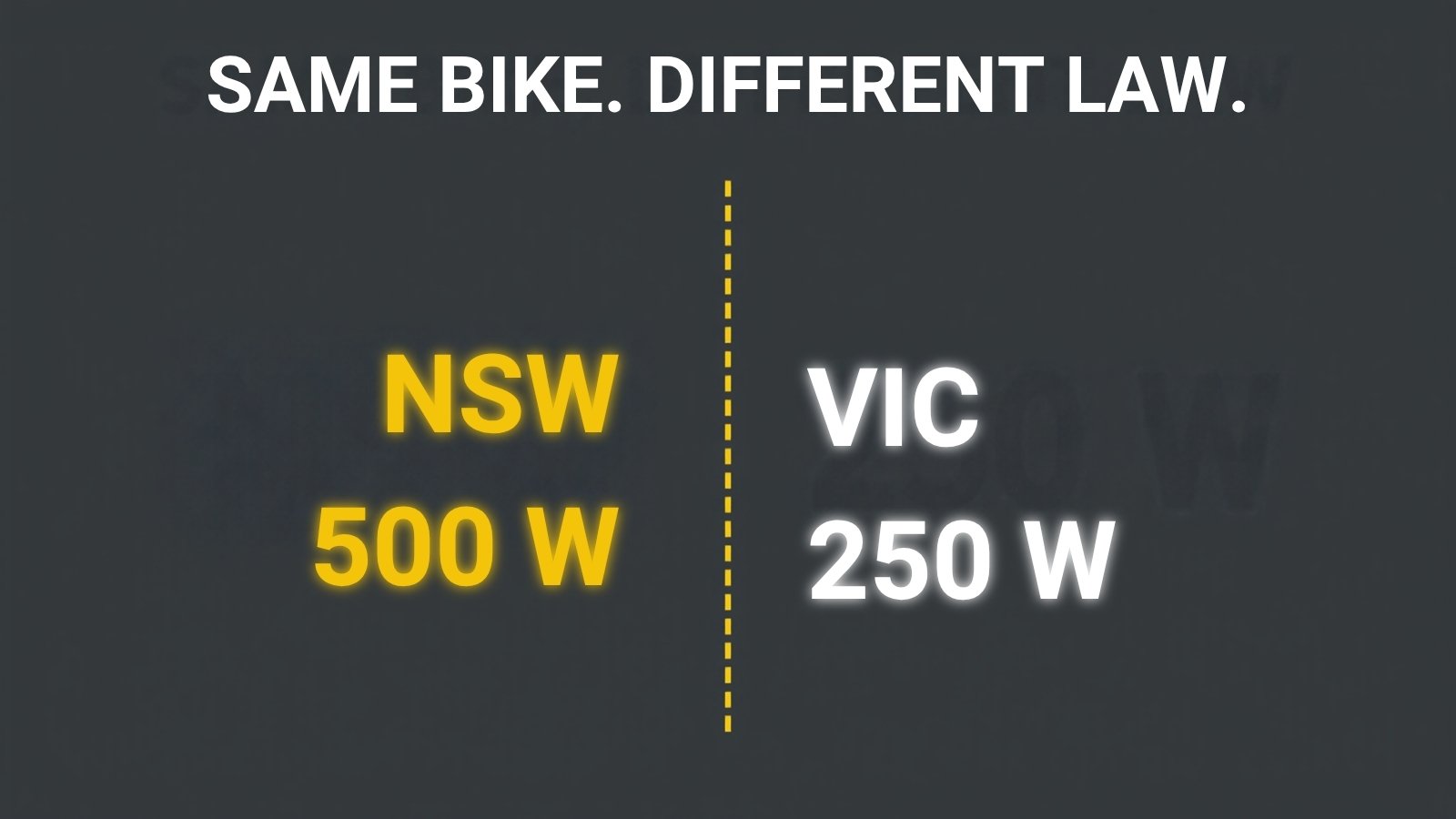
A 250-watt pedal-assist e-bike that stops assisting at 25 km/h is legal in every Australian state and territory. Above that line, Australia’s e-bike rules stop agreeing with each other. New South Wales permits up to 500 watts of maximum continuous rated power. Victoria, South Australia and Western Australia cap it at 250. Queensland spent 2026 rewriting age, licensing and behaviour rules instead. Same bike, same rider, five different answers — ride a Sydney e-bike across a border and you can become a criminal without touching the throttle.
That is not a drafting quirk. It is a policy failure that pushes riders into uncertainty, makes retailers guess, and hands the “e-bikes are chaos” headline to anyone who would rather Australia kept driving.
Why is a 500W e-bike legal in Sydney but not in Melbourne?
Because the states never agreed on which number to regulate. Transport for NSW defines a legal e-bike as one with “a maximum continuous rated power of 500 watts”, assistance that must not provide power above 25 km/h, and a throttle-only function that cuts out at 6 km/h. From 1 March 2029, NSW drops to 250 W and only EN 15194 certified e-bikes will be allowed on NSW roads.
Cross into Victoria and that same 500 W bike is not a bicycle at all. Transport Victoria recognises a pedalec at “a maximum continuous rated power of 250 watts” and a throttle-driven power-assisted cycle at “up to 200 watts maximum power output”. South Australia uses the same 250 W / 200 W split, cutting assistance at 25 km/h or at 6 km/h when you stop pedalling. Western Australia’s Road Safety Commission also runs 250 W and 200 W, and on multi-motor bikes “the limit applies to the total power output of all motors”.
Four jurisdictions sit at 250 W. One sits at 500 W — and it is the country’s largest e-bike market. A rider in Leichhardt can legally buy a bike a rider in Coburg cannot.
Who can ride one, and where, in each state?
Power is only one of four variables. Age, footpath access and speed-on-path rules diverge too.
| State | Motor power limit | Assist cut-off | Footpaths | Minimum age |
|---|---|---|---|---|
| NSW | 500 W (250 W + EN 15194 from 2029) | 25 km/h; throttle to 6 km/h | No, if 16+ (unless supervising a child) | None set |
| VIC | 250 W / 200 W throttle | 25 km/h | No, from age 13 | None; no licence |
| QLD | Rider pages lead with speed, not watts | 25 km/h assisted | Yes, at 12 km/h | 16 + licence; 12–15 supervised |
| WA | 250 W / 200 W other | 25 km/h | Yes, standard bike rules | 16+ with assist engaged |
| SA | 250 W / 200 W throttle | 25 km/h; 6 km/h unpedalled | Standard bike rules | None set |
Read it as a rider and the problem jumps out. A 15-year-old can ride to school in Melbourne or Sydney, but not unsupervised in Perth or Brisbane. An adult can hold 25 km/h on a Perth shared path and must drop to 12 km/h on a Queensland footpath. Nobody here is reckless — they are governed by five rulebooks written at five different times.
What did Queensland change, and what does it mean for NSW?
Queensland moved hardest and fastest. Per Queensland’s StreetSmarts, rules from 1 July 2026 cap assistance at 25 km/h, impose a 12 km/h limit on footpaths and when passing pedestrians on shared paths, and price a missing helmet at $518, speeding at $345 to $1,986, and drink riding at $518 to $6,908. From 31 August 2026 riders “must be 16 with a valid licence”, with 12 to 15-year-olds permitted under supervision. Compliance labelling becomes mandatory on 28 February 2027.
The enforcement is not theoretical: Queensland Government statements record 1,747 infringement notices and almost 400 illegal e-bikes and e-scooters seized since 1 July 2026, with police able to seize and destroy them.
NSW is on the same road. Transport for NSW confirms that on 21 August 2026 police and authorised officers gained “expanded powers to seize illegal e-bikes that are used on NSW roads and road-related areas and to efficiently dispose of them”. Illegal here means more than 500 W maximum continuous power or a motor that keeps assisting above 25 km/h, and the agency is blunt that “hacking or tampering with your e-bike may make it illegal”. Our complete guide to e-bike laws in NSW and Australia lays out every category.
Who actually pays for the patchwork?
Riders and small retailers — not the people writing the rules, and not the importers shipping 3,000-watt machines with a bicycle sticker on the box.
A family that buys a compliant bike in Sydney and moves to Adelaide can find their legal commuter is suddenly an unregistered motor vehicle. A Leichhardt shop selling online to Queensland must track a labelling deadline that does not exist in its own state. And every blitz aimed at the rider rather than the supply chain — the importer, the certification gap, the road design that left no safe space — makes the compliant rider feel like the problem.
The road-safety evidence is clear about what reduces harm: lower speeds, separated infrastructure, vehicle standards enforced at the point of import, and rules people can follow. Kerbside fines come last, not first. One national standard — one wattage number, one assist speed, one certification mark, one set of path rules — would do more in a year than five states fining their way there separately.
How do you buy a bike that stays legal anywhere?
Buy to the strictest number, not the loosest. A 250 W pedal-assist bike that cuts out at 25 km/h clears every limit in the table above — today, and after the NSW change in 2029.
It is why the Cyberbikes Centauro is built the way it is: a 250 W rear hub motor, a UL 2271-certified 48V 25Ah (1200Wh) Samsung battery, an ISO 4210 MTB-compliant 6061 aluminium frame, 4-piston hydraulic brakes on 180 mm x 2.3 mm rotors, a welded rear rack rated to 50 kg and a 150 kg rider-and-cargo load, at $3,999. The range comes from the battery, not from an illegal motor — the distinction these rules keep reaching for and missing. Helmets are mandatory for NSW riders either way.
If you are weighing whether one can replace a car trip, our car-free Sydney e-bike commuting and rent-to-own guide runs the numbers week to week.
Frequently Asked Questions
Is a 500W e-bike legal everywhere in Australia?
No. NSW currently allows a maximum continuous rated power of 500 watts, but Victoria, South Australia and Western Australia cap legal e-bikes at 250 watts for pedalecs and 200 watts for throttle-driven power-assisted cycles. A 500W bike bought legally in NSW is not a legal bicycle in those states, and NSW itself drops to 250 watts and EN 15194 certification from 1 March 2029.
What age do you have to be to ride an e-bike in Australia?
It depends on the state. Victoria sets no age limit and requires no licence for a compliant e-bike, and NSW sets no minimum age on its e-bike page. Western Australia requires riders to be 16 or older with power assistance engaged. Queensland requires riders to be 16 and hold a valid licence from 31 August 2026, with 12 to 15-year-olds allowed only under adult supervision.
Swap one car trip a week for an e-bike ride and see what changes. We are at Cyberbikes, 281 Parramatta Road, Leichhardt, if you want to talk it through in person.
#EbikeSydney #AustralianEbikeLaws #Micromobility #CarFreeSydney #Leichhardt #Cyberbikes #BikeInfrastructure #EbikeAustralia