For a legal 25 km/h e-bike in NSW, a slow-wind hub motor usually climbs better than a fast-wind one: it makes more torque from every amp the controller sends, and it spends more of its time near its efficient speed. A fast wind only earns its keep when you want a higher top speed from a lower battery voltage or a small wheel, and on a road-legal Sydney e-bike the motor stops helping at 25 km/h anyway.
That is the short answer. The longer one is worth knowing, because “fast wind vs slow wind” is one of the most misunderstood specs in the hub motor world. Below we unpack what the winding actually changes, what it doesn’t, and how to match it to your battery, wheel and hills. Our numbers come from the engineering pages at ebikes.ca (Grin Technologies) plus basic motor physics, and the riding context comes from what we see every week at Cyberbikes in Leichhardt.
What does “fast wind” and “slow wind” mean on a hub motor?
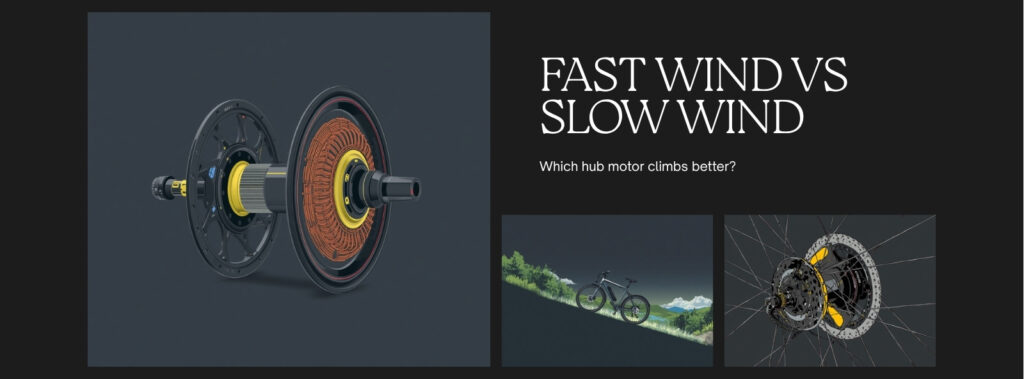
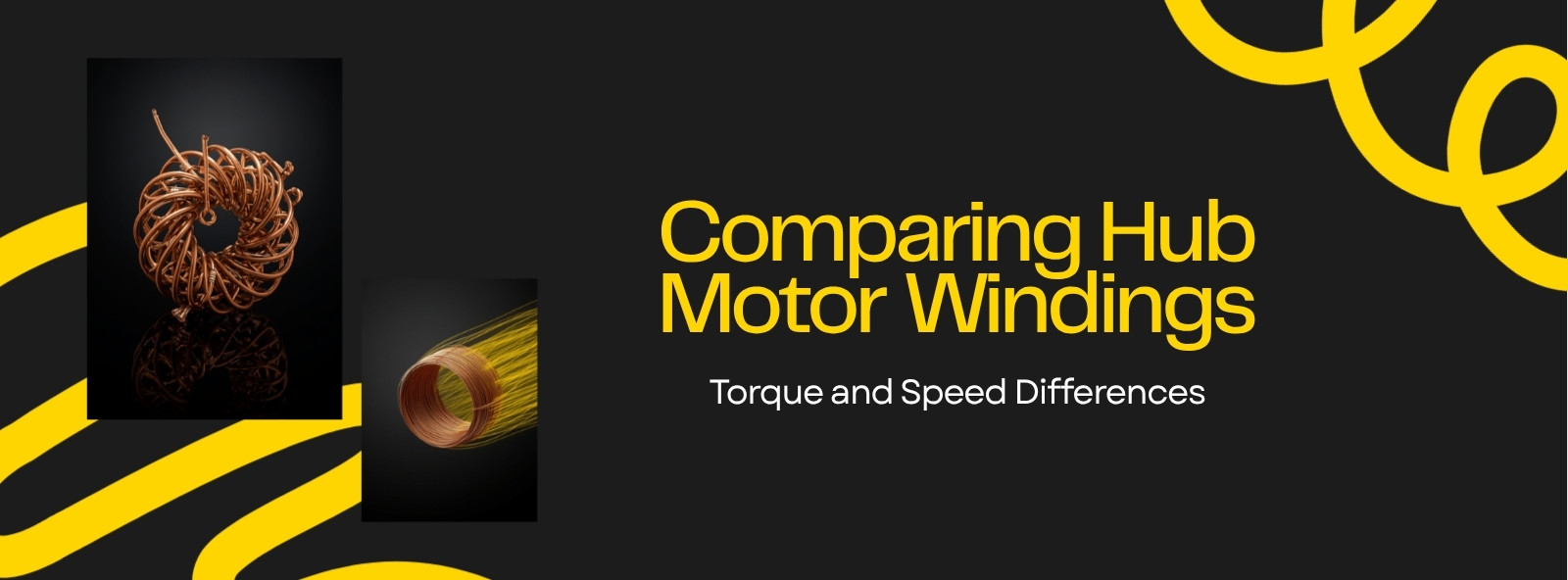
Inside every hub motor is a stator: a ring of iron teeth, each wrapped in copper wire. The winding is simply how many turns of wire go around each tooth. Grin’s hub motor guide uses Crystalyte’s naming as an example: a 406 has 6 turns per pole, a 4011 has 11.
- Fewer turns = fast wind. The motor spins more RPM for every volt of battery, so it reaches a higher top speed.
- More turns = slow wind (often sold as “standard”). Fewer RPM per volt, but more torque for every amp of current.
Manufacturers express this as a speed constant in RPM per volt. Grin’s FH212/RH212 motor, for example, comes in a standard wind of 8.1 rpm/V (7.5 turns) and a fast wind of 10.2 rpm/V (6 turns), according to its product info page.
Does a slow wind make the motor stronger?
No, and this is the part most spec sheets skip. Grin puts it plainly: motors in the same family can deliver the same torque at the same efficiency; the lower-turn versions simply need more current to do it. Rewinding trades current for voltage; it does not add copper, magnets or cooling. The power going in (V × A) for a given torque and speed is the same either way.
Fast wind vs slow wind: which hub motor climbs better?
If both windings can make the same torque, why does the slow wind usually win on hills? Because your controller has a current limit, and that limit, not the motor, decides how much torque you actually get.
For an ideal permanent-magnet motor, torque per amp and speed per volt are two sides of the same constant: torque constant (Nm/A) ≈ 9.55 ÷ speed constant (rpm/V). Run the Grin FH212 numbers through it:
| FH212 winding | Speed constant | Approx. torque per amp | Unloaded speed, 26″ wheel, 36V | Unloaded speed, 26″ wheel, 48V |
|---|---|---|---|---|
| Standard (slow) wind | 8.1 rpm/V | ≈ 1.18 Nm/A | 38 km/h | 49 km/h |
| Fast wind | 10.2 rpm/V | ≈ 0.94 Nm/A | 46 km/h | 61 km/h |
Put the same current limit on both and the slow wind produces roughly 26% more torque at the wheel (10.2 ÷ 8.1). On a hub motor there is no gearbox between motor and wheel, so that torque arrives at the tyre as is.
A worked example on a Sydney hill
Take 100 kg of rider plus bike on a 10% grade, the sort of pinch you find climbing out of the Parramatta Road valleys. Gravity alone pulls back with about 100 kg × 9.81 m/s² × 0.0995 ≈ 98 N; add roughly 10 N of rolling resistance and you need around 108 N at the tyre. On a 26-inch wheel (radius about 0.335 m) that is about 36 Nm at the hub if the motor did all the work.
- Slow wind at ≈1.18 Nm/A: about 31 A of motor current.
- Fast wind at ≈0.94 Nm/A: about 38 A of motor current.
If the controller tops out below 38 A, the fast-wind bike simply can’t hold that climb on motor alone; you pedal harder or slow down. That is the “slow wind climbs better” feeling riders describe, and it’s the controller limit talking. Your legs close the gap, which is exactly what a pedal-assist e-bike is designed for.
Does a fast-wind hub motor run hotter?
Not for the same torque. Heat in the copper follows I²R: current squared times winding resistance. The fast wind pulls more current for a given torque, but its fewer, thicker turns have lower resistance, and Grin’s point is that the two cancel out. What does cook a motor is torque itself. Grin’s power ratings page explains that doubling current to double torque produces four times the heat, and that it is torque, not output power, that overheats a hub.
So the real heat question is how much torque you ask for, and for how long. Long, slow, heavily loaded climbs are the worst case for any hub motor, whatever the winding. If you ride steep hills with cargo, pedal in a low gear, keep your speed up where you safely can, and treat the motor as help rather than a winch. We covered the symptoms in more detail in why an e-bike loses power on steep hills.
Why the winding matters more on a 25 km/h NSW e-bike
Here is the local twist. According to Transport for NSW, an e-bike on NSW roads can have a maximum continuous rated power of 500 W, the motor may only assist while you pedal up to 25 km/h, and throttle-only assistance cuts out at 6 km/h. From 1 March 2029 only EN 15194 certified e-bikes will be allowed, and bikes over the limits are illegal even if software restricts them.
Grin notes a permanent-magnet motor is best run at about 80% of its unloaded speed, where efficiency is around 80%. Look back at the table. At 25 km/h on a 48V pack and a 26-inch wheel, the FH212 standard wind is running at about 51% of its unloaded speed and the fast wind at about 41%. Both are loafing well below their sweet spot, and the fast wind is further away. All that top-speed headroom is speed the law never lets you use.
How do battery voltage and wheel size change the choice?
Unloaded speed = speed constant × battery voltage × wheel circumference. That gives you a simple way to size a winding for a legal bike. To put 25 km/h near 80% of unloaded speed, you want an unloaded speed of roughly 31 km/h. With a 26-inch wheel (about 2.1 m around) that works out to roughly 5 rpm/V on a 48V pack or 7 rpm/V on 36V.
- Higher voltage? Choose a slower wind; the voltage already provides the speed.
- Smaller wheel (20-inch)? A faster wind makes sense. Grin says its fast wind is aimed at 20-inch wheels and the standard wind at 26-inch and larger.
- Bigger wheel? It needs more torque for the same push at the tyre, so lean slower.
You can test any combination for free in the ebikes.ca motor simulator: pick a motor, battery and controller, set your weight and the grade, and watch the efficiency and heat curves move.
Does the winding change e-bike range?
A little, through efficiency, but it’s never the headline. Grin’s pedal-assist guide says range depends on the average power you draw, not on the type of control system. Energy is simple: Wh = V × Ah, and range = battery Wh ÷ Wh per km. The Cyberbikes Centauro carries a 48V 25Ah (1,200 Wh) Samsung battery, per its product page. As an illustration, riding it at 10 Wh/km gives about 120 km, and at 11 Wh/km about 109 km. A motor running closer to its efficient speed helps shave that Wh/km, but your weight, tyre pressure, assist level and hills move it far more. For the full picture, see our e-bike battery and range guide.
What about geared hubs and the Centauro?
A geared hub motor solves the same problem a different way: a small, fast-spinning motor drives the wheel through internal planetary gears, turning high RPM into low-speed torque. Our video walks through how that works and what to look for:
The Cyberbikes Centauro e-bike uses a 250 W rear hub motor on a 48V system with 26 × 2.4 tyres, pedal assist to 25 km/h and throttle to 6 km/h, and it’s listed as EN 15194 compliant. For how the motor, controller and sensors work together, read our complete guide to how e-bike motors, sensors and controllers actually work.
Quick checklist before you buy a hub motor e-bike
- Ask for the speed constant (rpm/V), not only the wattage. Grin notes that winding resistance and KV are rarely published.
- Check it against your battery voltage and wheel size with the formula above.
- Ask for the controller current limit: it caps your hill torque.
- Make sure the bike is legal in NSW: 500 W maximum continuous, assist to 25 km/h, throttle to 6 km/h.
- Test ride it on a real hill, loaded the way you’ll actually ride.
Frequently Asked Questions
Is a fast-wind or slow-wind hub motor better for hills?
A slow-wind hub motor is usually better for hills because it makes more torque per amp. With the same controller current limit, Grin’s FH212 standard wind (8.1 rpm/V) gives roughly 26% more torque than its fast wind (10.2 rpm/V).
Does a fast-wind hub motor overheat more?
Not for the same torque. The fast wind draws more current but has lower winding resistance, so copper heat is about the same. Heat rises with the square of torque, so long, slow, heavy climbs are what overheat any hub motor.
Which winding suits a 25 km/h legal e-bike in NSW?
Usually a slower wind. Motors are most efficient near 80% of unloaded speed, so for 25 km/h you want about 31 km/h unloaded: roughly 5 rpm/V on 48V or 7 rpm/V on 36V with a 26-inch wheel.
Feel the difference on a real hill
Numbers only go so far. Book a test ride at Cyberbikes, 281 Parramatta Road, Leichhardt, and we’ll take the Centauro up a proper Inner West climb so you can feel what the motor and your legs are doing. Questions first? Call us on 0491 794 668, Tuesday to Saturday, or browse the range at cyberbikes.com.
#ebike #ebikeSydney #hubmotor #ebiketech #CyberbikesCentauro #Leichhardt #InnerWest #electricbike #Cyberbikes