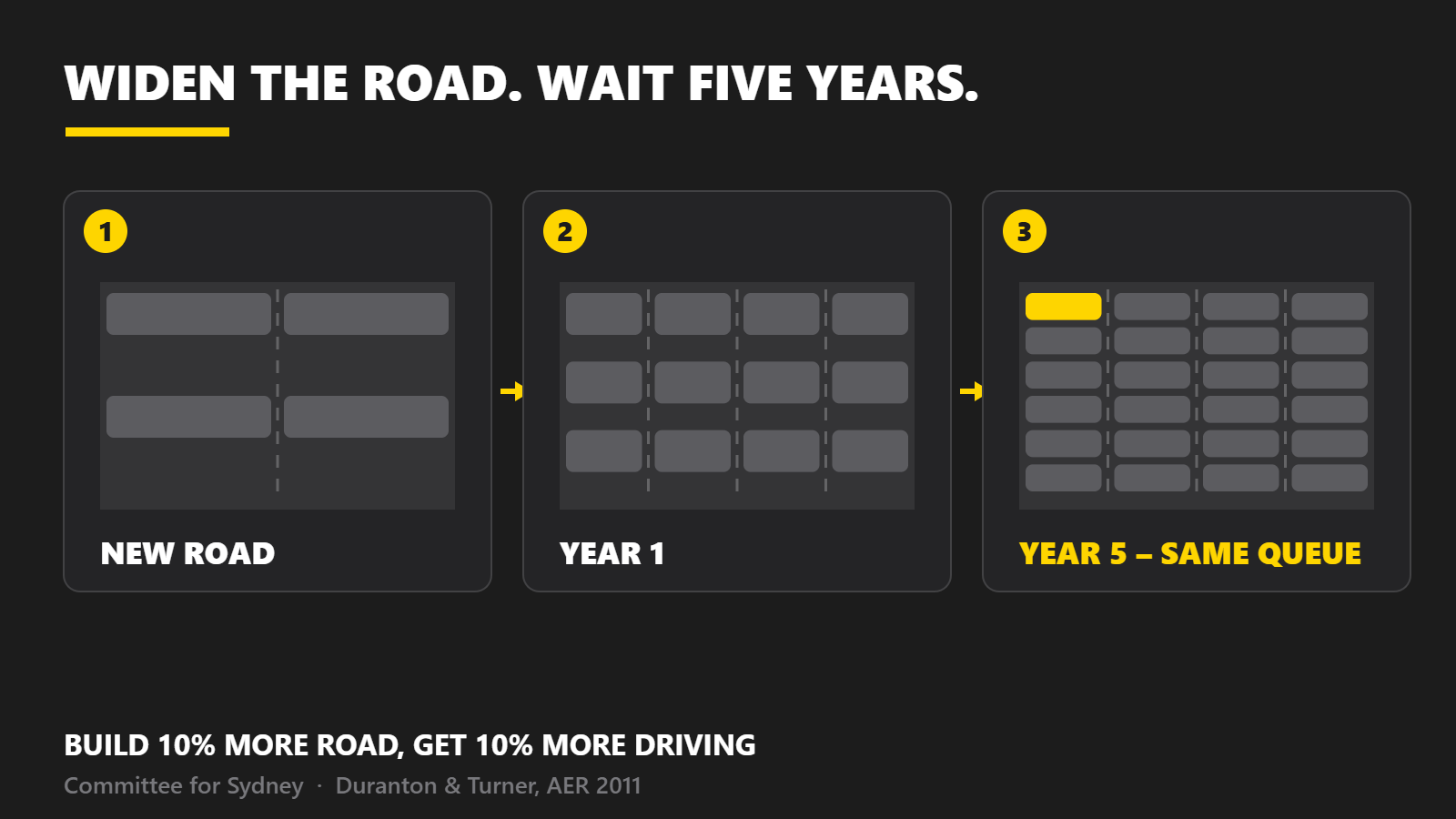
No. Sydney traffic has never been fixed by adding lanes, and the evidence says it never will be — new road capacity fills up again within a few years. The Committee for Sydney puts the mechanism in one line: increasing a road by 10 per cent immediately increases average vehicle travel by 4 per cent, and this “reaches 10 percent—equalling all the new road capacity—within a few years.” The lanes are real. The relief is temporary.
This is not a complaint about drivers. Nobody stuck on the M4 chose the design of the network they are sitting in. Road capacity, land use and pricing are set by policy, and policy decides whether a city of five million spends its mornings moving or queuing. Sydney has been buying lanes for more than a decade. It is worth asking what we got for the money.
What actually happens when Sydney adds a lane?
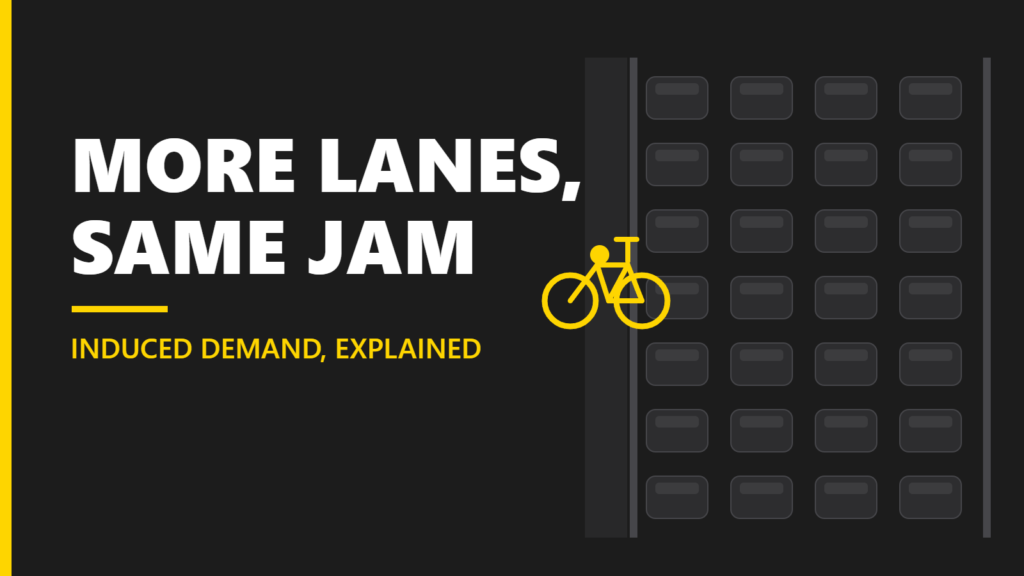
Traffic is not a fixed quantity of cars hunting for space. It is demand that responds to how easy driving feels. Make a corridor faster and more people drive it, drive it further, drive it at peak instead of off-peak, and switch out of trains and buses to do it. The Committee for Sydney calls this “triple convergence”: the extra traffic arrives from “other times of travel; other routes of travel; or other modes of travel.”
The economics has been settled for fifteen years. In The Fundamental Law of Road Congestion (American Economic Review, 2011), Gilles Duranton and Matthew Turner found that vehicle kilometres travelled “increases proportionately to roadway lane kilometers for interstate highways and probably slightly less rapidly for other types of roads.” Their conclusion is blunt: “increased provision of roads or public transit is unlikely to relieve congestion.” Build 10 per cent more road, get roughly 10 per cent more driving, and end up with the same queue — only wider, and paid for.
Has Sydney already run this experiment?
At enormous scale. The 2015 WestConnex business case put the project at $16.812 billion in nominal outturn costs, up from $14.881 billion in 2013. The NSW Audit Office then identified a further $4.26 billion of works funded outside that budget but necessary for WestConnex to meet its objectives: $2.3 billion of network integration, $1.76 billion for the Sydney Gateway road component and $198 million for the Parramatta Road Urban Amenity Program. Call it $21 billion of motorway.
The Rozelle Interchange alone cost $3.9 billion. University of Sydney researchers Christopher Day and Dick Day record that its November 2023 opening “was met with gridlock”, with changes to surface roads having “significantly slowed traffic” on Victoria Road. And after all of it, the Committee for Sydney still counts seven of Australia’s eight most congested corridors inside Sydney, with delays costing the six largest Australian capitals $13.7 billion a year — projected to pass $50 billion by 2031.
Why does a 23-lane freeway in Houston matter in Leichhardt?
Because it is the cleanest test anyone has run. Texas spent more than US$2.8 billion widening Houston’s Katy Freeway to 23 lanes, briefly the widest freeway on earth. Using Houston Transtar traffic data for 2011 to 2014, City Observatory found the morning commute on the widened road had grown by 25 minutes — 30 per cent — and the afternoon commute by 23 minutes, or 55 per cent.
Twenty-three lanes is not a lane shortage. It is proof that you cannot out-build induced demand, and it ought to settle the argument before the next Sydney corridor is widened.
| Project | Spend | Measured result |
|---|---|---|
| Katy Freeway, Houston (23 lanes) | US$2.8 billion+ | AM commute +30%, PM +55% (2011–2014) |
| WestConnex, Sydney | $16.8 billion + $4.26 billion outside budget | 7 of Australia’s 8 worst corridors still in Sydney |
| Rozelle Interchange | $3.9 billion | November 2023 opening “met with gridlock” |
So what actually shrinks a traffic jam?
Moving more people through the same space — which means handing that space to modes that use less of it per person. It is the one lever induced demand cannot defeat, because you cannot induce demand for road capacity you never built.
Sydney already has the receipts wherever it has built properly. City of Sydney counts for 2022/23 recorded peak-hour bike trips up 18 per cent year on year, with the Bourke Street cycleway carrying 1,616 trips a day (up 41 per cent) and the Castlereagh Street cycleway 862 a day (up 47 per cent). On Campbell and Euston roads, riding is up 609 per cent since 2010. Separated lanes fill; painted gaps do not. The trouble is that the network keeps breaking off mid-route, which is exactly why so many Sydney bike lanes just stop.
What are the NSW e-bike rules if you swap a car trip?
Transport for NSW allows a maximum continuous rated power of 500 watts, with the motor providing no power above 25 km/h and any throttle-only assistance cutting out at 6 km/h. From 1 March 2029 only EN 15194 certified e-bikes, rated at 250W, will be allowed on NSW roads. A bike above those limits “is illegal, even if the power or speed is restricted by software (app, switch or code)”, and an approved helmet is mandatory. The full picture is in our complete guide to e-bike laws in NSW and Australia.
What does this mean for one Sydney commute?
A car occupies the same road space whether it carries one person or five, and in Sydney’s peak it is almost always one. An e-bike uses a fraction of that space, parks in a fraction of it, and needs no new lane built first. The Cyberbikes Centauro is built for that swap: a 250W rear hub motor, a 48V 25Ah (1200Wh) Samsung battery certified to UL 2271, a full electrical system to UL 2849, an ISO 4210 frame, EN 15194 compliance, 4-piston hydraulic brakes on 180mm rotors and a 150kg maximum rider-and-cargo load, with a 50kg rear rack that covers the shopping run as well as the commute. If you are weighing up what dropping a car would actually look like, our car-free Sydney e-bike commuting and rent-to-own guide works through the numbers.
Sydney will keep being told that the next interchange is the one that finally fixes it. It will not be — the maths has been in since 2011. Swap one car trip a week for an e-bike ride and see what changes. You can ride a Centauro at Cyberbikes, 281 Parramatta Road, Leichhardt.
Frequently Asked Questions
Does adding lanes reduce traffic congestion?
No. The Committee for Sydney reports that increasing a road by 10 per cent immediately increases average vehicle travel by 4 per cent, reaching 10 per cent — all of the new capacity — within a few years. Duranton and Turner’s 2011 study in the American Economic Review found vehicle kilometres travelled increase proportionately to lane kilometres, and concluded that increased provision of roads or public transit is unlikely to relieve congestion.
Did the Rozelle Interchange fix Sydney traffic?
No. The $3.9 billion interchange opened in November 2023 and University of Sydney researchers Christopher Day and Dick Day record that the opening was met with gridlock, with changes to surface roads significantly slowing traffic on Victoria Road. Across the wider network, the Committee for Sydney still counts seven of Australia’s eight most congested corridors inside Sydney.
What is the legal power limit for an e-bike in NSW?
Transport for NSW allows a maximum continuous rated power of 500 watts, with motor assistance providing no power above 25 km/h and throttle-only power cutting out at 6 km/h. From 1 March 2029 only EN 15194 certified e-bikes, rated at 250W, will be allowed on NSW roads. A bike that exceeds those limits is illegal even if the power or speed is restricted by software such as an app, switch or code.
#EbikeSydney #CyberbikesLeichhardt #InducedDemand #WestConnex #SydneyTraffic #CarFreeSydney #UrbanPlanning #ActiveTransport #InnerWest #RentToOwnEbike