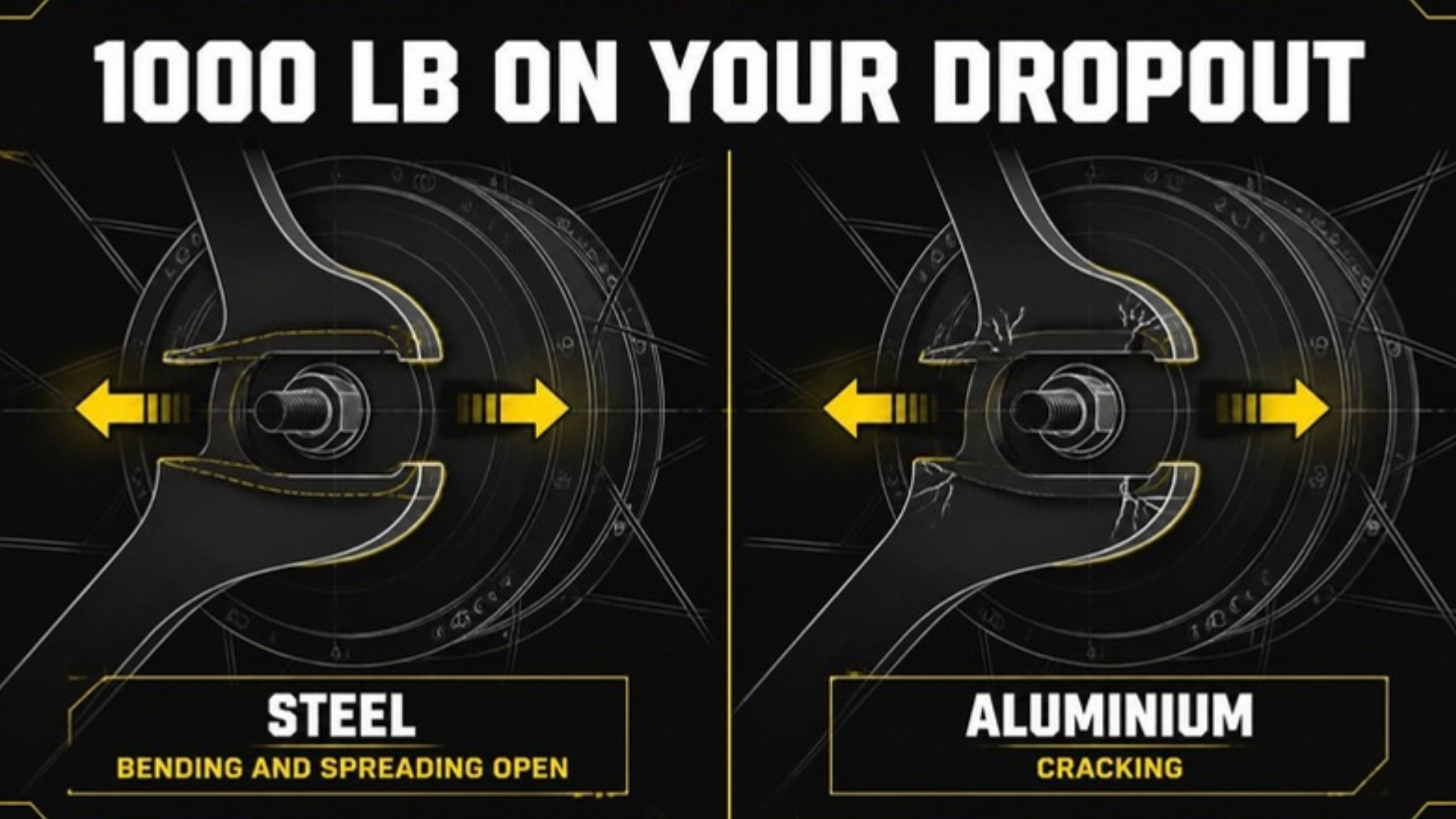
Most factory e-bikes sold in Australia do not need an aftermarket torque arm, but almost every high-power hub-motor conversion does — and the number that decides it is torque, not watts. Grin Technologies’ bench testing shows that a hub motor with a 12 mm axle producing 40 N·m of torque exerts “a spreading force of just under 1000 lb on each dropout” — roughly 4.4 kN, or about 450 kg trying to prise your frame open, every time you pull away from the lights.
What is an e-bike torque arm, and what does it actually do?
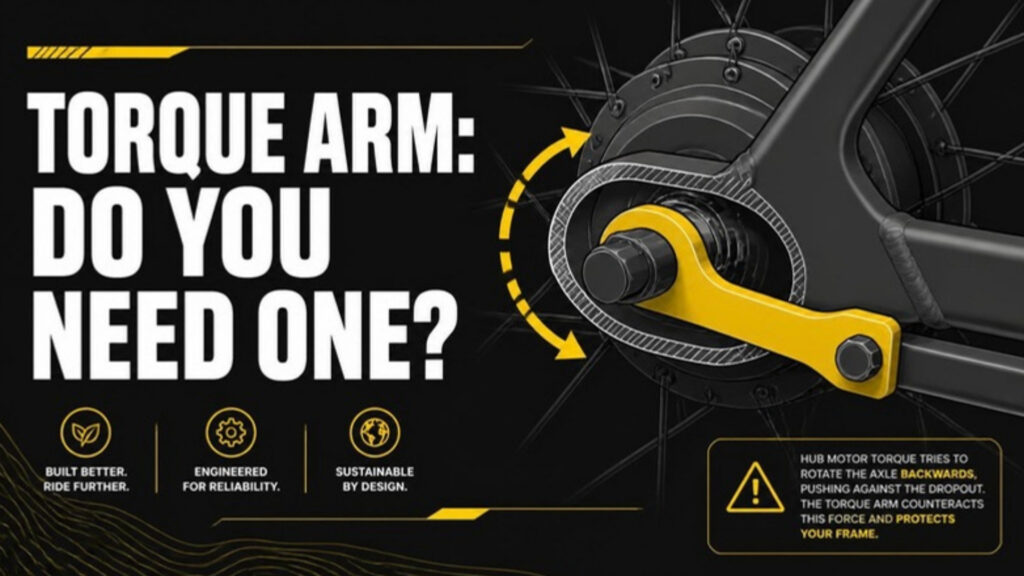
A torque arm is a small steel plate that clamps onto the flats of a hub motor axle and bolts to the frame, giving the axle a second place to push against instead of relying on the dropout slot alone.
The reason it exists is Newton’s third law. As Grin Technologies explains on ebikes.ca, “for all the torque that the motor generates spinning a wheel forwards, there is an equal and opposite torque on the axle causing it to rotate backwards.” The wheel goes one way; the axle tries to go the other. Something has to hold it.
On a normal bike, nothing needs to. A rear axle only carries chain tension and your weight. On a hub-motor e-bike, the axle is the thing transmitting every newton-metre the motor makes, straight into two small slots in your frame. Grin’s guidance is blunt about what happens when those slots lose: “the axle will spin freely, wrapping and severing off the motor cables and potentially causing the wheel to fall right out of the bike.”
How much force does a hub motor really put on your dropouts?
Far more than most riders picture, because axle torque gets multiplied by a very short lever. A standard bicycle dropout is cut for 10 mm wide flats, and hub motors use either 12 mm or 14 mm axles — the 14 mm version “has a much wider flat area and provides more spinout protection”. Spread 40 N·m across a lever that short and you get Grin’s ~1000 lb (4.4 kN) per dropout.
Grin’s own testing found that “axle spinout happens at around 60-90 N-m with most forks.” That is the failure threshold, and it is worth knowing where your bike sits relative to it.
Here is the part people get wrong. Watts are volts times amps — a 48 V pack at 20 A is 960 W of electrical input — but watts are not what breaks dropouts. Torque is. The same ebikes.ca motor power ratings page makes the same point about heat: “torque causes motor overheating, not power,” because winding losses scale with the square of current (I²R). Double the current for double the torque and you get four times the heat — and roughly double the force on your dropout. A motor making peak torque at walking pace is producing very little power and enormous axle force at the same time. That is exactly the moment a dropout gives up: heavily loaded, moving slowly, on a hill.
Why do aluminium dropouts fail differently from steel?
Steel gives you a warning; aluminium does not. Grin’s testing is unambiguous: “Aluminum dropouts tend to crack and fail catastrophically while steel dropouts will just spread open.” A spreading steel dropout shows it — wider slot, nuts loosening, wheel sitting crooked — so you get weeks of hints. An aluminium dropout can look perfect right up until it lets go, and on a front fork that means the wheel leaves the bike while you are steering it.
This is why the risk is so lopsided between the two ends of the bike. Grin lists three setups where a torque arm is not optional but essential: “powerful setups (>1000 watts input power), setups with front aluminum dropouts, [and] setups with regen braking.” For a standard 36 V 20 A system with steel front dropouts or thick aluminium rear dropouts of 8–9 mm or more, they rate torque arms optional but recommended.
Worth noting the flip side, because internet forums get this backwards constantly: aluminium and carbon frames are not disqualified from hub motors. Grin’s hub motor compatibility guide states that “as long as you have a properly fitted torque arm to transfer axle torque to the bike frame, then the material of the frame and dropout is not much of an issue,” and points out that “the pulling forces and stresses that a hub motor puts on a bike are much less than the forces caused by disc brakes, or the stresses caused from hitting bumps and potholes on a road.” The problem was never the aluminium. The problem is asking a slot to do a torque arm’s job.
Does a legal Australian e-bike like the Centauro need one?
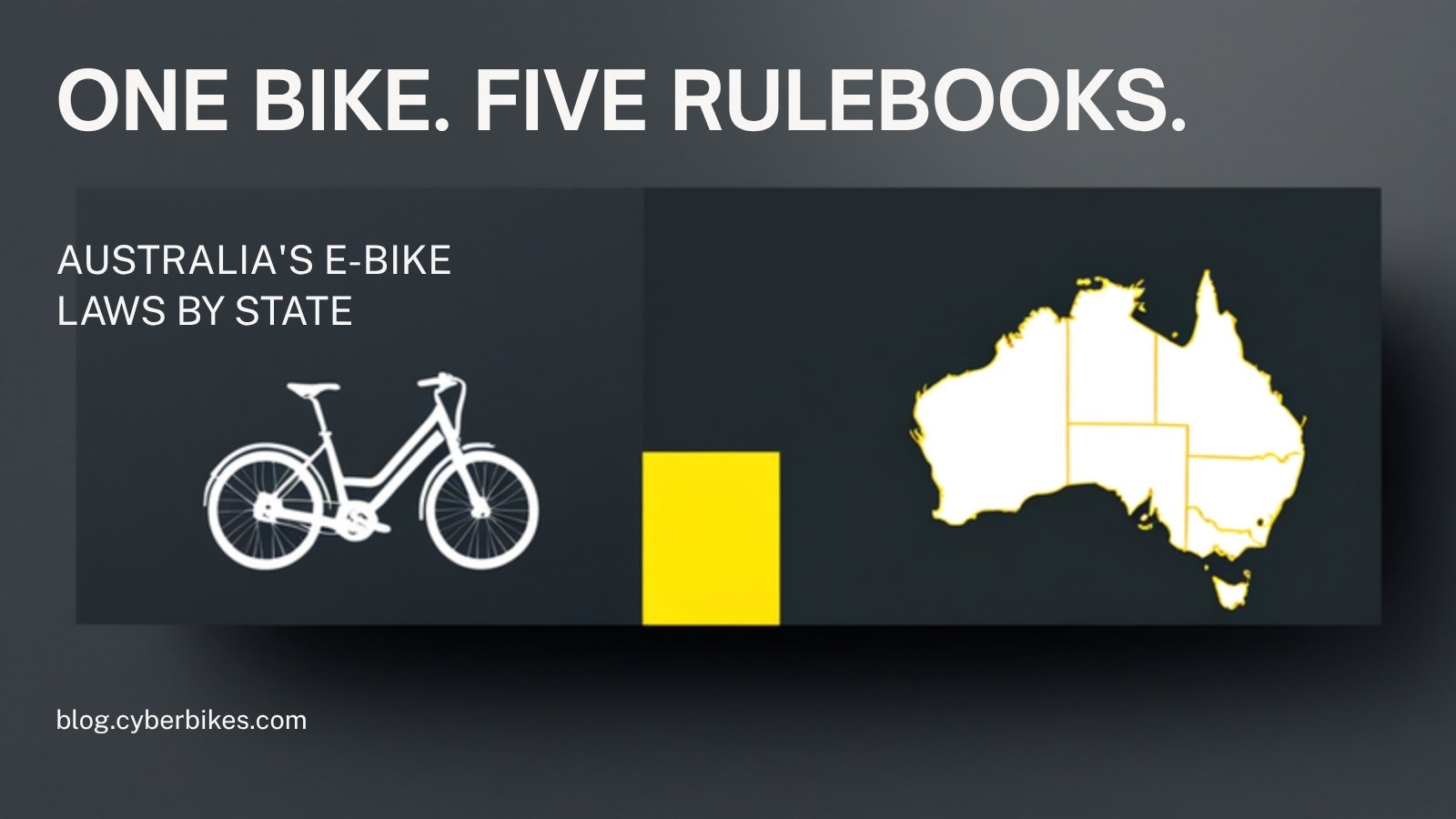
Generally no, and the law is part of the reason. Transport for NSW sets the ceiling at “a maximum continuous rated power of 500 watts”, with assistance that cuts out above 25 km/h and any throttle-only function limited to 6 km/h. From 1 March 2029, only EN 15194 certified e-bikes will be allowed on NSW roads, and the continuous power limit drops to 250 W. Transport for NSW is also explicit that a bike over those limits “are illegal, even if its power or speed is restricted by an app or switch.”
Read that alongside Grin’s threshold and the picture is clear: a road-legal Australian e-bike sits well below the >1000 W input power where a retrofit torque arm becomes mandatory. The bikes that get into trouble are almost always the ones running far past the legal limit, or DIY kits bolted into a fork that was never designed for driven torque.
The other half of the answer is that a factory bike is engineered as one system. The Cyberbikes Centauro runs a 250 W rear hub motor on an ISO 4210 MTB-compliant 6061 aluminium alloy frame, with a 48 V 25 Ah (1200 Wh) Samsung battery — voltage times amp-hours, the arithmetic that actually sets your range. It is rated to a 150 kg maximum rider and cargo load with a 50 kg rear rack, and complies with UL 2849, UL 2271, ISO 4210 and EN 15194. Rear dropouts on a purpose-built e-bike frame are sized for the motor they ship with. A bike shop conversion into a random 15-year-old hardtail is a different proposition entirely, and we will tell you so before we do it.
Does regenerative braking make axle spin-out worse?
Yes, and in a way that catches people out, because the damage comes from direction changes rather than raw force. Under regen, “the torque on the axle reverses direction, which can allow the axle to rotate a bit the other way until it bottoms out on the forward surfaces.”
Grin’s warning follows: “If there is a sufficient amount of play, this back and forth rocking of the axle can eventually cause the axle nuts to loosen.” A regen bike repeats that cycle at every set of lights on Parramatta Road. Loose nuts are the failure mode, not one heroic overload — which is why regen sits on Grin’s essential list alongside 1000 W builds and aluminium forks.
How do you check your own dropouts in five minutes?
Four checks, no tools beyond a spanner and a torch. This is the same walkthrough we do on the stand at Leichhardt.
- Axle nut tension. If they need retightening every few weeks, the axle is moving. Find out why before you keep riding it.
- Slot width. Compare the dropout opening to the axle. A slot that has widened is a steel dropout telling you it is losing.
- Witness marks. Bright scratches or a polished arc where the axle flats meet the dropout mean rotation has already happened.
- Cable routing. A motor cable that has started to twist near the axle is the first sign of the failure Grin describes, where the cable wraps and severs.
Planning a conversion? Grin reports that roughly 20–30% of bike frames require at least a little bit of filing to accept a motor axle, and that spreads beyond 5 mm need permanent cold-setting — practical only on steel. For which end to drive, our comparison of front versus rear hub motors for Sydney riding covers the trade-offs, and the full picture is in our guide to how e-bikes actually work: motors, sensors and controllers.
What does all that torque feel like on a real Sydney commute?
Numbers on a bench are one thing; peak-hour traffic is another. Here is the Centauro running Sydney CBD to Leichhardt at peak hour, unedited, in 19 minutes — every set of lights in that clip is another full torque cycle through the axle.
Frequently asked questions
Do I need a torque arm on a 250W e-bike?
Usually not on a purpose-built factory e-bike, where the frame and dropouts were designed around the motor. Grin Technologies rates torque arms as essential above 1000 watts of input power, with front aluminium dropouts, or with regenerative braking, and optional but recommended on a standard 36V 20A system with steel front dropouts or thick aluminium rear dropouts. A road-legal NSW e-bike capped at 500 watts continuous sits below that essential threshold.
What happens if a hub motor axle spins out?
According to Grin Technologies, the axle spins freely, wrapping and severing the motor cables, and the wheel can fall out of the bike. Their testing found axle spinout happens at around 60 to 90 newton-metres with most forks. Aluminium dropouts tend to crack and fail catastrophically, while steel dropouts spread open more gradually, which usually gives the rider some warning.
Can you fit a hub motor to an aluminium or carbon frame?
Yes. Grin Technologies states that as long as a properly fitted torque arm transfers axle torque to the frame, the material of the frame and dropout is not much of an issue, and notes that hub motor forces are much less than the forces from disc brakes or from hitting bumps and potholes. The risk comes from relying on the dropout slot alone to resist motor torque, not from the frame material itself.
Get your dropouts checked before they tell you themselves
If your axle nuts keep loosening, or you are weighing up a conversion and want an honest answer about whether your frame should carry a hub motor, bring the bike in. Book a test ride or a look-over at Cyberbikes, 281 Parramatta Road, Leichhardt, or call 0491 794 668, Tuesday to Saturday. Prefer to start without the commitment? The Centauro is available rent-to-own from $99.99 a week, maintenance included — so the dropout inspection is our problem, not yours.
#eBikeSydney #Cyberbikes #CentauroEbike #HubMotor #TorqueArm #ElectricBikeLeichhardt #EbikeMaintenance #NSWEbikeLaws