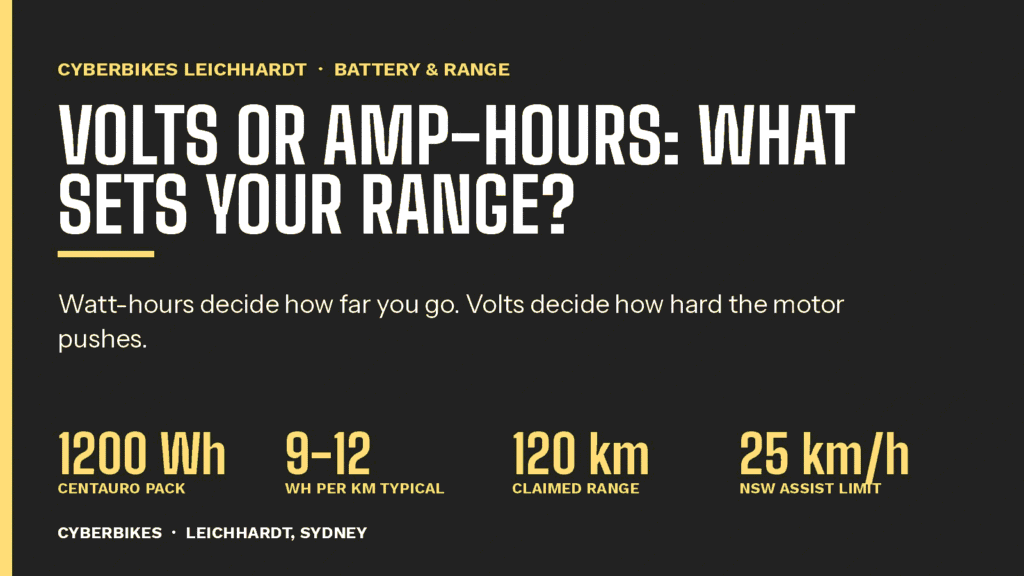
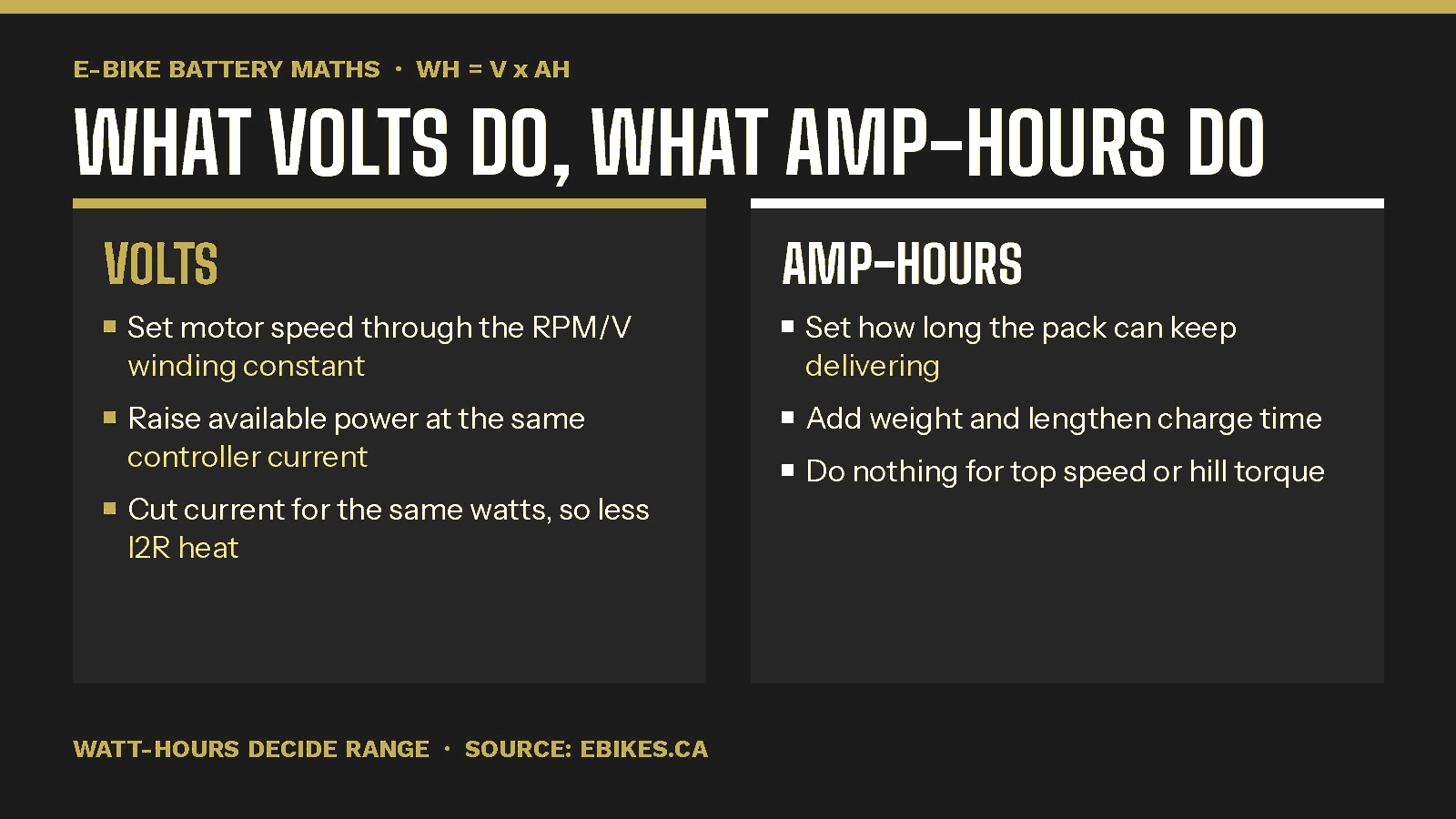
Neither one on its own. Your e-bike range is set by watt-hours, and watt-hours are volts multiplied by amp-hours. A 48V 25Ah pack holds 1,200Wh; so does a hypothetical 60V 20Ah pack. Volts decide how hard and how fast the motor can push, amp-hours decide how long the pack can keep feeding it, and only their product tells you how far you will actually get. Grin Technologies, whose battery reference at ebikes.ca is the closest thing the industry has to an honest textbook, puts it simply: watt-hours are approximated by multiplying amp-hours by pack voltage, so 24V 8Ah and 48V 4Ah are both 192Wh — the same energy in a different shape.
That one sentence settles about half the arguments we hear across the counter at Cyberbikes in Leichhardt. Below: the maths, what voltage genuinely buys you, why higher voltage runs cooler, and what it means on a real Sydney ride.
How do you turn volts and amp-hours into kilometres?
Two steps. First, energy: Wh = V × Ah. Second, consumption: divide those watt-hours by how many watt-hours each kilometre costs you. That second number is the one most spec sheets never mention, and it is where ebikes.ca earns its keep. Grin’s measured figures for real riding are:
- 6–8 Wh/km — minimal assist, motor mainly helping on hills, around 30km/h.
- 9–12 Wh/km — typical assist, motor on constantly while you pedal, around 40km/h.
- 14–20 Wh/km — power hungry: little pedalling, heavy loads, or high speed.
Run the Cyberbikes Centauro through it. Its product page lists a 48V 25Ah Samsung pack at 1,200Wh and a claimed range of up to 120km at 25km/h for a 75kg rider on flat road with no headwind. Divide one by the other and the bike is being quoted at 10Wh/km — which sits neatly inside Grin’s “typical assist” band rather than above it. That is a quietly reassuring sign: the claim is made at a consumption figure an independent source considers normal, not at some fantasy 5Wh/km.
Do the same arithmetic on your own commute. Leichhardt to the Sydney CBD and back is roughly 14km. At the pessimistic end of the typical band — 12Wh/km, because Sydney has hills and traffic lights — that is about 168Wh a day, or seven round trips from a 1,200Wh pack. Grin’s rule of thumb is that a 40–50km commute wants about 400Wh. Any e-bike range claim that does not survive this two-line calculation is marketing.
Does a higher-voltage battery actually make you faster?
Yes — voltage, not amp-hours, is what sets speed. A permanent-magnet motor has no fixed RPM of its own. As ebikes.ca explains on its motor power ratings page, the motor’s RPM-per-volt winding constant combines with battery voltage to set how fast it wants to spin. More volts, more revolutions, more speed for the same motor.
It also changes available power. Grin’s worked example uses a Crystalyte H3540 hub motor: on 36V with a 20A controller it peaks at 600W of output; move the same motor and controller to 52V and peak output rises to 840W. Hold the current limit steady and extra volts hand you extra watts, because watts are volts times amps.
Now the nuance. Keep that motor on 36V but fit a 40A controller and peak output jumps to 1,058W — higher than the 52V setup’s 840W. On paper the 36V/40A bike wins; in practice Grin notes the 52V bike would feel more powerful in everyday riding, because it keeps accelerating past 55km/h while the big-amp 36V bike dumps its peak low down. Peak watts wins arguments. Voltage is what you feel.
Which brings the Australian asterisk: in NSW none of this buys you legal speed. Transport for NSW requires the motor to cut out completely at 25km/h, caps continuous rated power at 500W (dropping to 250W with mandatory EN 15194 certification from 1 March 2029), and limits throttle-only operation to 6km/h — and is explicit that software, app or switch limits do not make an over-limit bike legal. So extra voltage on a compliant Australian e-bike gives the motor headroom to hold 25km/h up a grade instead of sagging. That is the honest pitch, and it is the one we make.
Why does higher voltage run cooler at the same power?
Because heat follows current, not watts — and it follows current brutally. Grin states the relationship plainly: doubling the current doubles torque and power, but increases copper heating by a factor of four. That is the I²R relationship, and it is the single most useful piece of physics an e-bike owner can carry around.
Work an example. To make 750W you can draw 20.8A from a 36V pack or 15.6A from a 48V pack. Same watts, three-quarters the current. Because losses scale with the square of current, the 48V system throws away roughly 56% as much heat in the windings, wiring and connectors as the 36V one doing identical work. This is exactly why higher-voltage systems feel unbothered on long climbs while lower-voltage ones go soft: the motor is not running out of power, it is running out of thermal headroom.
Grin is blunt about where that ends: if heat builds faster than it dissipates the motor can cook — enamel insulation burning off the copper, nylon gears softening and stripping, magnets demagnetising. Good enamel survives excursions of 150–180°C, but nobody sensible rates a motor for continuous duty that hot. Hub motors also take one to two hours to reach a steady temperature while a typical climb lasts five to ten minutes, which is why a motor survives a brutal hill yet is slowly killed by a long loaded flat run. Our definitive guide to e-bike batteries covers how the pack shares that thermal budget, and how e-bikes actually work: motors, sensors and controllers covers the hardware.
What does a bigger amp-hour pack really cost you?
Weight, charge time and money — never speed. Amp-hours are cells in parallel: add them and the pack stores more energy and delivers current more comfortably, but voltage, and therefore the motor’s behaviour, is unchanged. A 48V 25Ah pack will not climb a hill faster than a 48V 12Ah pack of the same cell quality. It will simply still be climbing when the small one is flat.
The costs are real. The Centauro’s product page puts the bike at 37kg with the battery fitted and quotes about five hours empty-to-full — the direct consequence of carrying 1,200Wh. There is a discharge-rate upside too: Grin defines 1C as the pack’s amp-hour rating expressed in amps, so a 25Ah pack asked for 20A works at well under 1C, while a 10Ah pack doing the same job sits at 2C and sags harder. Bigger packs are easier on themselves. Our comparison of fast and slow e-bike chargers covers charging habits.
Volts or amp-hours: which should you actually pay for?
| What you want | What to buy | Why |
|---|---|---|
| Hold 25km/h up a real hill | Volts | Higher voltage raises peak power at the same controller current (600W to 840W in Grin’s example) |
| Ride further between charges | Amp-hours | Range is watt-hours divided by Wh/km; at fixed voltage only Ah moves it |
| A motor that stays cool loaded | Volts | Same watts at lower current; I²R losses fall with the square of current |
| A pack that ages well | Amp-hours | A larger pack runs at a lower C-rate for the same demand |
| Legal riding in NSW | Neither, alone | 500W continuous cap and a hard 25km/h assist cut-out apply whatever the pack |
For most Sydney riding you buy a sensible voltage once, then buy watt-hours. The Centauro’s 48V keeps its 250W continuous rear hub motor pulling to the legal cut-out on a grade; the 25Ah is what turns that into a bike you charge twice a week instead of nightly. Its spec sheet also lists UL 2849 for the electrical system, UL 2271 for the battery, ISO 4210 for the frame and EN 15194 for power and speed — worth checking on any bike, given what changes in NSW in 2029.
How much of your claimed range will you really see?
Read the conditions attached to the claim. The Centauro’s 120km is quoted at 25km/h, flat, 75kg rider, no headwind — the honesty is in the fine print, not the headline, and every condition is a lever. Grin’s consumption bands span 6–8Wh/km to 14–20Wh/km, a factor of roughly two and a half, purely on how you ride and what you carry. On a 1,200Wh pack that is the difference between about 150km and about 60km from the same battery.
If you want to model your own route rather than trust anybody’s number, ebikes.ca publishes free motor and trip simulators that let you set voltage, controller current, rider weight, grade and headwind and watch the watt-hours per kilometre move. It is the fastest way we know to stop guessing about e-bike range and start calculating it.
See it explained on the bike
Watt-hours are also what make the running-cost argument so lopsided. Here is our take on what a second car costs against what an e-bike’s energy costs:
Frequently asked questions
Does a higher voltage battery give more e-bike range?
Only if it also carries the same or more watt-hours. Range depends on watt-hours, which are volts multiplied by amp-hours. A 52V 10Ah pack holds 520Wh and a 48V 15Ah pack holds 720Wh, so the lower-voltage pack goes considerably further despite the lower voltage. Higher voltage does help indirectly, because the same power is delivered at lower current and less energy is lost as heat.
How many watt-hours per kilometre does an e-bike use?
Grin Technologies at ebikes.ca measures about 6 to 8 watt-hours per kilometre with minimal assist around 30km/h, 9 to 12 with typical assist around 40km/h, and 14 to 20 for power-hungry riding with little pedalling, heavy loads or high speed. Dividing a pack’s watt-hours by the figure matching your riding gives a realistic range estimate.
What is the maximum legal e-bike power in NSW?
Transport for NSW allows a maximum of 500 watts continuous rated power, falling to 250 watts with mandatory EN 15194 certification from 1 March 2029. The motor must cut out completely at 25km/h, and throttle-only operation must cut out at 6km/h. Software or switch limits do not make an over-limit bike legal in NSW.
Work out your own numbers with us
Bring your commute and we will do the watt-hour maths on the spot — no guesswork, no invented range figures. You can ride the 2026 Cyberbikes Centauro with its 48V 25Ah Samsung pack up a real hill rather than reading about one. Rent-to-own from $99.99 a week, or book a test ride at Cyberbikes, 281 Parramatta Road, Leichhardt. Call 0491 794 668, Tuesday to Saturday.
Sources: Grin Technologies (ebikes.ca) battery and motor power ratings references and simulators; Transport for NSW e-bike rules; Cyberbikes Centauro product page, read 12 October 2026.
#ebike #ebikerange #ebikebattery #wattHours #ebikeSydney #Leichhardt #Cyberbikes #Centauro #electricbike #rentToOwn #SydneyCommute #NSWebikelaw