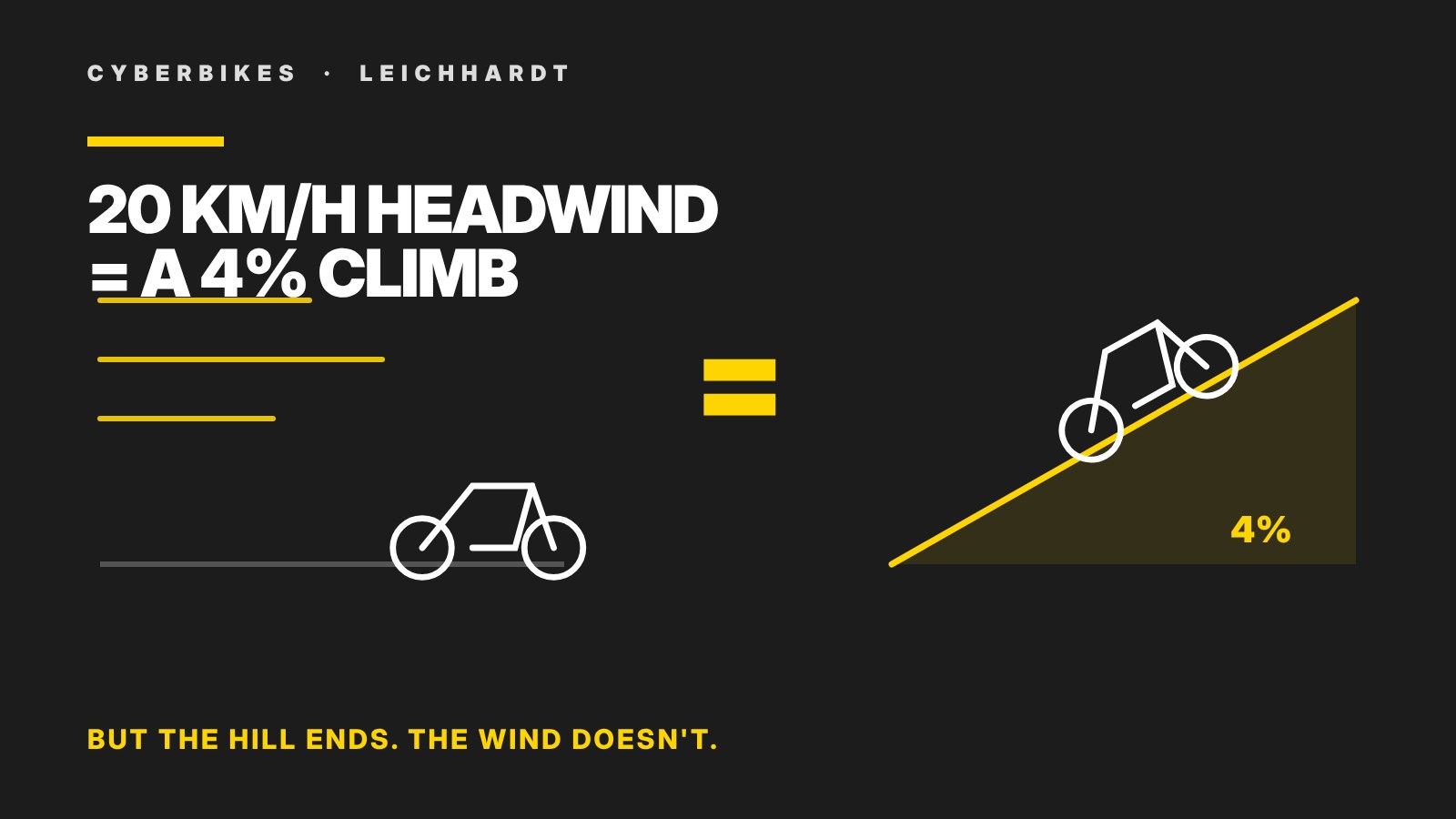
Short answer: on a flat Sydney run, a steady 20 km/h headwind costs you more e-bike range than a 3% hill does. At 25 km/h with a 100 kg rider-plus-bike, our worked example puts the hill at about 204 extra watts and the headwind at about 276 extra watts — the wind behaves like a 4% climb. The difference that matters is that the hill ends at the top. The wind holds that gradient for the whole 15 km.
That is why two riders on identical bikes finish the same Leichhardt-to-CBD commute with wildly different battery readings. Below we work the physics with numbers you can check, using the load model and motor data published by Grin Technologies at ebikes.ca. For the broader picture, our definitive guide to e-bike batteries and range covers capacity, chemistry and charging.
How much power does a headwind really cost?
Air resistance rises with the cube of your speed through the air, and a headwind adds straight onto that air speed. Ride at 25 km/h into a 20 km/h northeasterly and your bike is pushing through air at 45 km/h, even though the speedo still reads 25.
Two inputs set how badly that hurts. The ebikes.ca motor simulator asks for CdA, which it describes as “the effective frontal area for the vehicle,” ranging “from 0.2 for a streamlined recumbent to 0.8 for a wide upright mountain bike,” and Cr, the rolling drag coefficient, where “bike tires range from about 0.004 for a high pressure road slick, up to 0.012 for a low pressure knobby wheel.” Those two numbers, not your motor badge, decide what the wind charges you.
Taking a typical upright commuter — CdA 0.6, Cr 0.008, 100 kg all up, sea level, 25 km/h — here is the power needed at the wheel:
| Condition at 25 km/h | Power at the wheel | Extra vs calm |
|---|---|---|
| Flat, no wind | 178 W | — |
| Flat, 10 km/h headwind | 296 W | +118 W |
| Flat, 20 km/h headwind | 453 W | +276 W |
| Flat, 30 km/h headwind | 650 W | +472 W |
| 2% grade, no wind | 314 W | +136 W |
| 3% grade, no wind | 382 W | +204 W |
| 5% grade, no wind | 518 W | +341 W |
Doubling the wind from 10 to 20 km/h does not double the cost — it more than doubles it. That is the cube law doing its work, and it is the single most under-appreciated fact about e-bike range.
How much power does a hill really cost?
Hills are mercifully linear. The ebikes.ca simulator documentation gives the rule of thumb directly: “the pounds thrust needed to overcome gravity when climbing a hill is simply weight * %grade.” Double the gradient and you double the climbing load. Nothing cubes, nothing surprises you.
What hills do instead is cap your speed. The same page shows a typical setup settling at “a 10% grade at 8kph, 5% grade at 19 kph, 3% at 28 kph” — the motor finds the speed where its thrust matches gravity, and that is the speed you get.
Hills also have a second, kinder property: they are finite. Norton Street rises for a few hundred metres. A nor’easter off the harbour blows all afternoon.
Which one eats more e-bike range in Wh/km?
Watts tell you how hard the motor is working. Watt-hours per kilometre tell you how far you get. Divide power by speed, then allow for the controller, motor and drivetrain losses — roughly 80% system efficiency on a decent hub drive — and the same three conditions look like this:
- Flat, calm, 25 km/h: about 7.1 Wh/km at the wheel, about 8.9 Wh/km out of the battery.
- 3% grade, calm: about 15.3 Wh/km at the wheel, about 19.1 Wh/km from the battery.
- Flat, 20 km/h headwind: about 18.1 Wh/km at the wheel, about 22.7 Wh/km from the battery.
Put that against a real pack. The Cyberbikes Centauro carries a 48V 25Ah Samsung pack — 1200Wh, UL 2271-certified — and its product page quotes “up to 120 km at 25 km/h,” measured on a flat road with a 75 kg rider and, in the page’s own words, no headwind. Read that qualifier again. Every manufacturer relies on you skipping it.
At 8.9 Wh/km, 1200 Wh is a very long day. At 22.7 Wh/km in that 20 km/h headwind, the same pack covers roughly 53 km. Nothing has failed. No cell has degraded. The air simply started charging rent.
This is the same mechanism behind why stop-start traffic eats e-bike range differently to open road — the load, not the badge on the motor, writes the number on your display.
Does slowing down help more in wind or on a hill?
Slowing down is dramatically more effective into wind than on a climb. This is the practical payoff of the whole article, and almost nobody rides this way.
Into that 20 km/h wind, dropping from 25 km/h to 20 km/h takes you from about 18.1 to 14.8 Wh/km at the wheel — an 18% saving. Drop to 15 km/h and you are at 11.8 Wh/km, a 35% saving. You arrive later, but you arrive.
On a 5% climb, the same speed reductions barely move the needle: 20.7 Wh/km at 25 km/h, 19.0 at 20 km/h, 17.6 at 15 km/h. That is a 15% saving for a 40% speed cut, because the energy you spend lifting mass up a hill is fixed by the hill, not by how fast you climb it.
So: on hills, pick an assist level and let the bike settle. Into wind, back off. On a 25-knot southerly along the Cooks River, dropping 5 km/h is worth more to your battery than any accessory you can bolt on.
Which one is more likely to cook your motor?
The hill — and by a clear margin. The ebikes.ca page on motor power ratings is blunt about why: “it’s not the output power but the output torque of the motor which causes it to heat up and eventually fail,” and “it is ultimately the torque and not power that causes a motor to overheat.”
Torque means current, and current means heat. The same page notes that because copper windings have resistance, doubling the current increases heat “by a factor of FOUR (the I2R relationship).” That is the whole story in one line.
A steep climb is the worst case: high torque at low rpm, which means lots of current and little airflow or rotor speed to shed the heat. Wind on the flat is gentler — the motor is still spinning near its happy rpm, so the same output power is produced at lower current. The page also reminds us that power is “torque * RPM * 2Pi/60 ~ Torque * RPM * 0.104,” so 20 Nm at 100 rpm is “209 watts” while the same torque at 300 rpm is “628 watts.” Same heat, three times the work done.
One consolation from that page: hub motors take “upwards of 1-2 hours” to reach steady-state temperature, so a short sharp climb rarely kills anything.
What does this mean for a legal 250W e-bike in NSW?
It means you cannot buy your way out of the wind with watts, so you have to buy your way out with efficiency and battery size. Legal limits here are firm. Transport for NSW currently sets a 500W maximum continuous power limit, with “a maximum of 250W from 1 March 2029,” pedal assist that “does not provide power at speeds higher than 25km/h,” and a throttle-only function “that cuts out at 6km/h.”
The standard matters too: Transport for NSW advises choosing “a bike that complies with European Standard EN 15194 – it’s legal now and in the future,” and states that “from 1 March 2029 only EN 15194 certified e-bikes will be allowed on NSW roads.” Software limiting is explicitly not a loophole — a bike is still illegal “even if the power or speed is restricted by software (app, switch or code).”
Within those rules, the levers that beat wind are posture (lower CdA), tyres and pressure (lower Cr), and watt-hours in the pack. The Centauro’s answer is the third: 1200Wh, EN 15194 power and speed compliance, UL 2849 system, UL 2271 battery, 26 x 2.4 tyres, a 150kg rider-and-cargo rating and about 5 hours to charge from empty — all read from the live product page today.
Frequently Asked Questions
Is a tailwind worth as much as a headwind costs?
No. Because drag scales with the square of air speed in the force term, a 20 km/h headwind at 25 km/h costs you about 276 extra watts, while the same tailwind only saves you around 110 W. On an out-and-back ride you lose more going out than you gain coming home, which is why a round trip in windy weather always costs more battery than the same trip in still air.
Does rider weight matter more on hills or in wind?
On hills, decisively. Climbing power is proportional to total mass, so an extra 20 kg of groceries on a 5% grade adds roughly 68 W at 25 km/h. In wind, extra mass is almost irrelevant — it only shows up through rolling resistance, adding about 11 W for the same 20 kg. What hurts in wind is frontal area, which is why sitting upright with a loaded front basket is more expensive than the weight alone suggests.
Will a bigger motor get me through a Sydney headwind faster?
Not legally, and not usefully. NSW pedal assist must stop providing power above 25 km/h regardless of motor size, so a larger motor cannot raise your top speed into a headwind. It can only hold 25 km/h with more headroom — and it will drain the battery faster doing it. More watt-hours, better tyres and a lower riding position are the changes that actually extend range on a windy day.
Try it against a real Sydney headwind
Numbers on a page are one thing; a loaded bike into a westerly on Parramatta Road is another. Come and ride one. Cyberbikes Leichhardt is at 281 Parramatta Road, Leichhardt, open Tuesday to Saturday — book a test ride on 0491 794 668, or browse the full range at cyberbikes.com. Rent-to-own starts from $99.99 per week if you would rather find out over a few months of real commutes than over a 20-minute loop.
#ebike #SydneyCommute #EbikeRange #Cyberbikes #Centauro #Leichhardt #ElectricBikeSydney #BatteryRange #CarFreeSydney