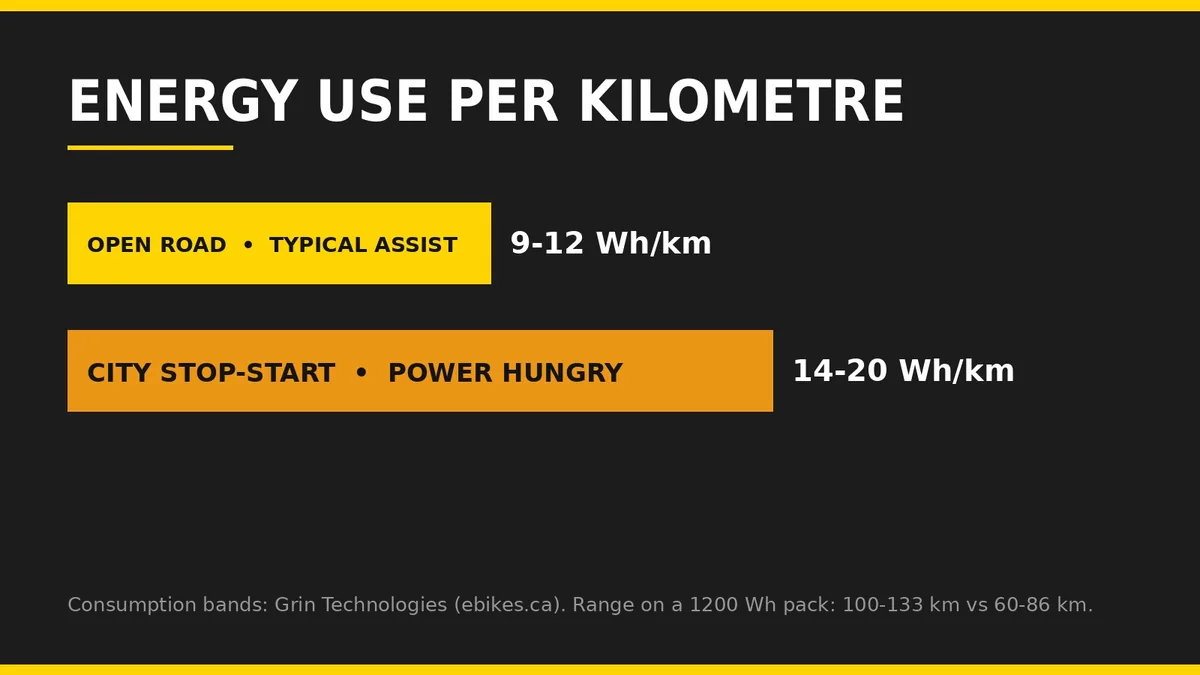
Stop-start city riding drains your e-bike battery far harder than open-road cruising. Grin Technologies puts steady, moderate assist at 9–12 Wh/km and power-hungry riding at 14–20 Wh/km (ebikes.ca). On a 1200 Wh pack that is the difference between roughly 120 km of open-road range and closer to 70 km crawling along Parramatta Road — the same battery, the same motor, a 40 per cent swing in how far you actually get.
Riders at Cyberbikes in Leichhardt ask this one constantly, usually after a weekend ride returns home with half a battery while the Monday commute of half the distance arrives nearly flat. Nothing is broken. Traffic is simply an expensive way to move a bike. Here is the engineering behind it, and what you can do about it.
Why does stop-start riding cost more watt-hours per kilometre?
Because every time you brake, you throw away the energy you just spent getting up to speed — and then pay for it again. Energy in a battery is simply watt-hours = volts × amp-hours. A 48 V 25 Ah pack holds 48 × 25 = 1200 Wh. What varies is not how much you have, but how many watt-hours each kilometre costs you.
The physics of a stop is unforgiving. Kinetic energy is ½ × mass × velocity², so a 112 kg system (a 37 kg e-bike plus a 75 kg rider) moving at 25 km/h carries about 2,700 joules — roughly 0.75 Wh. Brake to a halt and all of it becomes heat in the rotors. Do that 40 times on a 10 km inner-west commute and you have scrubbed off about 30 Wh at the wheel; allowing for motor and drivetrain losses, closer to 37 Wh drawn from the battery purely to replace energy you destroyed at traffic lights.
Open-road riding has no such tax. Once you are at cruising speed, the motor only fights rolling resistance and air drag, both of which are steady and relatively cheap at the 25 km/h where Australian pedal assist cuts out. That is why Grin’s consumption table separates minimal assist at 6–8 Wh/km, typical assist at 9–12 Wh/km and power-hungry riding at 14–20 Wh/km. City traffic pushes you into the top band without you ever touching a different setting.
Does motor heat punish city riding more than open road?
Yes, and the penalty is quadratic rather than linear. Grin’s power-ratings page is blunt that there is no standardised “rated watt” for e-bike motors, and that what actually kills a motor is heat in the windings, not the number on the sticker (ebikes.ca). The governing relationship is I²R: as Grin puts it, double the current through the windings and you generate four times the copper heat.
That matters in traffic because current tracks torque, not speed. Mechanical output follows Power (W) = torque × RPM × 0.104, so pulling away from a standstill means maximum torque at almost zero RPM — high current, very little useful power, and all the waste heat landing in the motor. Cruise at 25 km/h and the same motor spins fast, draws modest current and runs cool. A hub motor that is perfectly happy for 40 km on an open road can heat-soak in twenty minutes of light-to-light riding.
Heat then compounds the range problem: hot copper has higher resistance, so a warm motor converts a bigger share of your watt-hours into waste heat instead of forward motion. We covered how to tell that apart from a tired pack in our breakdown of e-bike power fade from motor heat versus battery sag. For the full picture of how the motor, controller and sensors interact, our guide to how e-bikes actually work — motors, sensors and controllers walks through the whole chain.
Can regenerative braking win back what stop-start riding costs?
Partly, and only on the right hardware. Grin’s regen page reports recovering 3–8 per cent of energy on a typical ride with a direct-drive setup, rising toward the top of that range where braking is frequent, and reaching about 20 per cent on a heavy recumbent trike (ebikes.ca). Their summary is the useful part: “The heavier the vehicle and the more you brake, the more you get back.”
Crucially, regen is close to zero on steady flat riding and is maximised in exactly the hilly, stop-and-go conditions that cost you range in the first place. So regen does not make city riding cheap — it just softens the bill by single-digit percentages.
The hardware catch is absolute. Grin notes regen is available only on a direct-drive hub motor, or a geared hub that does not freewheel; a conventional freewheeling geared hub cannot do it, and mid-drives have “essentially no path to regen”. If your bike has a standard geared rear hub, no firmware update will add it. Our definitive guide to e-bike batteries covers how pack capacity, not regen, does the heavy lifting on range.
What do these numbers mean for a real Sydney commute?
Take the 2026 Cyberbikes Centauro, which the product page lists with a 48V 25Ah (1200Wh) Samsung lithium-ion battery, a 250W rear hub motor, and a claimed range of “up to 120 km at 25 km/h, measured on a flat road with a 75 kg rider and no headwind”. That claim is internally consistent: 1200 Wh ÷ 120 km = 10 Wh/km, which sits squarely in Grin’s “typical assist” band. It is an honest open-road number, not a fantasy one.
Now apply traffic. Push consumption to the middle of the power-hungry band at 17 Wh/km and the same 1200 Wh pack returns about 71 km. At the 20 Wh/km worst case it is about 60 km. Both still comfortably cover a Leichhardt-to-CBD return trip several times over — but it explains why your display’s range estimate collapses the moment you join congested traffic.
| Riding condition | Energy use | Range from 1200 Wh |
|---|---|---|
| Minimal assist, steady | 6–8 Wh/km | 150–200 km |
| Open road, typical assist | 9–12 Wh/km | 100–133 km |
| City stop-start / power hungry | 14–20 Wh/km | 60–86 km |
Weight is the other lever city riders forget. The Centauro page lists 37 kg with the battery fitted and a 150 kg maximum rider and cargo load, with the rear rack “rated to carry 50kg”. Every extra kilogram raises the ½mv² cost of each stop, so a loaded cargo run through traffic is the most expensive riding you can do — and, per Grin, also the scenario where regen would give the most back.
Does NSW law change the stop-start equation?
It caps the cheap end rather than the expensive one. Transport for NSW states that a legal e-bike has “a maximum continuous rated power of 500 watts” and “a motor that does not provide power at speeds higher than 25km/h”, with any throttle-only function cutting out at 6 km/h. From 1 March 2029, “only EN 15194 certified e-bikes will be allowed on NSW roads” (transport.nsw.gov.au).
Because assistance stops at 25 km/h regardless, you cannot burn range chasing high speed on the open road the way a speed-pedelec rider could — which is precisely why open-road consumption stays in that efficient 9–12 Wh/km band. Note too that Transport for NSW is explicit that bikes exceeding the limits “are illegal, even if its power or speed is restricted by an app or switch”. The Centauro is listed as certified to UL 2849, UL 2271, ISO 4210, and EN 15194.
How do you claw back range in heavy traffic?
- Anticipate instead of braking. Every avoided full stop from 25 km/h saves roughly 0.75 Wh at the wheel. Rolling through at 10 km/h instead of stopping dead keeps about 84 per cent of that energy, because the cost scales with the square of speed.
- Drop an assist level in traffic. You are accelerating to 25 km/h only to brake again, so high assist buys you seconds, not distance.
- Use your gears. Pulling away in a high gear forces maximum torque at low RPM — the exact I²R-heavy condition that cooks a hub motor and wastes watt-hours.
- Keep tyres properly inflated. Rolling resistance is a constant per-kilometre tax that traffic already makes you pay more often.
- Carry less through town. Mass multiplies every single stop; save the 50 kg rack load for the steadier run home.
None of this is about babying the bike. It is about recognising that your range figure was measured in the one condition city riding never gives you: steady speed, no stops.
Watch: what e-bike energy actually costs
Even at the worst stop-start consumption figures above, the electricity bill stays trivial — which is the quiet punchline of the whole exercise. A 60 km city range costs the same cents-per-charge as a 120 km open-road one.
Frequently asked questions
Does stop-start riding damage an e-bike motor?
It stresses it more than open-road riding. Grin Technologies explains that motor failure comes from heat in the windings, and that doubling winding current produces four times the copper heat (the I²R relationship). Repeated acceleration from a standstill means high current at low RPM, so hub motors run hottest in traffic. Choosing a lower gear when pulling away and dropping an assist level both reduce that current.
How many watt-hours per kilometre does an e-bike actually use?
Grin Technologies lists 6–8 Wh/km for minimal assist, 9–12 Wh/km for typical assist, and 14–20 Wh/km for power-hungry riding. City stop-start conditions push most riders toward the upper band. On a 1200 Wh battery that equates to roughly 100–133 km of open-road range versus about 60–86 km in heavy traffic.
Will regenerative braking fix my city range?
Only marginally, and only on compatible hardware. Grin Technologies reports typical recovery of 3–8 per cent of energy, up to about 20 per cent on a heavy recumbent trike, and close to zero on steady flat riding. Regen requires a direct-drive hub motor or a geared hub that does not freewheel; mid-drive systems have essentially no path to regen.
Ride both conditions before you decide
Numbers on a page settle an argument; a test ride settles a purchase. Bring your actual commute to us and ride it — the traffic on Parramatta Road is the honest test bench, not a flat road with no headwind. Come and see the team at Cyberbikes, 281 Parramatta Road, Leichhardt, or call 0491 794 668, Tuesday to Saturday. If you would rather spread the cost, our rent-to-own plan starts from $99.99 per week.
#ebike #ebikesydney #cyberbikes #leichhardt #ebikerange #ebikebattery #electricbike #commuting #sydneycycling #ebiketech