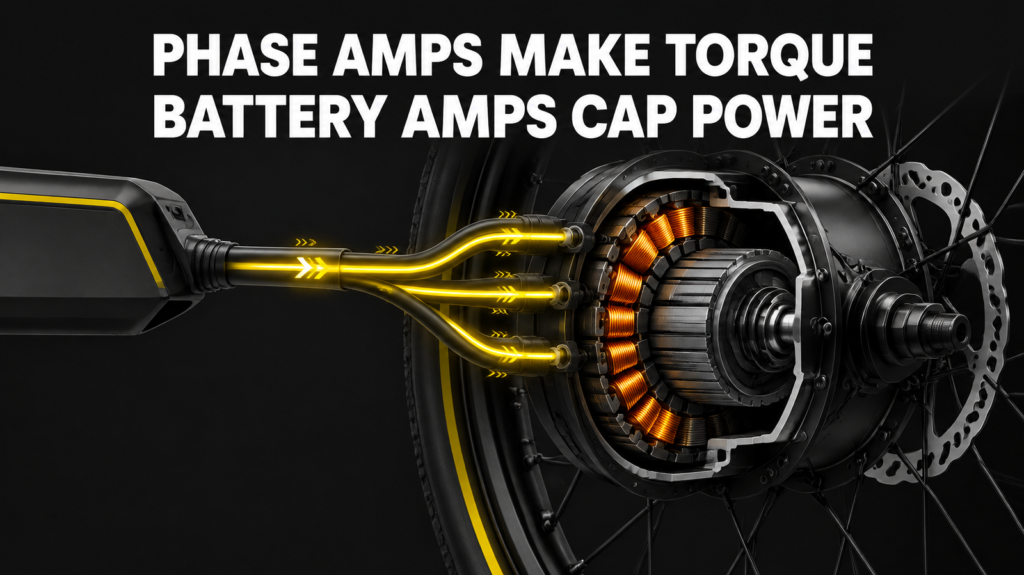
Phase amps make your torque. Battery amps cap your power. Your e-bike controller enforces two completely separate current limits, and the phase-current limit — commonly two to three times the battery-current limit, according to Grin Technologies’ motor simulator — is the one that decides how hard your bike pulls away from a kerb on Parramatta Road. Battery amps decide how much power the pack can push at full speed. Two numbers, two jobs, and almost every spec sheet in Australia only tells you one of them.
At Cyberbikes Leichhardt we open controllers every week, and this is the most misunderstood pair of numbers in the trade. Here is what each does, and what it means for a road-legal e-bike in Sydney.
What is the difference between phase amps and battery amps?
Battery amps are what the controller draws from your pack. Phase amps are what the controller sends into the motor windings. They are not the same current, and on a hill they are not even close.
Your battery supplies plain DC at roughly a fixed voltage. A brushless hub motor needs three-phase AC that rises and falls with wheel speed. The controller sits between them, chopping the DC thousands of times a second and feeding the phases in sequence. In doing so it behaves like a step-down converter: it hands the motor a lower voltage than the battery’s, and in exchange a higher current.
Power in roughly equals power out, minus losses, and input power is simply volts times amps. Draw 15 A from a 48 V pack and that is about 720 W going in. If the wheel is barely turning and the motor only needs 16 V across its windings, that same 720 W arrives as roughly 45 A of phase current. Same power, very different amperage.
Which number actually makes torque on a Sydney hill?
Phase amps make torque. In a permanent-magnet motor, torque is very nearly proportional to the current flowing through the windings — not to the current leaving the battery. Double the phase amps and you roughly double the twist at the axle.
That is why two bikes quoted at the same wattage can feel completely different at a standstill. The one with the higher phase-current limit leans into the hill; the one with a conservative phase limit feels like it is waiting for you to get moving first. It is also why torque and power are different questions. Grin’s power-ratings page gives the relationship as power in watts ≈ torque × RPM × 0.104, and works an example: 20 Nm at 100 rpm is only about 209 W, while that same 20 Nm at 300 rpm is about 628 W. Identical torque, triple the power — because the wheel is spinning three times faster.
Translate that to the pinch on Norton Street: when your speed drops, RPM drops, so power falls away even though the motor is still making full torque. It has not gone soft — it is doing its hardest work at its least efficient speed.
Why are phase amps higher than battery amps?
Because at low wheel speed the controller is running at a low duty cycle. At a crawl it might only be switching on for a quarter of each cycle, so the motor sees a quarter of the pack voltage and about four times the battery current.
Grin’s simulator exposes both limits as separate inputs and notes that phase limits are often set two to three times the battery limit. As you accelerate, duty cycle climbs toward 100%, the gap narrows, and near top speed the two converge:
- Standstill: phase amps peak, torque is maximum, speed is zero.
- Mid-range: both climb, and peak mechanical output lands here — Grin puts it at roughly 40–50% of the motor’s unloaded RPM.
- Top speed: phase amps ≈ battery amps, torque is low, and the controller is pinned against the battery-current limit.
That last point matters for anyone shopping on wattage. Grin’s power-ratings page notes that peak motor output arrives exactly when the controller hits the battery-current limit — so advertised peak power describes your controller and battery, not your motor.
Their worked examples show it plainly: a 36 V pack with a 20 A controller gives roughly 600 W of peak output; fit a 40 A controller and it rises to about 1058 W; keep the 20 A controller but lift the pack to 52 V and you get about 840 W. The motor never changed.
Why do big phase amps cook motors instead of making speed?
Because heat in the windings follows phase current squared. Copper losses obey I²R, so doubling the current through the windings produces four times the heat — Grin states the fourfold I²R relationship directly. Triple the current and you are at nine times.

This is why Grin argues that it is a motor’s output torque, not its output power, that heats it up and eventually kills it. A motor hauling 30 kg of groceries up a driveway at walking pace makes very little power and a great deal of heat: phase current is high, and there is almost no airflow or RPM to carry it away.
Two further points are worth holding onto. Hub motors take far longer to reach thermal equilibrium than most riders assume — a motor that feels fine after two minutes of climbing can still be heading for trouble at twenty, which is why Grin’s simulator reports time-to-overheat at 150 °C and final temperature after two hours. And cooling modifications raise a motor’s continuous rating without improving peak performance at all, because peak is set by the controller and pack. Cooling buys endurance, not punch.
It explains a workshop regular, too: the rider who turns phase amps up for “more power”, gets a genuinely stronger launch, then melts a hall sensor six weeks later. The extra torque was real. So was the extra heat.
How do riders actually change these settings?
On Bafang mid-drives both limits live in the controller’s programming — where most of these decisions get made or wrecked. Our workshop walks through the real settings:
What do phase and battery amps mean for a 250W e-bike in NSW?
The law limits continuous rated power and assisted speed — not phase current. Transport for NSW currently sets a maximum of 500 W continuous rated power, with the limit dropping to 250 W plus mandatory EN 15194 certification from 1 March 2029. Pedal assistance must stop at 25 km/h, and throttle-only operation must cut out at 6 km/h. Critically, Transport for NSW states that e-bikes exceeding any of these limits are illegal even where the power or speed is restricted by software, an app, a switch or a code.
So a compliant bike can still have a generous phase limit and a punchy launch, because torque off the line and assisted top speed are separate things. What it cannot have is a continuous rating above the legal ceiling or assistance past 25 km/h. To understand how controller, sensors and motor fit together before you touch a setting, start with our guide to how e-bikes actually work: motors, sensors and controllers, and our breakdown of sine-wave versus square-wave e-bike controllers.
The 2026 Cyberbikes Centauro is built to those limits: a 250 W rear hub motor, pedal assist cutting out at 25 km/h and throttle at 6 km/h, running a 48 V 25 Ah Samsung pack. Multiply it out — Wh = V × Ah — and 48 × 25 gives 1200 Wh, which the product page rates at up to 120 km at 25 km/h on flat road with a 75 kg rider and no headwind, from about a five-hour charge. The battery is UL 2271 certified, the electrical system UL 2849, the frame ISO 4210, and it stops on 4-piston hydraulic brakes with 180 mm × 2.3 mm rotors. It carries 150 kg of rider and cargo, 50 kg of that on the welded rear rack, at 37 kg on the scales and $4,249 online.
How do you read these numbers on a real e-bike?
Three practical rules from the bench:
- If a seller quotes only watts, ask for the controller’s battery-amp and phase-amp limits. Watts alone cannot tell you whether a bike will climb.
- Judge launch feel by phase amps, cruising power by battery amps. A bike that feels weak off the line but fine at 25 km/h has a modest phase limit, not a tired battery.
- Watch your display’s watt readout on your worst hill. A high draw held for minutes at low speed is the thermal danger zone, not a brief sprint.
To run the maths on your own commute, Grin’s motor simulator lets you set battery current, phase current, grade, weight and rolling resistance (about 0.004 for a road slick up to 0.012 for a knobby) and reports Wh/km alongside motor temperature. It is the honest way to answer “will this bike climb my street”.
Frequently Asked Questions
Do more phase amps make an e-bike faster?
Not at the top end. More phase amps give you more torque, so you accelerate harder and climb better, but top speed is governed by the battery-current limit, pack voltage and the motor’s winding speed. Raising phase amps mainly buys launch and hill performance — and extra winding heat, since copper losses rise with the square of the current.
Can phase amps be higher than the battery’s rated current?
Yes, and normally they are. At low wheel speed the controller runs a low duty cycle, so it delivers the motor a lower voltage and a proportionally higher current for the same power. Grin’s simulator notes that controller phase limits are often two to three times the battery-current limit.
Is turning up phase amps legal on an e-bike in NSW?
NSW law limits continuous rated power and assisted speed, not phase current. Transport for NSW currently allows up to 500 W continuous rated power, dropping to 250 W with mandatory EN 15194 certification from 1 March 2029, with pedal assist stopping at 25 km/h and throttle cutting out at 6 km/h. A bike exceeding those limits is illegal even if restricted by software.
Come and feel the difference
Numbers on a page will only take you so far. The fastest way to understand phase amps is to ride two bikes up the same hill, which is what a test ride at Cyberbikes Leichhardt is for. We are at 281 Parramatta Road, Leichhardt — open Tuesday and Thursday 10am–3pm, Wednesday and Friday 10am–5pm, closed Saturday, Sunday, Monday and public holidays. Call 0491 794 668 to book, browse the range at cyberbikes.com, or ask us about rent-to-own from $75 per week if you would rather ride now and pay weekly.
Sources: ebikes.ca power ratings, ebikes.ca motor simulator (Grin Technologies); Transport for NSW e-bike rules; Cyberbikes Centauro product page.
#CyberbikesLeichhardt #EBikeSydney #PhaseAmps #EBikeTorque #HubMotor #EBikeController #CentauroEBike #ElectricBikeSydney #EBikeTech #SydneyCommute