A sine-wave e-bike controller wins on smoothness and noise — Grin Technologies rates its field-oriented controllers as delivering “higher motor efficiency than typical trapezoidal controllers” — but the efficiency gain is small, and it will not turn a 250 W hub motor into a rocket. A square-wave (trapezoidal) controller is cheaper, perfectly legal and perfectly rideable; it simply buzzes at walking pace and throws away a little more of your battery as heat. In short: the controller changes how your e-bike feels far more than how far it goes.
Four questions riders ask us at the Leichhardt shop, answered below:
- What physically differs between the two waveforms?
- Does a smoother controller add range — and how much, in kilometres?
- Why do phase amps and battery amps show completely different numbers?
- Does the controller keep the motor cooler, and does it affect NSW legality?
For the whole drivetrain picture, start with our guide to how e-bike motors, sensors and controllers actually work.
What actually differs between a sine-wave and a square-wave e-bike controller?
Both controllers do the same job — take DC from the battery and switch it into the motor’s three phases in the right order. The difference is the shape of the current they push.
A square-wave controller (also called trapezoidal or block commutation) energises two of the three phases at a time and steps between six fixed positions per electrical revolution. Those abrupt steps create torque ripple, and torque ripple is exactly what you hear as that classic low-speed buzz or growl when you pull away from the lights.
A sine-wave controller varies the current in all three phases continuously, so the magnetic field rotates smoothly instead of jumping. On Grin Technologies’ Phaserunner this is implemented as field-oriented control (FOC) — Grin describes it as a “compact state-of-the-art field oriented motor controller (FOC)” and sells it on the “smooth response of a FOC with a torque throttle”. The current never steps; it sweeps.
| What you notice | Square wave (trapezoidal) | Sine wave (FOC) |
|---|---|---|
| Low-speed noise | Audible buzz or growl | Near silent |
| Torque ripple | Six steps per electrical rev | Smooth, continuous |
| Motor efficiency | Baseline | Higher than “typical trapezoidal controllers” (Grin) |
| Cost and complexity | Lower | Higher |
| Legality in NSW | Identical — the law rates the bike, not the waveform | Identical |
Does a sine-wave controller give you more range?
A little — not a lot. Range is decided by energy and by how hard you ask the motor to work, not by the shape of the waveform.
The arithmetic is simple. Energy in a pack is Wh = V × Ah. The Cyberbikes Centauro carries a 48 V 25 Ah Samsung pack, which is 48 × 25 = 1,200 Wh. Its product page claims up to 120 km at 25 km/h, measured on a flat road with a 75 kg rider — so that scenario works out at 1,200 Wh ÷ 120 km = 10 Wh per kilometre.
Now apply a few percent better motor efficiency. Ten Wh/km becomes roughly 9.7 Wh/km, which stretches that same pack by something like three or four kilometres. Useful, but trivial next to the things that really move Wh/km: a headwind, a hill, tyre pressure, total weight, and which assist level your thumb is parked on.
Grin says this plainly on its pedal-assist page: “The range you get on an ebike fundamentally has nothing to do with what kind of control system you use, and everything to do with the average amount of power you draw.” Buy a sine-wave controller for the silence and the smooth take-off. Do not buy it expecting another 20 km.
Why do phase amps and battery amps show different numbers?
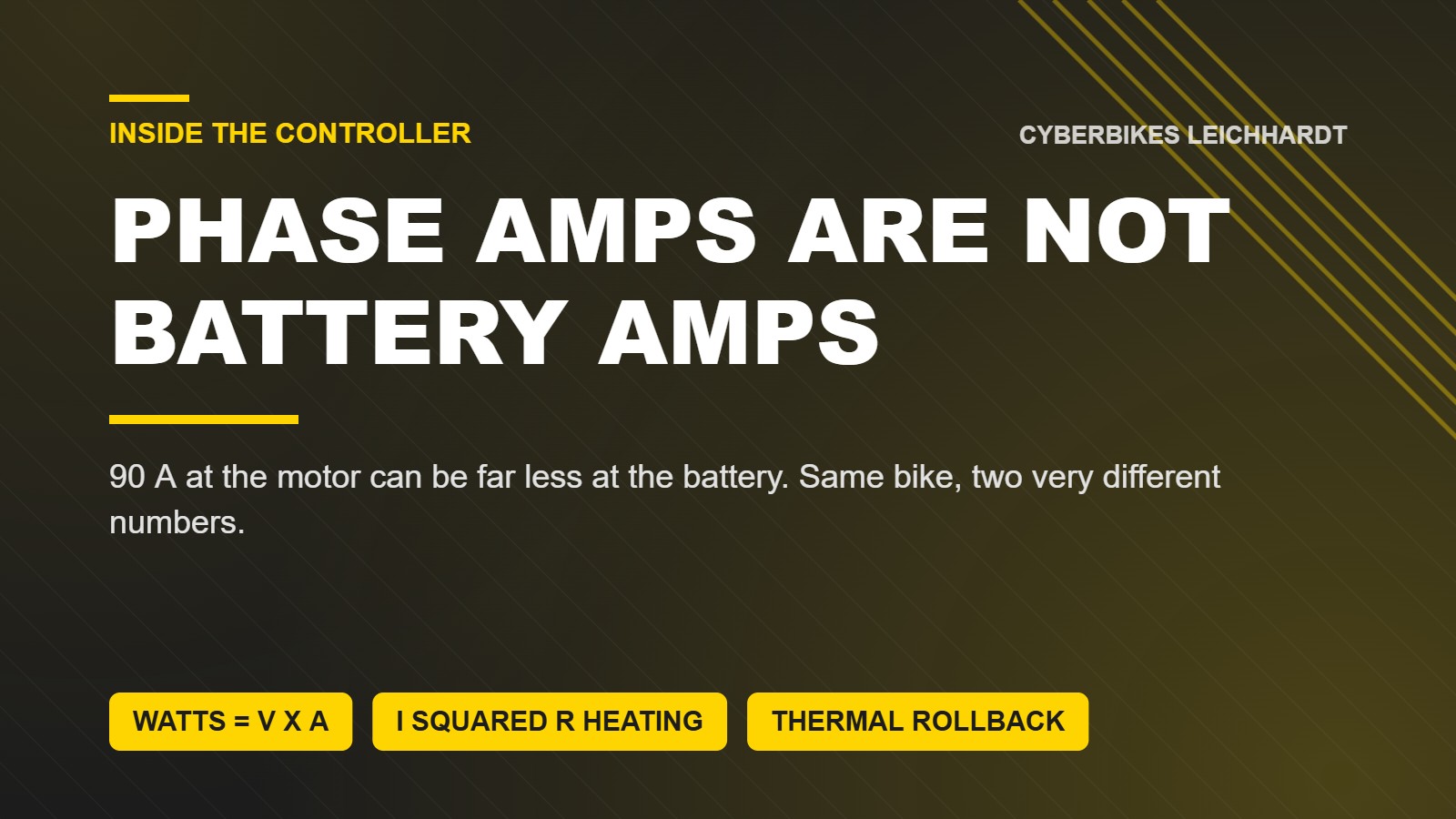
Because a controller is a switching converter, not a piece of wire. The current flowing into the motor windings is often far higher than the current leaving your battery.
Grin’s own figures make the gap obvious. The Phaserunner is listed at 90 A peak phase current, with continuous phase current “typically 45-50A” without extra heatsinking — close to 70 A with finned heatsinks, and around 30 A buried in an insulated cavity. Yet Grin notes that “battery current draw on the Phaserunner is much lower” than those phase numbers.
Use watts = volts × amps and it clicks. Pull 20 A from a 48 V pack and you are drawing 48 × 20 = 960 W. At low road speed the motor’s back-EMF is small, so the controller can deliver a much larger winding current at a much lower effective voltage — strong torque off the line without the pack ever supplying 90 A. That is why a spec sheet quoting phase amps always looks more impressive than the same bike quoting battery amps.
We unpack that number game further in whether controller amps beat motor watts.
Does a smoother controller keep your motor cooler?
Slightly — but torque, not waveform, is what actually cooks an e-bike motor. Heat in copper follows the I²R relationship, and Grin puts the consequence bluntly: “If you double the current through the windings…you increase the amount of copper heat being generated by a factor of FOUR (the I2R relationship).”
Because a sine-wave controller produces the same torque with a slightly lower RMS current, it generates slightly less copper heat. That is a real effect, just a second-order one. Grin’s power-ratings page is emphatic that it is sustained torque — grinding uphill at low wheel speed — that burns insulation, softens gears and risks demagnetising magnets.
Controllers also defend themselves. The Phaserunner includes “Automatic thermal rollback to prevent controller overheating”, documented as engaging above roughly 80 °C heatsink temperature. If your bike mysteriously goes soft halfway up a long climb, that is usually thermal protection doing its job, not a fault.
The everyday Sydney version: dragging up from Iron Cove toward Leichhardt in too high a gear at 8 km/h is exactly what heats a hub motor. Drop a gear and spin faster. No controller upgrade fixes a cadence problem.
Does the controller decide whether your e-bike is legal in NSW?
No — NSW law rates the bike, not the waveform. But the controller is what enforces the two limits that matter: the power rating and the assist cut-out.
Transport for NSW currently sets “a maximum continuous rated power of 500 watts”, requires “a motor that does not provide power at speeds higher than 25km/h”, and allows throttle-only assistance only up to 6 km/h. From 1 March 2029, “only EN 15194 certified e-bikes will be allowed on NSW roads”, alongside a 250 W rating.
The sentence every shopper should read twice: “E-bikes that exceed any of these limits are illegal, even if the power or speed is restricted by software (app, switch or code).” A dealer offering to “unlock” a bike after purchase is offering to make it illegal. For the full picture, see the complete guide to e-bike laws in NSW.
One more wrinkle worth knowing before you compare spec sheets. Grin’s power-ratings page states there is “NO SUCH THING as a ‘rated watt’ or any standardized method for rating ebike motor power”, and demonstrates the same motor producing 600 W at 36 V / 20 A and 1,100 W at 48 V / 35 A. The number on the sticker is a compliance figure, not a performance promise.
What does all this mean for a Leichhardt commute?
Pick the bike for its rating, its battery energy and its brakes; treat waveform smoothness as a comfort feature. Here is what we can read straight off the Cyberbikes Centauro product page today: a Super 250 W rear hub motor, a 48 V 25 Ah (1,200 Wh) Samsung lithium-ion battery, and a claimed range of up to 120 km at 25 km/h on flat road with a 75 kg rider.
- Safety approvals: UL 2849 for the electrical system, UL 2271 for the battery, ISO 4210 MTB-compliant frame, and EN 15194 — the standard NSW will require from 2029.
- Stopping power: 4-piston hydraulic brakes with 180 mm × 2.3 mm rotors, on 26 × 2.4 e-bike-rated tyres.
- Comfort: 100 mm front travel and 120 mm rear travel.
- Load: 37 kg with the battery fitted, 150 kg maximum rider and cargo load, 50 kg rear rack, optional 15 kg front basket.
The Centauro product page does not publish its controller type, so we are not going to claim one here — come and ride it at 281 Parramatta Road, Leichhardt and judge the take-off with your own ears. You can see the full build on the 2026 Cyberbikes Centauro full-suspension e-bike page.
Watch: why the wattage number on the sticker misses the point
Controllers are where the real power decisions happen, which is why a rated-watts figure says so little:
Frequently Asked Questions
Is a sine-wave e-bike controller worth paying extra for?
It is worth it if low-speed noise and jerky take-off bother you, because a sine-wave controller removes both. It is not worth it as a range upgrade: Grin Technologies notes that e-bike range depends on the average power you draw, not the control system, so expect a few percent rather than a few extra charges.
Why does my e-bike motor buzz when I start from a standstill?
That buzz is torque ripple from square-wave or trapezoidal commutation, where the controller energises two phases at a time and steps between six positions per electrical revolution. It is normal, it is not a fault, and it usually fades as road speed rises. A sine-wave controller using field-oriented control removes it almost entirely.
Does a bigger controller make an e-bike illegal in NSW?
What matters in NSW is the bike’s maximum continuous rated power of 500 watts, assistance stopping at 25 km/h and throttle-only power cutting out at 6 km/h. Transport for NSW states that e-bikes exceeding these limits are illegal even if the power or speed is restricted by software, so a controller that can be unlocked beyond them puts the bike outside the law.
Ride one before you buy one
Waveforms are easy to argue about and very easy to settle: roll away from a standstill on one bike, then the other, and your ears will tell you in three seconds. Cyberbikes rent-to-own starts from $99.99 per week, so you can live with a bike through a full Sydney week of hills, headwinds and traffic lights before committing. Drop in at 281 Parramatta Road, Leichhardt, browse the range at cyberbikes.com, or call 0491 794 668, Tuesday to Saturday.
Technical sources: ebikes.ca (Grin Technologies) and Transport for NSW. Centauro specifications read live on 2 October 2026.
#Cyberbikes #EBikeSydney #ElectricBikeLeichhardt #EBikeController #SineWaveController #EBikeTech #CentauroEBike #RentToOwnEBike #InnerWestSydney #EBikeCommute