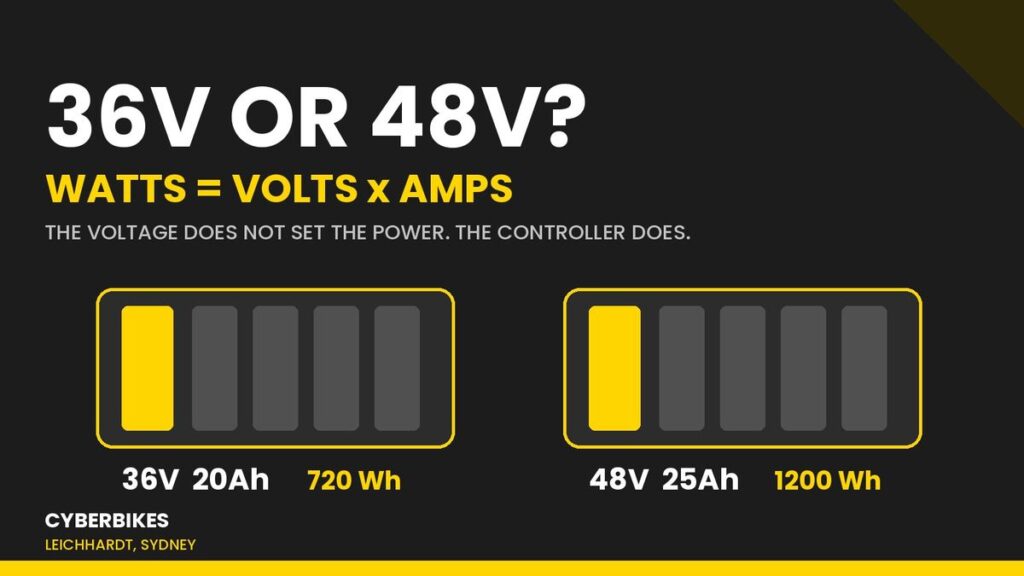
Neither voltage sets your power — the controller does. Electrical power is volts multiplied by amps, so a 48V pack feeding a 15A controller (720 W) and a 36V pack feeding a 20A controller (720 W) put exactly the same watts into the motor. What 48V genuinely changes is that it delivers those watts at lower current, which cuts resistive heating and lifts the motor’s top speed for the same winding. That is the whole answer, and everything below is the engineering behind it.
Does a 48V e-bike make more power than a 36V one?
Only if the controller lets it. Grin Technologies, the Vancouver motor lab behind the widely used motor simulator, puts the arithmetic plainly on its power ratings page: electrical input power is volts × amps, and peak output power “is mostly a function of the motor controller and battery pack” rather than the motor itself.
Their own bench numbers on a single Crystalyte H3540 hub motor show how much the controller decides:
- 36V pack, 20A controller — about 600 W peak output, at roughly 40 km/h
- 36V pack, 40A controller — about 1058 W peak output, at roughly 33 km/h
- 52V pack, 20A controller — about 840 W peak output, pulling strongly past 55 km/h
Same motor in all three cases. Doubling the controller’s current on 36V added more peak power than raising the voltage did — but raising the voltage added speed, because a motor has no fixed rpm. Its speed comes from its rpm-per-volt winding constant multiplied by the voltage you apply. More volts, more revolutions, higher unloaded wheel speed.
This is also why Grin warns that there is no standard method behind the “rated watts” on a spec sheet, and that the same motor gets sold as 250 W, 500 W or 1000 W depending on the vendor. If you want to compare two e-bikes honestly, compare the battery voltage, the controller’s current limit and the motor’s torque — not the marketing number. We dig into that trap in our guide to how e-bike motors, sensors and controllers actually work.
Why does a 48V system run cooler at the same power?
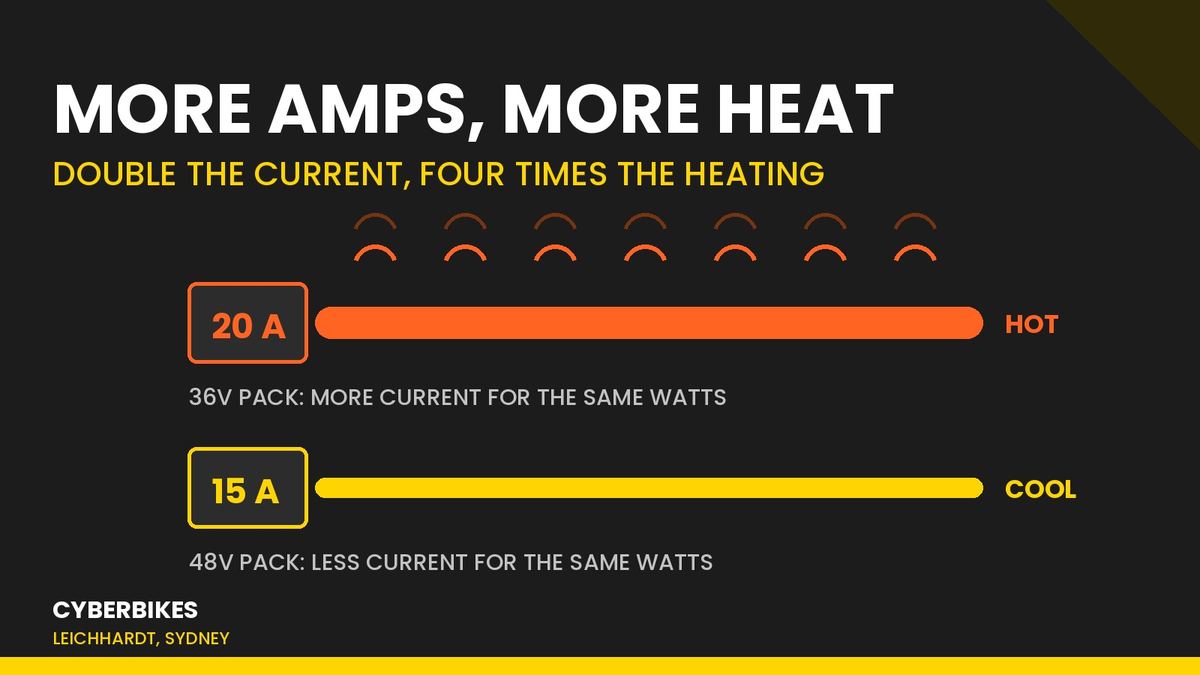
Because heat in copper rises with the square of current. Grin’s power ratings page states it directly: double the current and you quadruple the copper heating in the windings. Voltage does not appear in that relationship at all.
Work it through for 720 W of input power. On 36V you need 20 A. On 48V you need 15 A. The current ratio is 0.75, so the resistive loss ratio is 0.75 × 0.75 = 0.56 — the higher-voltage system throws away roughly 44% less heat in the wiring and windings for identical power at the wheel. You feel that as a motor that holds its output longer on a long climb instead of fading, and as connectors and controllers that run cooler under load.
Grin’s lab is blunt about the consequence: overheating risk tracks torque and how long you sustain high current, not output power on its own. A 36V bike grinding up a hill at walking pace is the worst case — maximum current, minimum airflow, minimum rpm.
Does 48V give you more range than 36V?
Not because of the voltage. Range comes from stored energy, and stored energy is watt-hours: volts × amp-hours. A 36V 20Ah pack holds 720 Wh. A 48V 25Ah pack holds 1200 Wh. The 48V pack goes further because it is a bigger pack, not because it is a higher voltage. Swap the numbers around — a 36V 30Ah pack at 1080 Wh beats a 48V 15Ah pack at 720 Wh — and the ranking flips.
Our own 2026 Cyberbikes Centauro runs a 48V 25Ah Samsung pack — 1200 Wh — behind a 250 W rear hub motor, and the product page quotes up to 120 km at 25 km/h, measured on flat road with a 75 kg rider and no headwind at a steady 250 W. Divide 1200 Wh by 120 km and you get 10 Wh per kilometre under those test conditions. That figure is the one worth carrying around, because it travels: a hilly Inner West commute into a headwind might cost you 15–20 Wh/km instead, and you can size any pack against it.
Where the higher voltage does quietly help range is in those resistive losses. Less current for the same power means fewer watt-hours burned as heat rather than motion — a small single-digit gain, not a transformation. If range is your real question, the full breakdown lives in our definitive guide to e-bike batteries and range, and the volts-versus-amp-hours split is unpacked in volts or amp-hours: what sets your e-bike range.
Can you fit a 48V battery to a 36V e-bike?
Not safely, and usually not at all. Three things have to survive the extra voltage: the controller’s capacitors and MOSFETs, the display, and the charger. A 36V system typically tops out around 42 V fully charged; a 48V system reaches about 54.6 V. That is a 30% overvoltage on components chosen for the lower figure, and the usual failure mode is a popped capacitor or a cooked controller rather than a polite error message.
Then there is the legal side. Transport for NSW sets the ceiling for an electrically power-assisted cycle at 500 watts maximum continued rated power, with assistance reduced progressively and cut off by 25 km/h, and the motor must never be the only source of propulsion. Anything that does not meet those requirements is, in the regulator’s words, illegal on the road and restricted to private property. A voltage upgrade that raises your bike’s continuous output past the limit takes a legal e-bike and makes it an unregistered motor vehicle — software limiting does not fix that. The current rules are on the Transport for NSW e-bike page.
If you want more usable power from a 36V bike, the honest upgrade path is a controller with a higher current limit — within what the motor’s thermal mass and the law can take — not a bigger battery bolted onto unchanged electronics.
Which voltage actually suits Sydney riding?
Sydney is a hill city with long flat corridors between the hills, which is the exact profile that rewards headroom. A 36V system is perfectly adequate for a flat 8 km run on the Bay Run. It gets thermally stressed on the sustained climbs out of the harbour foreshore, because it has to pull more amps to make the same torque, and more amps means the square of the heat.
| What you are comparing | 36V system | 48V system |
|---|---|---|
| Current for 720 W input | 20 A | 15 A |
| Relative resistive heating | 1.00 | 0.56 |
| Energy in a 25Ah pack | 900 Wh | 1200 Wh |
| Wheel speed for the same winding | Lower | Higher |
| Legal assist cut-out in NSW | 25 km/h either way | |
Note the last row. Both systems assist to the same 25 km/h, because the limit is written into the law, not into the battery. What the higher voltage buys you in NSW is not speed — it is thermal margin, steadier assist on hills, and bigger packs at sane current levels. That is why the Centauro is built around 48V: 1200 Wh of Samsung cells, a 150 kg maximum rider-and-cargo rating, a rear rack welded to the frame and rated to 50 kg, 4-piston hydraulic brakes on 180 mm rotors, and certification to UL 2849 for the e-bike system, UL 2271 for the battery and ISO 4210 for the frame.
See what 48V and 1200 Wh look like on a real ride
Frequently asked questions
Is a 48V e-bike faster than a 36V e-bike?
Mechanically yes, legally no. Higher voltage raises a motor’s unloaded speed because speed follows the rpm-per-volt winding constant times the applied voltage. But in NSW, pedal assistance must be cut off by 25 km/h on any road-legal e-bike, so both systems stop assisting at the same speed. The practical difference is that a 48V bike reaches that speed with less strain.
Does a 48V battery last longer than a 36V battery?
Per charge, only if it holds more watt-hours — energy is volts times amp-hours, so a 48V 25Ah pack at 1200 Wh beats a 36V 20Ah pack at 720 Wh, while a 36V 30Ah pack at 1080 Wh beats a 48V 15Ah pack at 720 Wh. Over its service life, the 48V pack has a mild advantage because it draws less current for the same power, and lower current means less internal heating.
How many watt-hours per kilometre does an e-bike use?
Around 10 Wh per kilometre at a steady 250 W on flat ground with no headwind, which is what the Centauro’s 1200 Wh pack and 120 km quoted range work out to. Hills, headwinds, heavier loads, stop-start traffic and higher assist levels push that figure up, so 15–20 Wh/km is a realistic planning number for a hilly Sydney commute.
Ride one before you argue about volts
Numbers settle arguments; a hill settles the question. Cyberbikes is at 281 Parramatta Road, Leichhardt, and the test ride is free — bring the climb you actually dread and see what 48V and 1200 Wh feel like under load. If buying outright is not the plan this month, rent-to-own on the Centauro starts from $75 a week with a $399.99 deposit and 12, 24, 36 or 48-week plans, including a helmet, alarm, GPS tracker, lock and a free tune-up every 12 weeks (prices read from cyberbikes.com on 18 November 2026). Shop hours are Tuesday and Thursday 10am–3pm, Wednesday and Friday 10am–5pm, Saturday 10am–4pm, closed Sunday, Monday and public holidays. Call 0491 794 668 or browse the Centauro specs.
#ebikesydney #cyberbikes #centauro #ebikebattery #48velectricbike #leichhardt #innerwest #ebikecommute #electricbikeaustralia