Two-thirds of Sydney’s youngest schoolkids now arrive by car. In the same part of Sydney in 1971, only 22.8% of 5-to-9-year-olds were driven to school. By 2003 it was 66.6%, while walking collapsed from 57.7% to 25.6% (van der Ploeg et al., Preventive Medicine, 2008). The trips did not get longer — nearly 60% of Australian parents say school is three kilometres or less from home. What changed is the street in between. The school run Sydney wakes up to every weekday morning is not a parenting failure. It is a road design failure, and it is fixable.
How many Sydney kids are actually driven to school?
The long-run numbers are brutal. The Sydney data set that tracks this — children aged 5 to 14 in the old County of Cumberland, covering most of the metro area — shows car trips to school tripling for the youngest group between 1971 and 2003: 22.8% to 66.6%. For 10-to-14-year-olds it went from 12.2% to 47.8%. Walking fell from 44.2% to 21.1% in that older group. Cycling barely registers at all, at 1–2% across the whole period.
Nationally, Healthy Active by Design puts the fall in active travel to school at roughly 75% to 25% over four decades. That is one of the fastest changes in how Australians move anywhere, and nobody voted for it.
Why do parents drive a three-kilometre trip?
Because the alternative was engineered out. Three kilometres is a 10-to-15-minute ride for an adult and about 20 minutes for a kid on a bike — if the route is safe. In most of Sydney it isn’t. The barriers parents report in Australian research are consistently about traffic: fast vehicles, no separation, intersections built for turning volumes rather than small people.
Notice the loop. Parents drive because the road feels dangerous. The road feels dangerous partly because of the cars driven by other parents. None of this is the fault of individual drivers — it is what you get when a street is designed to move vehicles past a school instead of to deliver children to one. The same loop locks in across whole suburbs: we have written about which Sydney suburbs are forced into car ownership, and the school gate is where it hits youngest.
Does the school run really cause Sydney’s traffic?
Here is where we will be honest, because the data does not say what cycling advocates often claim. The Grattan Institute’s Stuck in traffic? analysis of Sydney and Melbourne congestion found that public holidays visibly change congestion but school holidays “not so much”. Grattan also lists staggered school start times among the popular ideas it does not recommend.
So no — emptying the school run would not hand Sydney free-flowing motorways. That is the wrong prize anyway. The real costs of driving a three-kilometre school trip are:
- Children’s health. More than 70% of Australian children do not meet minimum physical activity recommendations. The daily trip to school used to supply that activity for free.
- Street danger concentrated at the worst place. Hundreds of vehicles converge on one gate inside a 20-minute window, reversing, double-parking and U-turning around pedestrians under 140 cm tall.
- Independence. A kid who has never navigated their own suburb becomes an adult with no transport option but a car.
Fix the school run because it is the single most winnable car trip in the city, not because it will unclog the M4.
What have other cities done about the school gate?
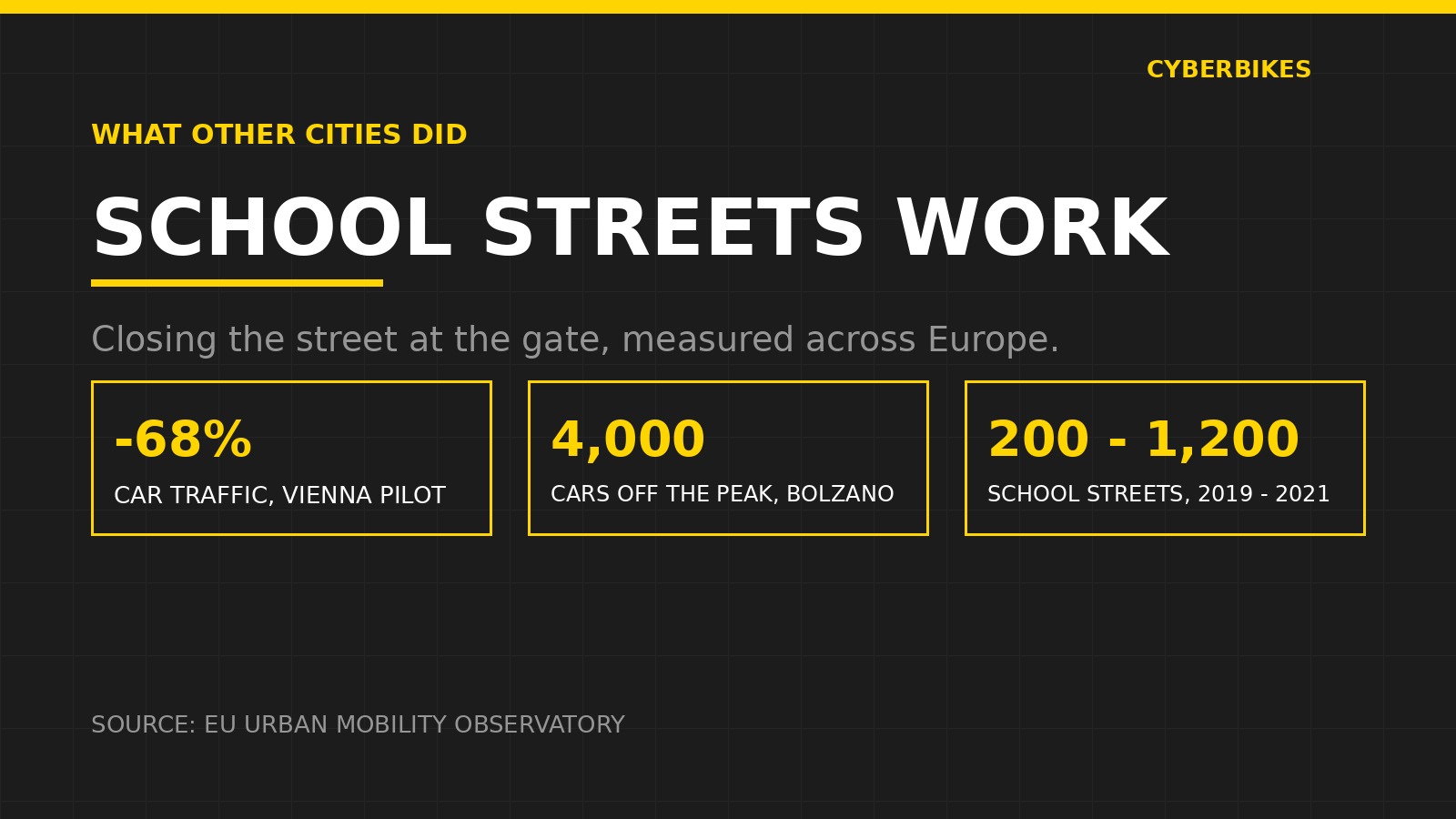
They closed the street. “School streets” — the road outside the gate shut to through traffic at drop-off and pick-up — went from roughly 200 across Europe in 2019 to about 1,200 by 2021, in 150 cities across 15 countries, according to the EU Urban Mobility Observatory. The measured results are not subtle:
- Vienna (Vereinsgasse pilot): car traffic down up to 68%.
- Bolzano, which has run school streets since 1989: up to 4,000 cars kept off the road in the peak period.
- Salzburg: at one primary school, scooting to school rose from 1% to 18%.
- Paris has pushed past 200 rues aux écoles since 2019, pedestrianising the street at the gate rather than policing the queue.
None of this is exotic engineering. It is a folding barrier, a sign, and a council willing to say that for 40 minutes a day, this piece of asphalt belongs to eight-year-olds.
What would fix the Sydney school run?
Four things, in order of how cheap they are:
- School streets at the gate. Sydney already accepts 40 km/h school zones in school hours; a timed closure of the final 100 metres is a smaller intervention than a new signalised crossing and costs a fraction as much.
- 30 km/h on residential streets around schools. Pedestrian survivability falls away sharply above 30 km/h, and the road-safety literature is unusually consistent that speed and road design — not driver character — decide outcomes.
- Continuous separated routes, not painted gestures. A bike lane that ends 200 metres short of the gate protects nobody at the point of maximum risk.
- Let the e-bike do the heavy lifting. A family e-bike with a rear rack or a kid seat turns a 3 km school trip plus a 9 km commute into one ride, uphill, in work clothes. In NSW an e-bike is legal to ride wherever a bicycle is: Transport for NSW allows up to 500 W maximum continued rated power with motor assistance that must cut out at 25 km/h, and no motor-only propulsion above 6 km/h. Helmets are mandatory for every rider, every age, every trip.
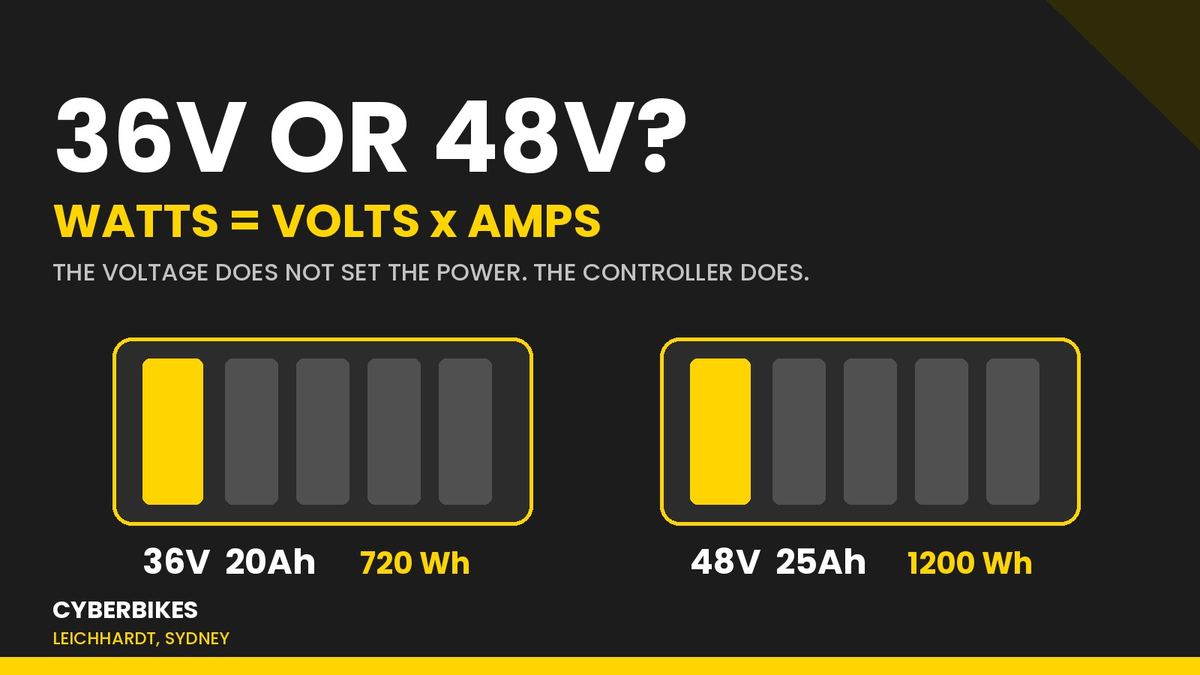
Our complete guide to car-free e-bike commuting in Sydney works through the route-planning and cost side in detail. On the bike side, the Centauro e-bike is the one we hand to parents at the Leichhardt shop: a 250 W rear hub motor, a 48 V 25 Ah Samsung battery, a welded rear rack, hydraulic brakes and a full-suspension step-through frame you can get on and off while holding a school bag.
Frequently Asked Questions
How far is too far to ride to school in Sydney?
Distance is rarely the limit — nearly 60% of Australian parents report a school within three kilometres, which is a 10-to-20-minute ride. The practical limit is whether the route has continuous separation from traffic. A 2 km trip across an arterial road is harder than a 5 km trip on a shared path.
Do school streets actually reduce traffic?
Yes, where they have been measured. Vienna’s Vereinsgasse school street cut car traffic by up to 68%, and Bolzano’s long-running programme keeps up to 4,000 cars off the road in the peak period, according to the EU Urban Mobility Observatory.
Can I legally carry my child on an e-bike in NSW?
Yes, on a bike built and equipped for it, with an approved helmet for every rider. Transport for NSW allows power-assisted pedal cycles up to 500 W maximum continued rated power, with assistance cutting out at 25 km/h and no throttle-only propulsion above 6 km/h. Check your bike’s rack or seat load rating before carrying a passenger.
Swap one car trip a week for an e-bike ride and see what changes. Come and talk it through with us at Cyberbikes, 281 Parramatta Road, Leichhardt.
#SchoolRun #EbikeSydney #CyberbikesLeichhardt #SchoolStreets #CarFreeSydney #ActiveTravel #SydneyCycling #BikeToSchool