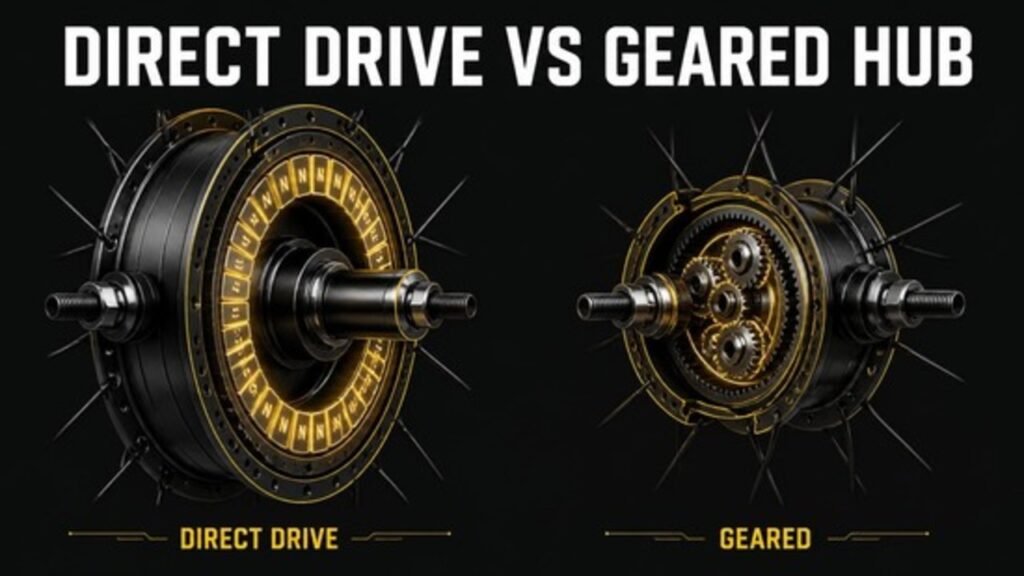
For most Sydney riding, a geared hub motor wins. It weighs roughly 50% less than an equivalently powerful direct drive motor, freewheels with almost no drag, and climbs more efficiently. A direct drive hub wins if you want near-silence, regenerative braking and top-end efficiency — and you can accept 0.3–1 N·m of permanent drag torque and a motor two to three times heavier (Grin Technologies, ebikes.ca).
That is the short answer. The longer one matters, because the direct drive vs geared hub motor choice quietly decides how your e-bike climbs Lilyfield Road, how hot it gets doing it, and how much range you actually see. Here is the engineering, from the Cyberbikes workshop in Leichhardt.
What is actually different inside a direct drive and a geared hub motor?
A direct drive (or gearless) hub motor is the simplest electric motor you will ever own. Grin Technologies describe it as “holding the axle and letting the body of the motor spin,” with the rim laced straight onto that spinning body — a radial-flux brushless DC machine with permanent magnets around the inside of the hub shell. There is no gearbox, so the motor turns at wheel speed: around 200 rpm.
That is both the problem and the appeal. Electric motors make power from speed, so a motor limited to 200 rpm must be physically big to produce useful output. Grin notes direct drive hubs are “usually large and heavy for their power output,” commonly 4–9 kg and over 20 cm in diameter.
A geared hub motor solves this with a planetary gear set: a small, fast-spinning internal motor drives a reduction gearbox, which drives the hub shell. Grin: “the motor spins internally at a high RPM and a planetary gear transmission reduces this” to wheel speed. The result is smaller and lighter — typically 2–4 kg — and almost all contain a one-way freewheel clutch, so the motor disengages when idle.
If you want the full picture of how the motor talks to the rest of the system, our guide to how e-bike motors, sensors and controllers actually work walks through the whole chain.
Which hub motor is lighter — and does weight matter in Sydney?
Grin’s figure is blunt: geared hubs “typically weigh about 50% less than an equivalently powerful direct drive machine.” On a bike you lift onto a Leichhardt apartment landing or a rear rack, 3 kg saved in the wheel is 3 kg you feel every single time.
Weight in the wheel is also unsprung and rotating, so it blunts suspension and makes the bike harder to flick around a pothole. That is why most commuter and cargo builds — including the Cyberbikes Centauro full-suspension step-through, which runs a 250 W rear hub motor — keep the motor compact and in the rear hub. The Centauro’s spec sheet does not state whether that hub is geared or gearless, so we do not guess: in the shop we lift the rear wheel and spin it. Coasts freely, it has a freewheel. Resists and cogs, it is direct drive. That ten-second test beats most marketing pages.
Which motor climbs a hill without cooking itself?
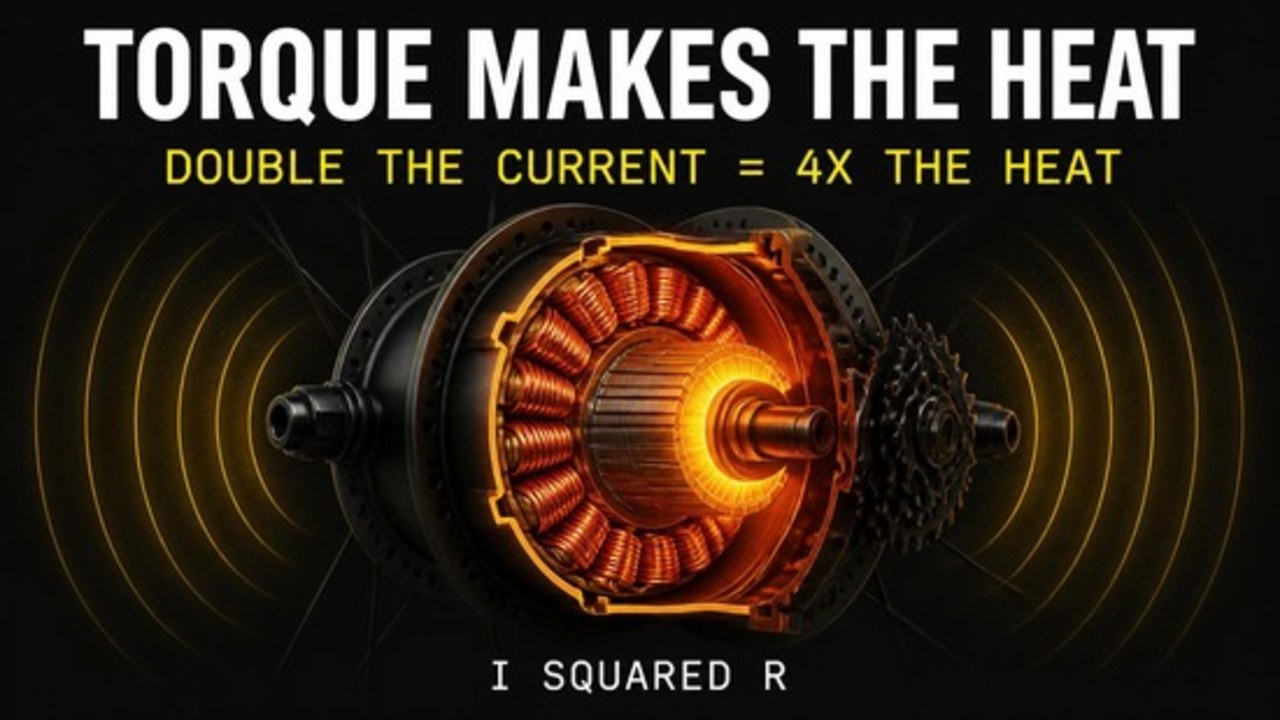
Electrical power is watts = volts × amps. To make more torque, the controller pushes more current through the copper windings — but winding heat follows I²R, scaling with the square of the current. Grin put it plainly: double the current to double torque and “you increase the amount of copper heat being generated by a factor of FOUR.” Critically, they note torque, not power, is what overheats a motor, because torque tracks current directly.
Translate that to a Sydney hill. Grinding up a steep pinch at 8 km/h asks for high torque at low rpm: the motor draws near-peak current while spinning too slowly to cool itself. Grin’s example of how far ratings drift from reality — an MXUS motor marketed as “5000 watts” delivered just 800 watts of output power at 250 rpm before its core hit 100 °C.
A geared hub dodges much of this: its internal motor spins fast even when the wheel is crawling. That is why Grin credit geared hubs with “better hill climbing efficiency” and direct drive with “better high speed efficiency.” Geared hubs also make more torque for their size — Grin cite the German Heinzmann at up to 80 N·m against about 35 N·m for a typical direct drive machine.
The trade-off is thermal headroom: a big direct drive hub has far more metal to soak up heat and more surface area to shed it, so on one long sustained climb it keeps taking abuse after a small geared hub has heat-soaked. Our write-up on fast-wind versus slow-wind hub motors covers how winding choice shifts the same balance.
Does regenerative braking actually give you range back?
Only a direct drive hub can do it properly. Because a gearless motor is “always mechanically engaged,” Grin state that “all direct drive hub motors can be made to do regen whether they are equipped to do so or not.” The geared hub’s freewheel is the obstacle — the same clutch that saves you drag “eliminates the possibility of regenerative braking,” unless deliberately locked.
How much does it buy you? Grin’s figure is 3–8% added range plus reduced brake-pad wear. Be honest about that number: on a 1200 Wh battery, 5% is about 60 Wh — a handful of kilometres. The brake-pad saving on a long descent is arguably the bigger win, especially on a loaded cargo bike.
What does each motor cost you when you are not pedalling?
Here the geared hub takes it back. Grin measure direct drive cogging or drag torque at 0.3 to 1 N·m, rising with motor speed, so “you are always overcoming the rolling resistance of the motor even when you are not using it.” Flat battery on the way home from Leichhardt? A direct drive bike fights you the whole way. A geared hub’s freewheel leaves “very little rolling friction.”
Range is just energy divided by consumption: Wh = volts × amp-hours, and range = Wh ÷ Wh per km. The Centauro’s published spec is a 48 V 25 Ah Samsung pack = 1200 Wh with a claimed up to 120 km at 25 km/h — an honest 10 Wh/km. Add persistent drag torque and your Wh/km climbs; that is range leaving for nothing. Our definitive e-bike battery and range guide breaks the Wh/km maths down further.
Which one is quieter, and which one lasts longer?
Direct drive wins both, on paper. Grin list “no moving parts to fail” as its durability advantage and recommend it “where complete silence is paramount.” Geared hubs have “many moving parts which are prone to wear, and they generate audible noise” — that faint whirr under load is the planetary set.
| What you care about | Geared hub | Direct drive hub |
|---|---|---|
| Typical motor weight | 2–4 kg | 4–9 kg |
| Typical torque | Up to ~80 N·m (Heinzmann) | ~35 N·m |
| Drag when unpowered | Freewheels, minimal | 0.3–1 N·m, rises with speed |
| Hill-climbing efficiency | Better | Worse at low speed |
| High-speed efficiency | Worse | Better |
| Regenerative braking | No (freewheel blocks it) | Yes, 3–8% range |
| Noise | Audible whirr | Near-silent |
| Parts that wear out | Planetary gears, clutch | Essentially none |
In practice a worn planetary set is a replaceable part; a cooked direct drive hub with partly demagnetised magnets is a wheel rebuild.
Does NSW law care which hub motor you choose?
The law does not care about internal architecture — it cares about numbers. Per Transport for NSW, a legal e-bike has “a maximum continuous rated power of 500 watts,” a motor that “does not provide power at speeds higher than 25km/h,” and any throttle-only function must cut out at 6 km/h. From 1 March 2029 only EN 15194 certified e-bikes will be allowed on NSW roads, with the limit dropping to 250 W. Transport for NSW is explicit that bikes over those limits “are illegal, even if its power or speed is restricted by an app or switch.”
This is where Grin’s warning bites. They state flatly that “there is NO SUCH THING as a ‘rated watt’ or any standardized method for rating ebike motor power,” citing rpm dependency, 1–2 hour thermal equilibration and ambient temperature. A 500 W sticker is a claim, not a measurement — which is exactly why NSW is moving to a certification standard rather than a number alone. The Centauro’s published spec lists UL 2849 and UL 2271 certification and an ISO 4210 frame, and quotes 25 km/h pedal assist with 6 km/h throttle.
We have opinions about who that 2029 halving actually protects:
So which should you actually buy?
For most Sydney riders — Inner West commute, kids on the back, hills in short bursts, a bike that must be liftable and coast well when the battery is flat — a geared hub motor is the right call. Choose a direct drive hub for long sustained descents where you want regen, high sustained speeds, or near-silence with nothing inside to wear out.
Whichever you pick, what decides your real-world experience is not the sticker watts — it is the current your controller allows, the heat the motor can shed making it, and how many Wh you carry. Model it before you buy with Grin’s motor simulator, which compares direct drive and geared hubs and predicts core temperature after two hours.
Frequently Asked Questions
Is a geared hub motor more efficient than a direct drive motor?
It depends on speed. Grin Technologies credit geared hub motors with better hill-climbing efficiency and direct drive hub motors with better high-speed efficiency, because a geared motor’s internal rotor spins fast even when the wheel is slow.
How much range does regenerative braking really add to an e-bike?
Grin Technologies put it at 3–8% of range from recaptured energy, available on direct drive motors and on geared motors with a locked clutch. On a 1200 Wh battery that is roughly 36–96 Wh. The reduction in brake-pad wear on long descents is often the more valuable benefit.
Does a direct drive hub motor slow you down when the battery is flat?
Yes. Grin Technologies measure direct drive cogging or drag torque at 0.3 to 1 N·m, and it increases with motor speed, so you are always overcoming the motor’s own resistance even unpowered. Geared hub motors contain a freewheel, leaving very little rolling friction when the motor is off.
Is a 500W e-bike legal in NSW?
Yes, as at October 2026. Transport for NSW allows a maximum continuous rated power of 500 watts, assist cutting out at 25 km/h and throttle-only cutting out at 6 km/h. From 1 March 2029 only EN 15194 certified e-bikes are allowed, with the limit dropping to 250 watts. A bike over the limits is illegal even if restricted by an app or switch.
Come and spin the wheel yourself
You cannot read drag torque off a web page. Come to Cyberbikes Leichhardt, 281 Parramatta Road, lift the rear wheel of a Cyberbikes Centauro, feel the difference, then take it up a real hill. Open Tuesday to Saturday — call 0491 794 668 to book a test ride. Rent-to-own starts at $99 per week, maintenance included.
#Cyberbikes #ebikeSydney #LeichhardtEbikes #HubMotor #DirectDrive #GearedHub #EbikeTech #CentauroEbike #SydneyCommute #RentToOwn #InnerWest #ElectricBikeAustralia