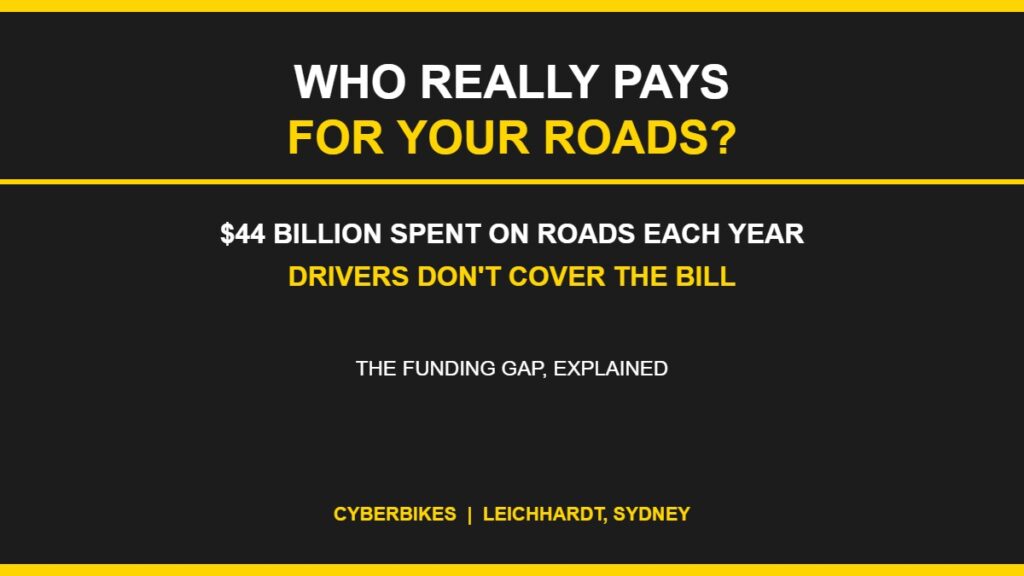
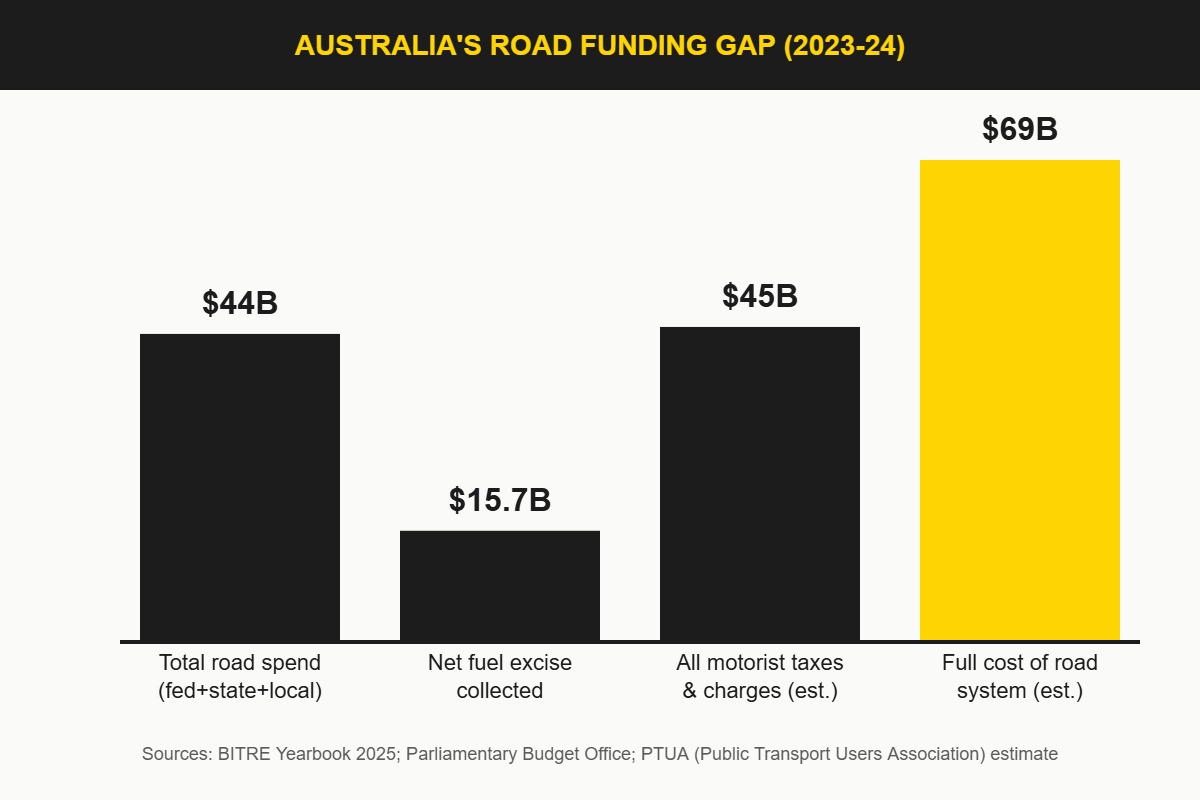
No — not even close. Australia’s governments spent roughly $44 billion on roads in 2023–24, while net fuel excise — the closest thing drivers pay to a dedicated “road tax” — brought in only around $15.7 billion nationally. Even counting every fee motorists pay (excise, registration, tolls, stamp duty), independent transport-funding analysis puts the true annual cost of Australia’s road system at $69 billion or more once safety, health and congestion costs are included — leaving a shortfall that ordinary taxpayers, not just drivers, end up covering. For a car-dependent city like Sydney, that gap matters more than it sounds.
How Much Does Australia Actually Spend on Roads Each Year?
According to the Bureau of Infrastructure and Transport Research Economics’ Australian Infrastructure and Transport Statistics Yearbook 2025, the public sector — federal, state and local governments combined — spent about $44 billion on roads in 2023–24. That figure covers construction, maintenance and resurfacing on everything from the M4 and Parramatta Road to the residential streets around Leichhardt that the Inner West Council maintains out of general rates.
Road widening is a big part of where that money goes. Transport for NSW’s “Magnificent Seven” program alone plans to widen 76.5km of arterial roads across South West Sydney, and the Westlink M7 upgrade is adding a lane in each direction between Prestons and Oakhurst. History suggests it won’t hold: economists Gilles Duranton and Matthew Turner’s landmark 2011 study found that a 1% increase in a city’s road capacity produces a roughly 1% increase in vehicle-kilometres travelled — the “induced demand” effect that fills new lanes within a few years of them opening.
How Much Do Drivers Actually Pay Toward That Bill?
Not as much as the “motorists already pay their way” argument assumes. Federal fuel excise sat at 52.6 cents a litre from February 2026, and Australia’s Parliamentary Budget Office estimates net fuel excise revenue at around $15.7 billion in 2023–24. Crucially, that money isn’t ring-fenced for roads at all — the formal link between fuel excise and road funding was scrapped in 1992, and the excise now flows into general government revenue alongside income tax and GST.
Layer in every other charge a driver pays — registration, licence fees, tolls, stamp duty on new cars — and the Public Transport Users Association’s widely cited “road deficit” analysis puts total motorist contributions at around $45 billion a year. Measured against its $69 billion-plus estimate of the full annual cost of the road system (direct spending plus crash, health and congestion costs), that leaves a shortfall of at least $24 billion a year — covered by general income tax revenue and council rates paid by drivers and non-drivers alike. Put simply: on the most generous measure, drivers cover at most about two-thirds of what roads actually cost. Industry groups dispute exactly how that “full cost” should be calculated, but even the narrower comparison — $44 billion spent against $15.7 billion in dedicated fuel excise — shows the gap is real.
| What the numbers show (2023–24) | Amount |
|---|---|
| Total public road spending (federal + state + local) | ~$44 billion/yr |
| Net fuel excise collected nationally | ~$15.7 billion/yr |
| All motorist taxes & charges combined (est.) | ~$45 billion/yr |
| Full cost of the road system, incl. externalities (est.) | $69 billion+/yr |
Why Is the 2026 EV Road-Charge Debate Reopening This Question?
Electric vehicles pay no fuel excise at all, and as EV uptake grows, that dents the fuel-tax pool further. The Australian Automobile Association has been pushing for a distance-based road-user charge to replace excise from the 2027 Federal Budget, while the Grattan Institute has warned governments to “charge smartly” rather than bolt on an ad-hoc EV tax. Treasurers are actively weighing options in 2026 — proof that even policymakers agree the current system, where fuel excise funds a shrinking share of a growing road bill, isn’t sustainable. None of this is an EV problem specifically; it’s the same funding gap petrol and diesel cars have quietly run for years, just becoming impossible to ignore.
What Does the Funding Gap Mean for How Sydney Gets Around?
It means Sydney’s car dependency is subsidised well beyond what shows up at the bowser or the rego renewal. Every ratepayer — including the household that has never owned a car — is helping cover a road network sized for peak-hour car traffic, on top of the billions Sydney already loses to congestion each year. Meanwhile, a bike lane costs a fraction of a traffic lane to build and maintain, and moves more people per hour once you account for its far lower cost per commuter.
This is exactly the calculation behind Cyberbikes’ push to get more Sydneysiders onto e-bikes for everyday trips. The current Centauro, for example, runs on a 250W rear hub motor with a 48V 25Ah (1200Wh) Samsung battery, UL 2271-certified, with an ISO 4210 frame, in a bike that costs a rounding error to run compared with a car — no excise, no rego, no share of a $24 billion shortfall. If you want the full picture on switching a daily car trip to an e-bike, our complete guide to going car-free in Sydney with an e-bike and rent-to-own walks through the real numbers. You can see the current Centauro specs and pricing on the Centauro product page.
If you’re curious what swapping even one car trip a week for an e-bike ride would do to your own numbers, come see us at Cyberbikes, 281 Parramatta Road, Leichhardt — it’s a smaller bill than most people expect.
Frequently Asked Questions
Do fuel excise and registration cover the full cost of Australia’s roads?
No. Australia’s governments spent about $44 billion on roads in 2023–24, while net fuel excise raised around $15.7 billion nationally, and fuel excise has not been formally tied to road funding since 1992. Even counting every tax and fee motorists pay, analysis from the Public Transport Users Association estimates total motorist contributions at around $45 billion against a full road-system cost of $69 billion or more — a shortfall covered by general taxpayers.
Why don’t electric vehicles pay fuel excise, and what is a road-user charge?
Fuel excise is charged per litre of petrol or diesel sold, so EVs don’t pay it because they don’t buy fuel. A road-user charge would instead bill drivers per kilometre travelled, regardless of what powers the vehicle. The Australian Automobile Association has called for this to start by the 2027 Federal Budget, and the Grattan Institute has urged governments to design it carefully so it applies fairly across all vehicle types.
How does this funding gap relate to e-bikes and cycling in Sydney?
Bike lanes cost far less to build and maintain than traffic lanes and don’t come with the same road-damage or congestion costs cars generate. Since e-bikes pay no fuel excise or registration and cause negligible wear on road surfaces, every trip shifted from a car to an e-bike reduces pressure on a road budget that already doesn’t break even.
#SydneyEbikes #CarFreeSydney #Leichhardt #RoadFunding #EbikeCommute #CyberbikesAU