Your e-bike loses power on a steep hill because three limits stack up at once: the controller caps how many amps it will push, the battery voltage sags under heavy load, and the motor heats up and starts protecting itself. None of these usually means your bike is broken — it is physics doing exactly what it should. Below we break down each limit in plain English, with the real engineering behind it, so you know when a bog-down is normal and when it is worth a service at Cyberbikes in Leichhardt.
A motor doesn’t have a fixed “power” it produces the moment you switch it on. As the Grin Technologies engineers at ebikes.ca put it, the output depends entirely on how hard the motor is loaded and the maximum electrical power the controller allows through. Point the bike up a 10% grade and the load jumps — and the powertrain answers to whichever limit it hits first.
The short answer: three limits that cap your hill power
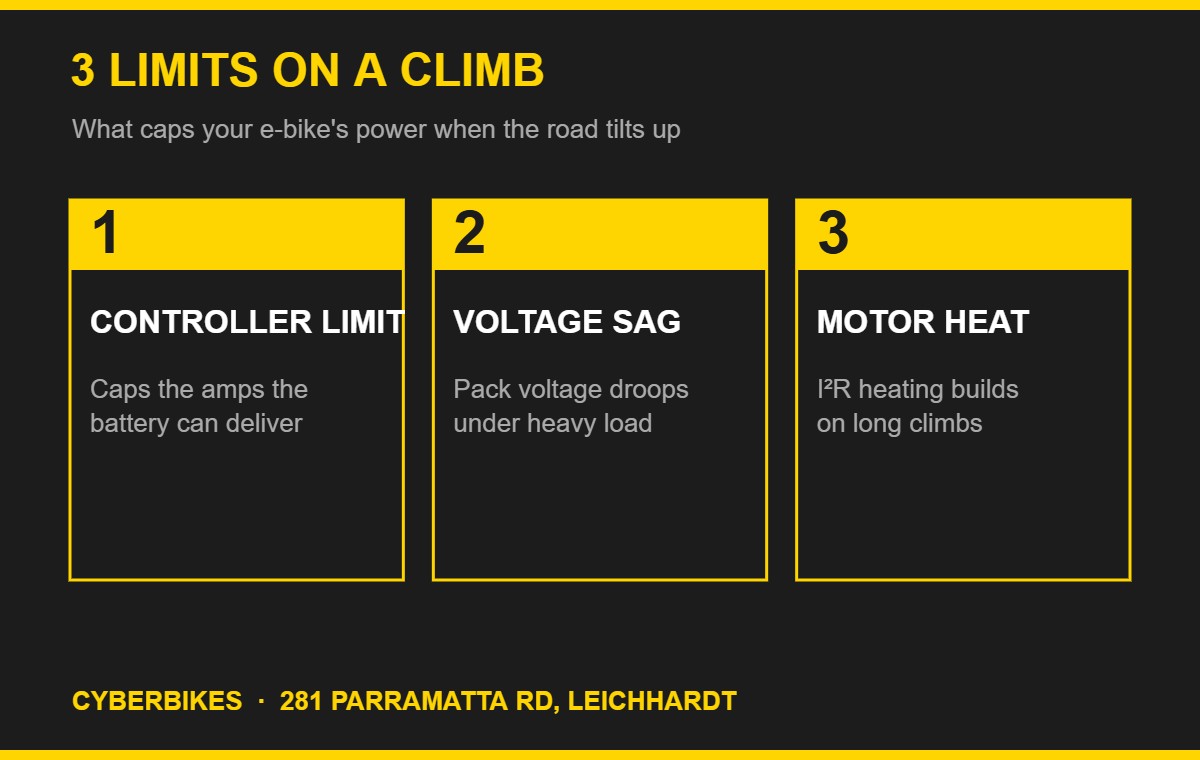
When your electric bike slows on a climb, one (or all) of these is happening. Here is the quick version before we dig into each.
| Limit | What’s happening | What you feel |
|---|---|---|
| Controller current limit | The controller clamps battery amps at its ceiling | Steady but capped power; bike settles to a speed |
| Voltage sag | Pack voltage droops under high current draw | Power fades; on a low battery it can cut out |
| Thermal rollback | Windings heat up on a long climb (the I²R effect) | Strong at first, weaker after several minutes |
Limit 1: Your controller’s current ceiling
The single biggest cap on hill power is the motor controller’s battery-current limit. On a climb your motor slows down, which lets it draw more current to make more torque — but only up to the number the controller is programmed to allow. As ebikes.ca explains, the peak output power of an e-bike happens right at the point where the controller hits its battery-current limit. Below that speed the controller is “current-limited”: the electrical input power (volts × amps, the figure a display shows) stays roughly constant while the motor’s actual mechanical output drops, because a slower motor is less efficient.
The practical takeaway is blunt: if a hill demands 600 watts to hold your speed and your setup can only deliver 300, the bike simply slows until 300 watts is enough. A watt is a watt no matter where it comes from — your legs make up the rest, or you go slower. That is why the amp rating of the controller matters as much as the motor sticker. If you want the full breakdown of that number, our guide to what an e-bike controller actually does walks through it.
Limit 2: Voltage sag — why the battery “droops” under load
Every battery has internal resistance, so the moment you pull a big current the voltage at the terminals drops. This is just Ohm’s law: the sag equals current multiplied by internal resistance (V = I × R). Cruise on the flat drawing 5 amps and a healthy 48V pack barely moves; hammer up a hill pulling 25–30 amps and that same pack can sag by several volts. Less voltage means less available power, so the bike feels like it is running out of puff right when you need it most.
Two things make sag worse: a low state of charge (a near-empty pack sags much harder than a full one) and cold weather, which raises internal resistance. If the sagging voltage dips below the battery management system’s low-voltage cutoff, the BMS shuts output off entirely to protect the cells — that is the classic “my e-bike cut out halfway up the hill” story. It is not a fault; it is the safety system doing its job. Keeping your pack charged and healthy is the fix, and our definitive guide to e-bike batteries covers how to keep sag low for longer.
Limit 3: Heat and the I²R problem on long climbs
Here is the piece of engineering most riders miss: it is the motor’s torque, not its power, that generates heat — and heat is what eventually cooks a motor. When you push more current through the copper windings to climb harder, the heat generated rises with the square of the current. Double the current for double the torque, and ebikes.ca notes you create four times the copper heat (the I²R relationship). That heat builds fast on a sustained climb.
The saving grace is time. A hub motor is a big lump of metal and takes a surprisingly long while — often one to two hours — to reach a steady-state temperature, while most real-world steep climbs are over in five to ten minutes. That is exactly why motors can safely handle far more power for a short burst than they can sustain forever, and that short burst is usually all you need to crest a hill. Drag the climb out too long, though (think a fully loaded cargo run up a long grade in summer heat), and the windings can pass 150–180°C, where enamel, nylon gears and magnets start to suffer. Many quality e-bikes will quietly reduce power before that point to protect themselves. If yours loses grunt on the same long hill every time and recovers once cool, that is thermal rollback, not a broken motor — and our explainer on why e-bike motors overheat goes deeper.
So would a bigger motor fix it?
Not the way most people expect. Because peak power is set mostly by the controller and battery — not the motor casting — the honest comparison is between what you change. ebikes.ca ran the exact same motor three ways, and the numbers are revealing:
| Same motor, different setup | Peak output | How it feels |
|---|---|---|
| 36V battery, 20A controller | ~600 W | Baseline |
| 36V battery, 40A controller | ~1058 W | Punchier off the line and on steep climbs |
| 52V battery, 20A controller | ~840 W | Slower launch, higher top speed, climbs faster overall |
More controller current buys low-speed punch and hill-climbing torque; more battery voltage buys higher cruising and climbing speed. The motor itself changes surprisingly little. For a legal path to more usable climb, see our breakdown of continuous vs peak power and what e-bike watts really mean. Just remember any change has to stay inside NSW law — more on that below.
What actually helps you climb better
You can’t rewrite physics, but you can stop fighting it. In our experience fitting and servicing e-bikes here in Sydney’s Inner West, these make the biggest difference on hills:
- Shift down and spin. Keep your cadence up so the motor stays in its efficient, cooler zone. Lugging a high gear at low RPM is where motors heat up and bog.
- Don’t crawl a long climb on throttle alone. Pedalling adds real watts and takes load off the motor, cutting current draw and heat.
- Keep the pack charged and healthy. A fuller battery sags less, so more of your power survives the hill.
- Mind tyre pressure and total load. Soft tyres and extra cargo raise the watts a grade demands.
- Model it before you buy. The free ebikes.ca motor simulator shows the exact output power and overheating risk for any motor, controller and battery combo across the whole speed range.
This is also where a well-matched bike beats a big number on a sticker. The Cyberbikes Centauro pairs a 250W rear hub motor with a 48V 25Ah (1200Wh) Samsung battery — a large, low-sag pack that holds its voltage on Sydney’s climbs — and carries a combined rider-and-cargo load up to 150kg. It is built to the UL 2849 e-bike-system and UL 2271 battery standards, plus ISO 4210 for the frame.
Is it normal, or should you get it checked?
In NSW, a road-legal e-bike is a pedal-assist “pedalec” capped at 250W continuous rated power with assistance cutting out at 25 km/h (throttle-only assist is limited to 6 km/h). Within those limits, a 250W bike is deliberately tuned for steady, sustainable help rather than motorbike-like surges — so a smooth slow-down on a very steep pinch is expected, not a defect. The Centauro, for example, is designed to comply with exactly those NSW power and speed rules.
Book a service, though, if the behaviour is new or getting worse: sudden hard cut-outs on a half-full battery, a big drop in range alongside the power loss, unusual heat or a burning smell from the motor, or error codes on the display. Those point to a tired battery, a sensor or controller fault, or a connector problem rather than plain physics — and they are exactly what our workshop diagnoses.
Watch: your e-bike’s real power, in numbers that matter
Understanding watts, amps and voltage also demystifies what an e-bike really costs to run. In this short Cyberbikes video we translate e-bike energy into the kilowatt-hour figures nobody shows you at the petrol pump.
Frequently Asked Questions
Why does my e-bike slow down going uphill even at full power?
Because a hill demands more power to hold speed than your controller and battery can supply. The controller caps battery current, so once you hit that ceiling the motor can’t make extra torque — the bike settles to whatever speed needs only the power available. It is normal physics, not a fault.
Why does my e-bike cut out completely on steep hills?
A full cut-out usually means voltage sag has dropped the pack below the battery management system’s low-voltage cutoff, so the BMS shuts output off to protect the cells. It is most common on a low or cold battery. Charge the pack; if it keeps happening on a half-full battery, have the battery checked.
Does a higher-wattage motor climb hills better?
Only partly. Peak power is set mostly by the controller’s current limit and the battery voltage, not the motor casting. More controller current gives low-speed hill punch; more voltage gives higher climbing speed. A well-matched 250W system with a strong battery often out-climbs a poorly matched bike with a bigger number on the sticker.
Ride the hills with a bike that’s matched, not just marketed
Power on a climb is a system, not a sticker — controller, battery and motor working together. Come in for a test ride at Cyberbikes, 281 Parramatta Road, Leichhardt, and feel how a properly matched 250W setup like the Centauro handles Sydney’s grades. Call us on 0491 794 668 or visit Tuesday–Saturday, and ask about our rent-to-own plans from $99/week.
#Cyberbikes #ebikeSydney #electricbikeLeichhardt #CentauroEbike #ebikePower #hillclimbing #ebiketech #Sydneycycling