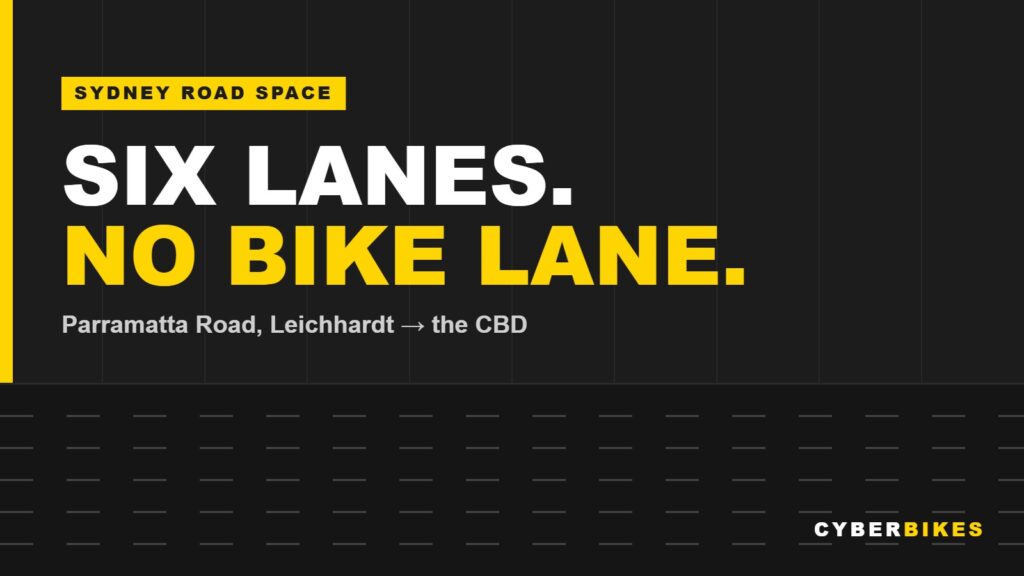
In 2020 the Committee for Sydney looked at Parramatta Road and recommended, in plain words, a complete separated bike path along the corridor. Six years later there still isn’t one. The two lanes WestConnex’s approval conditions required be converted between Burwood and Haberfield did get converted — into T3 transit lanes that operate 6am–10am and 3pm–7pm on weekdays only. Bikes are allowed to use them. That is the entire Parramatta Road bike lane: a part-time lane you share with buses and three-person carpools, on one section of road, for about 20 hours a week.
We sell e-bikes at 281 Parramatta Road, Leichhardt. We watch this road all day, so this one is personal.
So what did WestConnex actually free up?
The deal was always sold the same way: build the motorway, take the through-traffic off the surface road, hand the space back to the suburbs it runs through. The approval conditions put part of that in writing — a requirement to convert two lanes between Burwood and Haberfield, as Inner West Council’s own Parramatta Road Transport Study records.
Transport for NSW delivered it. Its T3 transit lanes project page, reviewed in July 2026, lists the work as complete between Burwood Road and Bland Street, Haberfield, both directions, 6am–10am and 3pm–7pm Monday to Friday. Bicycles may use a T3 lane. The page describes no dedicated cycling infrastructure, because none was built.
Here is the part that should bother anyone who sat through a decade of construction: the same study notes that WestConnex’s own business case expected 2031 traffic on the Inner West sections to be similar to 2012 volumes. The motorway was never modelled to empty this road. Space only comes back if someone reallocates it.
Why isn’t a part-time transit lane a bike lane?
Because a lane that exists 20 hours out of 168 is not infrastructure, it’s a timetable. Outside those windows it reverts to general traffic and kerbside parking, so the space you rode in at 9:55am is a queue of parked cars at 10:05am. Networks run on certainty, and “you may ride here, during these hours, if nobody has stopped in it” is the opposite of it.
It also doesn’t change what the road physically is. The Committee for Sydney’s Reclaiming Parramatta Road report describes a typical section as six lanes with a centre median, widening to eight or nine at Broadway, and footpaths only about 3 metres wide; Bicycle NSW counts seven lanes on the stretches it has looked at. Against that, riders get nothing permanent — and the council’s own study says flatly that there is no safe cycling opportunity along Parramatta Road, with the corridor still mapped as “proposed” on both sides of the strategic bicycle network.
Proposed. In a plan. That is where the Parramatta Road bike lane lives.
What is six lanes of car space actually buying the Inner West?
Not speed, which is the joke at the centre of all this. The Committee for Sydney found the corridor’s average bus speed is 14 km/h against a best-practice benchmark of 25–30 km/h, with general traffic averaging under 20 km/h and a 10 km bus trip from Burwood North to the CBD taking over 40 minutes. Infrastructure Australia’s 2019 audit ranked the road among the ten most congested in the country.
Not prosperity either. The same report found two in every three shops along the corridor closed or vacant before COVID, on a road within walking distance of 300,000 people. A high street with that many people beside it doesn’t fail by accident. It fails when the design assumes everyone is passing through at 60 km/h and nobody is arriving.
This is a design and funding problem — lane allocation, speed limits, signal phasing, business cases that score travel time and ignore whether a place is worth stopping in. It is not a problem with the people driving on it, most of whom have been handed no alternative that works.
Does the Inner West’s own mode-shift target survive without one?
Inner West Council’s planning work puts private car mode share at 79% in 2019, with a minimum target of 71% by 2036, while the corridor strategy proposes a 30% shift away from private car use across its precincts. You do not move eight percentage points of trips by asking nicely. You move them by building the thing that makes the alternative obviously faster.
Bicycle NSW puts the return on active travel investment at between 5:1 and 39.5:1 per dollar, while NSW directs about 0.2% of its budget to it. Those two numbers side by side explain more about Sydney’s streets than any amount of congestion commentary. Our guide to car-free commuting in Sydney by e-bike runs the numbers for a real trip, and we’ve looked at who actually decides how Sydney divides its road space.
What do you ride in the meantime?
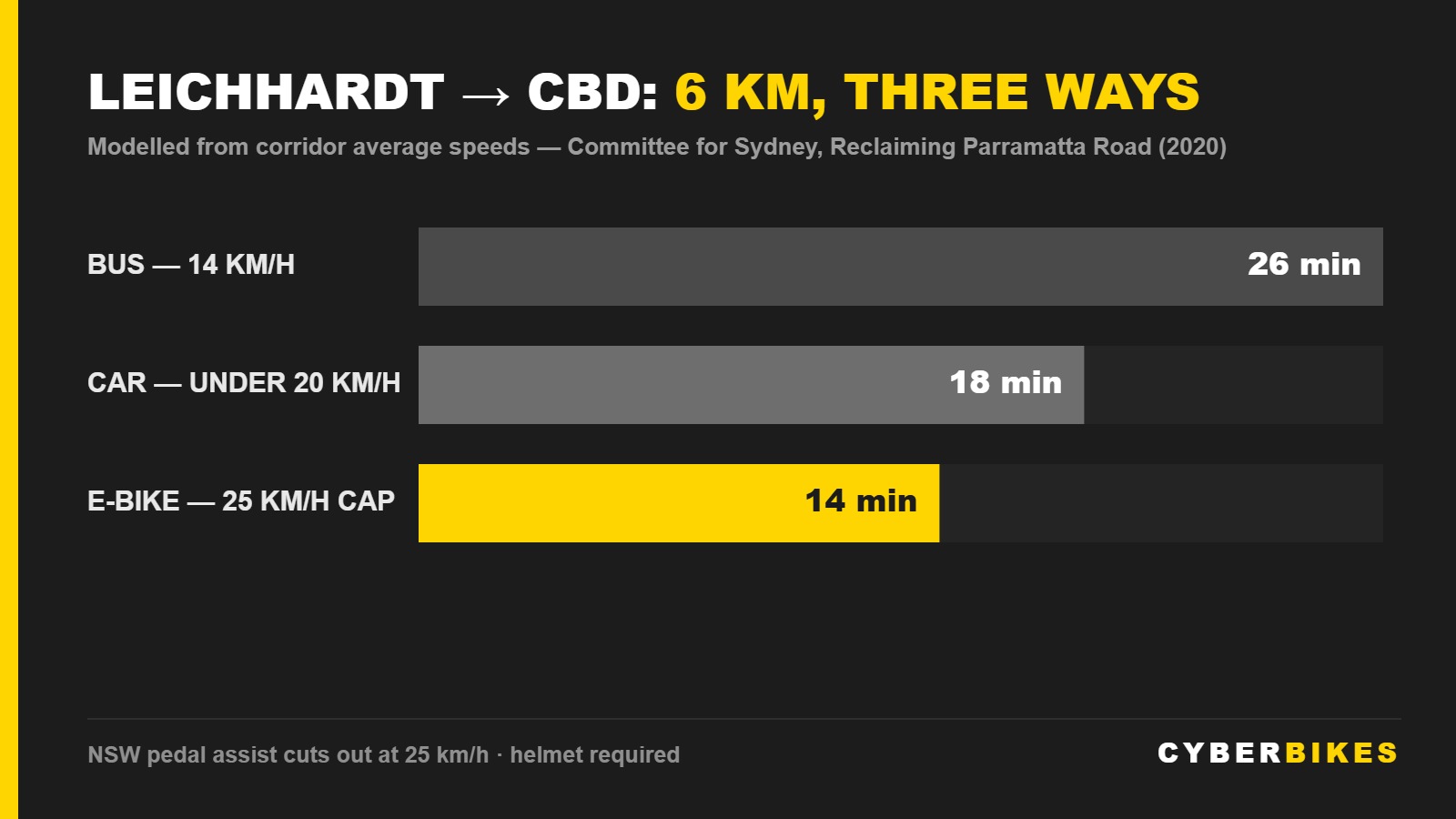
You ride beside it. The GreenWay opened on 14 December 2025 and runs about 6 km of separated path between Iron Cove and the Cooks River at Earlwood, roughly parallel to the corridor, linking to the 7 km Bay Run loop. For a Leichhardt-to-CBD trip of around 6 km, the corridor’s own average speeds put the bus at about 26 minutes, driving at around 18, and an e-bike held to the legal assist cap at roughly 14 — on a vehicle that parks in a doorway.
Worth knowing before you buy: Transport for NSW’s e-bike page caps an electrically power-assisted cycle at a maximum continued rated power of 500 watts, with power cut off at 25 km/h, and states that powered bicycles not meeting those requirements are illegal. Helmets are mandatory for every rider in NSW. Our complete guide to e-bike laws in NSW and Australia has the detail.
The bike we build for exactly this trip is the Cyberbikes Centauro — a full-suspension step-through with a 250W rear hub motor, a 48V 25Ah Samsung battery (about 1,200 Wh), hydraulic brakes, a welded rear rack and integrated GPS tracking. On Parramatta Road’s surface, full suspension is not a luxury. It’s a survival feature.
Frequently asked questions
Is there a bike lane on Parramatta Road?
No. There is no separated or dedicated cycleway on Parramatta Road. Between Burwood Road and Bland Street, Haberfield there are T3 transit lanes that bicycles may use, operating 6am–10am and 3pm–7pm on weekdays. Inner West Council’s Parramatta Road Transport Study states there is no safe cycling opportunity along the corridor, which is still mapped only as a proposed route.
Didn’t WestConnex promise to take traffic off Parramatta Road?
Its approval conditions required two lanes between Burwood and Haberfield to be converted, and Transport for NSW delivered that as part-time T3 transit lanes. But WestConnex’s own strategic business case expected 2031 traffic on the Inner West sections to be similar to 2012 volumes. Road space only changes use if it is deliberately reallocated.
What is the safest way to ride between Leichhardt and the city?
Use the separated routes rather than the corridor itself. The GreenWay, opened 14 December 2025, runs about 6 km between Iron Cove and the Cooks River at Earlwood and links to the 7 km Bay Run loop, giving traffic-separated riding for most of an inner-west trip.
If you’re ready to be part of a car-lighter Sydney, come see us at Cyberbikes, 281 Parramatta Road, Leichhardt — the shop on the six-lane road, arguing for fewer of them.
#ParramattaRoad #SydneyCycling #eBikeSydney #Leichhardt #InnerWest #RoadSpace #BikeLanes #Cyberbikes #CarFreeSydney #ActiveTransport