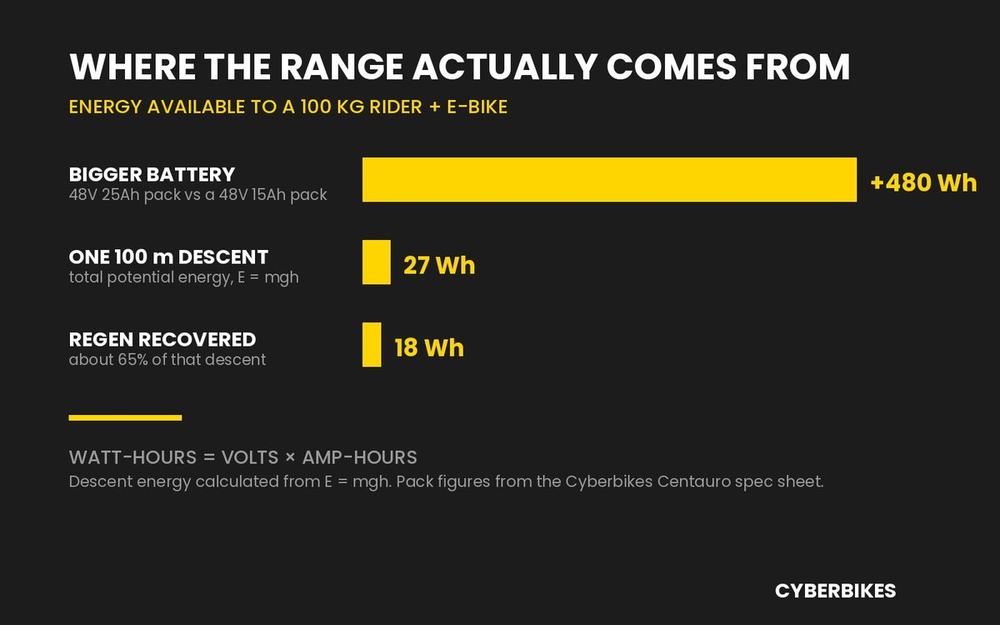
For e-bike range, a bigger battery wins, and it is not close. Regenerative braking on an e-bike typically hands back only a few watt-hours per descent — roughly 18 Wh from a 100 m hill for a 100 kg rider-and-bike — while stepping from a 48V 15Ah pack to a 48V 25Ah pack adds 480 Wh. That is more than 25 times the energy. If range is the problem you are solving, regen is a nice feature; watt-hours are the actual answer.
That said, regen is not a gimmick. It does real work on long descents, it saves brake pads, and it changes how a heavy bike feels coming down a hill. It just does not do what most product pages imply it does. Here is the engineering, with the numbers, the way we explain it on the workshop floor at Cyberbikes Leichhardt.
What is regenerative braking on an e-bike?
Regenerative braking uses the motor as a generator. When you brake normally, your kinetic and potential energy is converted into heat in the brake rotors and thrown away. With regen, the controller reverses the flow: the spinning wheel drives the motor, the motor pushes current back through the controller, and some of that energy lands in the battery instead of the atmosphere. As Grin Technologies explains on its regen page, the system “captures this braking energy and puts it back into the battery pack, rather than burning it all off as heat”.
Two things have to be true for that to happen. The motor has to be mechanically connected to the wheel in both directions, and the controller has to be built to accept reverse current. Grin is blunt about the second point: regen “does require a motor controller that supports regen, and many budget controllers either don’t or don’t support it very well”. That is why a spec sheet saying “regenerative braking” tells you very little on its own.
Which e-bike motors can actually do regen?
Only some. According to Grin, regen “is available on any system with a direct drive hub motor or a geared hub motor that doesn’t freewheel (like the GMAC)”. That single sentence rules out most of the e-bikes sold in Australia.
- Direct-drive hub motors — the magnets and windings are permanently coupled to the wheel, so spinning the wheel always spins the generator. Regen works.
- Geared hub motors — almost all of them contain a one-way clutch so the motor does not drag when you pedal unpowered. That clutch is exactly what makes them efficient and quiet, and it is exactly what makes regen impossible. The wheel simply spins without turning the motor.
- Mid-drive motors — they drive through the chain and the freewheel at the rear hub, so the same freewheeling problem applies.
This is the trade-off nobody puts on a poster: the freewheel that makes a geared hub motor light, efficient and pleasant to pedal is the same part that guarantees it will never regenerate a single watt-hour. If you want to see how that clutch works inside the hub, our workshop video below pulls one apart.
How much energy is really in a Sydney descent?
This is where the argument gets settled, because gravity does not negotiate. The potential energy in a descent is E = mgh: mass times gravity times height. Take a 100 kg combined rider and e-bike dropping 100 vertical metres — a solid Sydney hill, more than you will find on most inner-west commutes:
- 100 kg × 9.81 m/s² × 100 m = 98,100 joules
- 98,100 J ÷ 3,600 = 27.2 watt-hours of potential energy in the entire descent
- Assume a generous 65% recovery through motor, controller and battery losses: about 18 Wh actually stored
Eighteen watt-hours. On the 1200Wh pack fitted to our Centauro, that is 1.5% of the battery. At a realistic commuting consumption of 10 Wh/km it buys you under 2 km. And that is the best case, where you actually brake the whole way down rather than letting the bike run.
Why does a bigger battery win on e-bike range?
Because battery capacity is just arithmetic: watt-hours = volts × amp-hours. A 48V 15Ah pack holds 720 Wh. A 48V 25Ah pack holds 1200 Wh. The difference is 480 Wh — at 10 Wh/km, roughly 48 km of extra riding before you think about a charger.
Our 2026 Cyberbikes Centauro runs the larger end of that maths: the product page lists a 48V 25Ah (1200Wh) Samsung lithium-ion battery with a UL 2271-certified pack, a Super 250W rear hub motor, an ISO 4210 MTB-compliant 6061 aluminium frame, and 4-piston hydraulic brakes with 180mm × 2.3mm rotors. Note the last one: proper hydraulics are how you stop a loaded cargo commuter, not regen.
To work out your own numbers, you need your real consumption in Wh/km rather than a brochure range claim. Ours sits between roughly 8 and 15 Wh/km depending on rider weight, tyre pressure, wind and how hard you lean on the throttle. Divide your pack’s watt-hours by that figure and you have an honest range estimate. If you want the full picture on capacity, cells and degradation, our definitive guide to e-bike batteries goes through it properly.
So is regen worth anything at all?
Yes — just not as a range strategy. Judge it on braking, not on charging.
- Brake wear. On a long, steep descent the motor is taking load off your pads and rotors. For a heavy cargo bike carrying a child and a week of shopping, that is a genuine maintenance saving.
- Speed control. Regen gives smooth, modulated drag rather than on-off pad bite. Grin’s controllers let you set it up several ways, including e-brake levers, throttle modulation and a speed-limit governor that holds a descent at a set speed.
- Heat management. Motor heating follows the I²R relationship — as Grin’s power-ratings page puts it, doubling the current quadruples the copper heat. Ten amps gives you a relative heat number of 100; twenty amps gives you 400. Regen currents are usually modest, so this is rarely the limiting factor, but it is the same physics that decides whether your motor survives a long climb.
- Stop-start city riding. Every set of lights recovers a sliver. It adds up to a rounding error on range, but it is free.
What regen will not do is rescue a small battery. If you are choosing between a regen-capable direct-drive hub with a 720 Wh pack and a geared hub with 1200 Wh, the geared bike gets you home and the direct-drive bike does not. Grin’s own motor simulator makes the mechanism visible: with a direct-drive motor it shows negative torque and negative battery current once wheel speed exceeds the unloaded motor speed, while geared motors simply display freewheeling. The same tool models thermal behaviour to a 150°C threshold and reports consumption in Wh/km — which is, once again, the number that decides your range.
Does any of this change what is legal in NSW?
Regen itself is not regulated, but the motor it requires is. Read the current rules straight from Transport for NSW rather than from an older blog post, because the numbers changed:
- 500 watts maximum continuous rated power today, dropping to a maximum of 250W from 1 March 2029, when only EN 15194 certified e-bikes will be allowed on NSW roads.
- Pedal assistance must stop at 25 km/h; throttle-only operation must cut out at 6 km/h.
- Transport for NSW is explicit that bikes exceeding those limits “are illegal, even if the power or speed is restricted by software”. Seizure and crushing laws took effect on 21 August 2026.
- An approved helmet, securely fitted and fastened, is mandatory.
The practical consequence: a big direct-drive hub chosen purely to unlock regen can push a bike out of the legal envelope. A compliant motor plus a large legal battery is the combination that gives you distance without giving you a problem. If you want the deeper background on drive systems, we cover it in how e-bikes actually work: motors, sensors and controllers.
Frequently Asked Questions
How much range does regenerative braking add to an e-bike?
Very little. A 100 m descent for a 100 kg rider and bike contains 27.2 Wh of potential energy (E = mgh), and a realistic 65% recovery stores about 18 Wh. At 10 Wh/km that is under 2 km of extra range, or roughly 1.5% of a 1200Wh battery.
Can a geared hub motor do regenerative braking?
Almost never. Grin Technologies states regen is available on a direct drive hub motor or a geared hub motor that does not freewheel. Nearly all geared hub motors use a one-way clutch so the motor does not drag while you pedal, and that clutch prevents the wheel from driving the motor as a generator.
Is a bigger e-bike battery better than regenerative braking?
For range, yes. Watt-hours equal volts times amp-hours, so moving from a 48V 15Ah pack (720 Wh) to a 48V 25Ah pack (1200 Wh) adds 480 Wh — about 48 km at 10 Wh/km. That is more than 25 times what a typical regen descent returns.
Come and ride the maths
Spec sheets argue. Hills do not. Book a test ride at Cyberbikes Leichhardt, 281 Parramatta Road, bring the hill you actually have to climb, and we will show you the watt-hour figures on the display instead of asking you to trust a brochure. Call 0491 794 668, Tue–Sat, or take a look at the Centauro with the 1200Wh Samsung pack first.
#Cyberbikes #EbikeSydney #ElectricBikeLeichhardt #EbikeRange #RegenBraking #CentauroEbike #EbikeBattery #SydneyCommute #EbikeTech