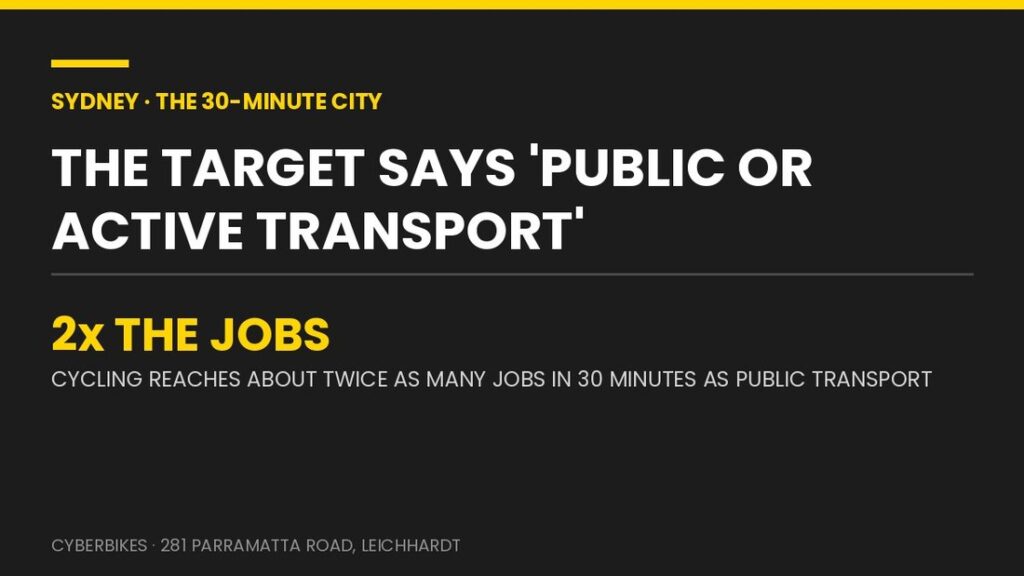
Yes — Sydney’s 30-minute city already exists for far more people than the train timetable suggests, and the official target says so out loud. Transport for NSW defines it as a city where people “can conveniently access jobs and services within 30 minutes by public or active transport, 7 days a week”. Active transport is written into the goal. And in all eight Australian capitals, people cycling reach about twice as many jobs within 30 minutes as people on public transport, according to the Access Across Australia analysis reported by The Conversation.
Read that again, because it reframes a decade of planning debate. We argue about whether the 30-minute city is achievable as if it depends on tunnels opening in 2032. For a big slice of Sydney, the tool that delivers it is already in the shed.
What does Sydney’s 30-minute city actually promise?
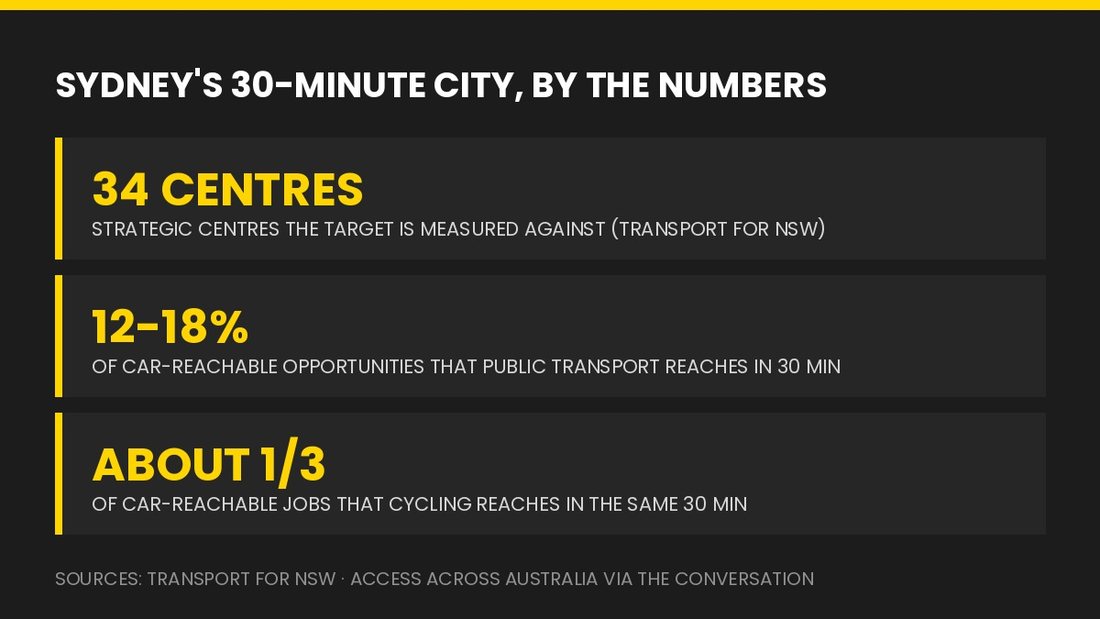
It is not a slogan; it is a measured target. The Transport for NSW Thirty Minute City and Metro Strategic Centre Catchments dataset defines the catchments against 34 strategic centres across Greater Sydney — 8 metro centres or clusters such as the Harbour CBD, Greater Parramatta and Liverpool, plus 26 strategic centres including Bankstown, Chatswood, Manly and Randwick.
Two details in that definition get quietly ignored. The first is “or active transport”. The second is “7 days a week” — a Tuesday-morning commute standard is not the test; a Sunday afternoon with a timetable running every 30 minutes is.
Why doesn’t public transport deliver it on its own?
Because Sydney’s network is radial, and most trips aren’t. The same Access Across Australia work found that public transport “reaches between 12% and 18% of the urban opportunities accessible by car under a 30-minute threshold”. Cycling, by contrast, reaches around one-third of the car-accessible opportunities in the same half hour.
This is not a failure of the people running the trains. It is geometry. Rail is superb along one corridor and useless across three — which describes most school, shopping and childcare trips in a spread-out city. Live between two lines and “30 minutes” means a line plus a wait plus a bus plus a walk. On a Sunday, the wait is what kills it.
How far does an e-bike really get you in 30 minutes?
Do the arithmetic rather than guessing. Under Transport for NSW e-bike rules, a legal pedal-assist e-bike has a maximum continuous rated power of 500 watts and the motor stops assisting above 25 km/h, with throttle-only power cutting out at 6 km/h. From 1 March 2029, only EN 15194 certified e-bikes will be allowed on NSW roads, and a bike above those limits is illegal even if an app restricts it. Helmets are mandatory.
Assist tops out at 25 km/h, but nobody averages that door to door. Lights, corners and shared paths pull a realistic average down to roughly 18–20 km/h. Thirty minutes at that pace is about 9 to 10 kilometres — and unlike the train, it is 9 to 10 kilometres in every direction, at 7pm, on a Sunday, with no timetable and no transfer.
From our shop on Parramatta Road, that radius takes in the Harbour CBD and a wide sweep of the inner and middle-ring suburbs. The same circle drawn from a station gets thin fast once you subtract the walk at each end and the wait in the middle. That is the entire argument, and it is why our car-free Sydney e-bike commuting and rent-to-own guide starts with a map rather than a spec sheet.
So what is actually stopping Sydney’s 30-minute city?
Not the vehicle. Three system failures, none of which are about individual choices.
- The target counts active transport; the budget doesn’t. A goal measured on bikes and feet is chased almost entirely with road and rail capital. If cycling doubles the 30-minute reach of public transport, funding it at a fraction of the rate is a strange way to hit your own indicator.
- The network is built in disconnected pieces. Sydney’s separated cycleways are good where they exist and then stop. A 9 km trip that is protected for 7 km and hostile for 2 km is priced by most people as a 0 km trip.
- Destinations are designed for parking, not arriving. Strategic centres are ringed with car parking and offer little secure bike parking or end-of-trip space. You can build the catchment and still fail the last 100 metres.
Fix the speeds, fill the gaps, add somewhere to lock up, and the catchment map changes without a single tunnel being dug. It is the cheapest accessibility upgrade this city has, sitting unclaimed.
Is an e-bike enough bike for a 30-minute Sydney trip?
For a 9–10 km trip carrying real cargo, yes. The Centauro full-suspension step-through e-bike product page lists a 150 kg maximum rider and cargo load, a rear rack rated to carry 50 kg, an optional front basket rated to carry 15 kg, a 48V 25Ah (1200Wh) Samsung lithium-ion battery and 4-piston hydraulic brakes with 180mm x 2.3mm rotors, along with UL 2849, UL 2271, ISO 4210 and EN 15194 and an 18-month limited warranty. On a 1200Wh pack, a 10 km each-way trip is not a range question — it is a parking question. For the legal detail on what you can ride and where, our complete guide to e-bike laws in NSW and Australia covers it.
We hear the same sentence at the Leichhardt shop most weeks: “I didn’t realise that was only 20 minutes.” The distance was never the barrier. The mental map was.
Frequently asked questions about Sydney’s 30-minute city
What is Sydney’s 30-minute city target?
Transport for NSW defines the 30-minute city as one where people can conveniently access jobs and services within 30 minutes by public or active transport, seven days a week. The catchments are measured against 34 strategic centres across Greater Sydney, including 8 metro centres or clusters such as the Harbour CBD, Greater Parramatta and Liverpool.
Does cycling reach more of Sydney than public transport in 30 minutes?
Yes. The Access Across Australia analysis found that people cycling can reach about twice as many jobs within 30 minutes as people using public transport, in all eight Australian capital cities, and around one-third of the job opportunities reachable by car in the same time.
How far can you travel in 30 minutes on an e-bike in Sydney?
NSW law caps motor assistance at 25 km/h, and a realistic door-to-door average including traffic lights and shared paths is closer to 18 to 20 km/h. That puts a 30-minute e-bike trip at roughly 9 to 10 kilometres in any direction, without a timetable or a transfer.
Sydney set itself a target that explicitly counts bikes, then kept measuring its progress in tunnels. The 30-minute city is not waiting on a ribbon-cutting. For a lot of us it is waiting on about two kilometres of missing paint and concrete.
If you’re ready to be part of a car-lighter Sydney, come see us at Cyberbikes, 281 Parramatta Road, Leichhardt. Bring the trip you think is too far — we’ll measure it with you.
#30MinuteCity #EbikeSydney #Cyberbikes #Leichhardt #SydneyPlanning #ActiveTransport #CarFreeSydney #EbikeCommuting #SydneyTransport #UrbanPlanning