A cadence sensor only measures how fast you spin the pedals and delivers a preset burst of power the moment it detects movement; a torque sensor measures how hard you push and multiplies that effort in real time. In plain terms, a cadence sensor feels like a smart throttle that switches on when you pedal, while a torque sensor feels like your own legs, only stronger. Both are called pedal-assist systems (PAS), both are legal on Sydney roads, and knowing the difference is the single biggest factor in whether a new e-bike feels natural or twitchy under you.
At Cyberbikes in Leichhardt we get asked “torque sensor vs cadence sensor — which is better?” almost every week. The honest answer is it depends on how you ride. Here is how each one actually works, straight from the engineering, and how to pick the right one for your commute.
Torque sensor vs cadence sensor: the short answer
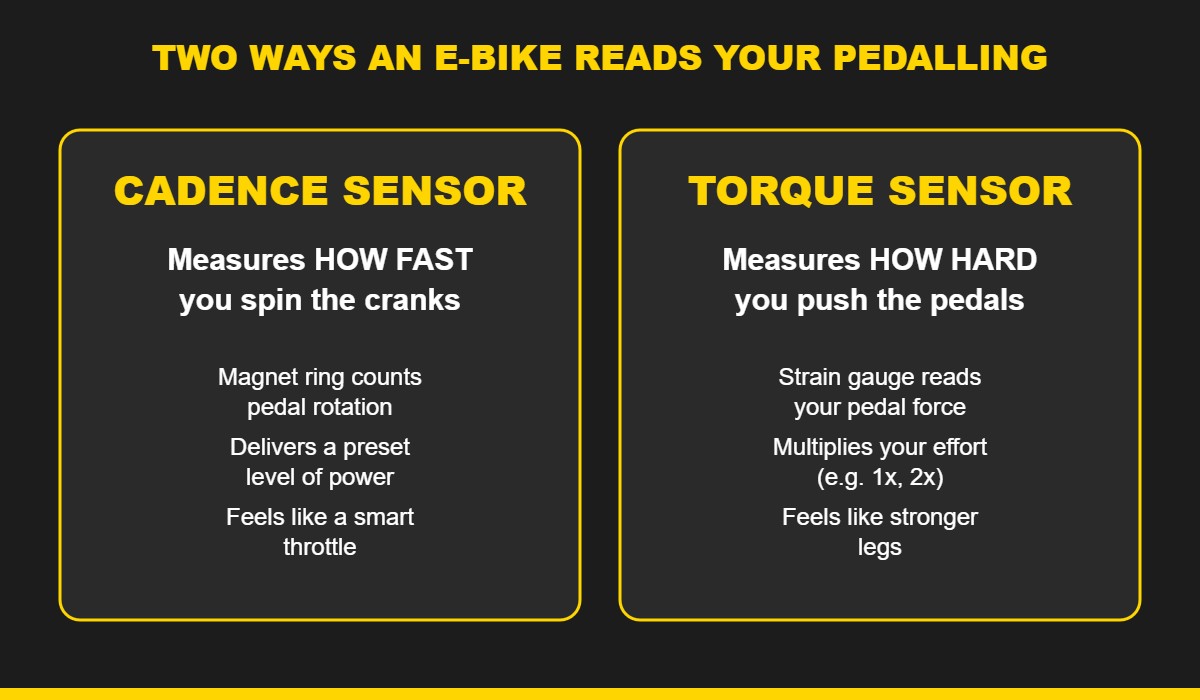
| Cadence (basic PAS) sensor | Torque sensor | |
|---|---|---|
| What it measures | Crank rotation speed only | The force you apply to the pedals |
| How power is delivered | A set power level whenever you pedal | A multiple of your own effort (e.g. 1× or 2×) |
| Feel | On/off, like a throttle you trigger by pedalling | Smooth, proportional, “bionic legs” |
| Best for | Riders who want power independent of effort | Riders who want a natural, bike-like ride |
| Typical cost | Lower | Higher |
How a cadence sensor actually works
A basic PAS (cadence) sensor is beautifully simple. A ring of magnets sits on the crank arm or bottom-bracket spindle, and a fixed sensor counts each magnet as it passes. That tells the controller one thing only: how fast the cranks are turning. It has no idea whether you are pushing hard up a hill or barely resting your feet on the pedals — so it usually just serves a fixed amount of power the instant it sees rotation, up to the bike’s speed limit.
The critical spec here is the number of magnetic poles. According to Grin Technologies’ engineers at ebikes.ca, early sensors had just 5 or 6 magnets, so you had to turn the cranks roughly half a rotation before the motor woke up — and there was a matching lag before it cut out. Today 12 poles is the norm, and 24-pole (or higher) sensors are increasingly common, giving much faster, crisper pedal response. If a cheap e-bike feels laggy or “surgey,” a low-pole cadence sensor is often why.
How a torque sensor actually works
A torque sensor measures the actual force you put through the drivetrain — most commonly via a replacement bottom bracket with internal strain sensing, though the force can also be read at the chainring, the chain, the rear dropout, or even the flex in the rear axle (the approach BionX pioneered). It converts that force into a small analog voltage, typically in a 0–5 volt range, that the controller reads many times a second.
The controller then applies a multiplier: pedal with 100 watts of your own effort at a 1× setting and the motor adds 100 watts; bump it to 2× and every watt you produce is doubled. Pedal harder, get more; ease off, get less. As the ebikes.ca engineers put it, it enables the feeling of a “bionic connection between the bike and the legs.”
Why “watts = torque × cadence” matters
Here is the detail most people miss: a torque sensor almost always includes a cadence signal too. That is not redundancy — it is physics and safety. Your actual power output equals torque multiplied by pedal speed (P = torque × rpm), so the system needs both numbers to know how many watts you are really producing. Just as importantly, if a bike could power up from a torque reading alone, a drifting or mis-calibrated signal could make it lurch forward with no pedalling at all. Requiring pedal rotation as well keeps that from happening. It is the same signal-reading logic that an e-bike motor controller uses to turn those sensor signals into power — worth a read if you want the full chain from pedal to wheel.
Which sensor is better for riding in Sydney?
It genuinely depends on the terrain and the rider. A torque-based system couples motor power directly to your effort, so the ride feels like a normal bicycle: you sweat going up Norton Street’s climbs and coast on the flats. Many riders love that honesty.
But one of the whole points of an e-bike is to decouple effort from terrain — to keep pedalling at one comfortable level whether the road tilts up or down, letting the motor make up the difference. A cadence system with an easy handlebar assist button does exactly that: it gives you throttle-like, independent control of power without holding a throttle all day. For a stop-start inner-west commute with lights every block, that predictability can actually be the nicer ride. This ties directly into whether a 250W motor is powerful enough for Sydney — the sensor decides when those watts arrive, and the motor decides how many.
The engineering details most riders miss
Two things separate a great pedal-assist bike from a mushy one. First, signal quality: Grin’s better cadence sensors use a two-wire “quadrature” signal so the system can tell forward pedalling from backward (important, because rolling the bike backward out of a rack spins the cranks in reverse — you do not want the motor kicking in then).
Second, drivetrain stiffness. A torque sensor has to flex a tiny amount to read force, but if it flexes too much the whole drivetrain feels “squishy,” like your pedals aren’t solidly connected to the wheel. The ebikes.ca benchmark is that with the rear wheel locked, full pedal force should move the end of the crank no more than 5–10 mm. Anything more and the ride quality suffers. These are exactly the things worth feeling for on a test ride.
What this means for your NSW pedelec
In NSW, a legal power-assisted pedal cycle (pedelec) is limited to 250 watts of continuous rated power with assistance that cuts off at 25 km/h (a separate 200 watt category exists for throttle-only “power-assisted” bikes). Both torque and cadence sensors fit inside these rules — the sensor only decides how the assist is delivered, not how much top speed or power you are legally allowed. Whichever system your bike uses, it must stop adding power once you hit 25 km/h. That is the law doing its job, not your sensor failing.
Feel the difference at Cyberbikes Leichhardt
Reading about pedal-assist only gets you so far — the feel is everything, and it is genuinely different bike to bike. Our flagship Cyberbikes Centauro e-bike pairs a 250W rear hub motor with a 48V 25Ah (1200Wh) Samsung battery, full suspension (100 mm front / 120 mm rear), and hydraulic brakes, and it is built to comply with UL 2849, UL 2271, ISO 4210 and EN 15194 standards — with a 150 kg maximum rider-and-cargo load. At $3,999.99 (or rent-to-own from $99.99/week), the best way to understand pedal-assist is to swing a leg over one and feel how it responds when you push.
Here is our full walk-through of the Centauro so you can see the assist in action before you visit:
Come in for a test ride at Cyberbikes, 281 Parramatta Road, Leichhardt — call us on 0491 794 668 or drop by Tuesday to Saturday, and ask us to demo both a cadence and a torque-style assist so you can feel the difference yourself.
Frequently Asked Questions
Is a torque sensor always better than a cadence sensor?
No. A torque sensor gives a more natural, proportional ride that mirrors your own effort, which many riders prefer. But a cadence sensor lets you set a steady power level independent of how hard you pedal, which some commuters find more relaxing in stop-start traffic. The “best” sensor depends on how and where you ride.
How can I tell which sensor my e-bike has?
Pedal very lightly from a standstill. If the motor delivers a fixed surge of power almost regardless of how gently you push, it is likely a cadence (basic PAS) sensor. If the power scales smoothly with how hard you press — a little push gives a little help, a hard push gives a lot — it is a torque sensor. When in doubt, ask the shop or check the spec sheet.
Does the sensor type affect my e-bike’s range?
It can. A torque sensor only adds power in proportion to your effort, so on easy stretches it often draws less from the battery than a cadence system serving a fixed power level. Real-world range still depends far more on rider weight, terrain, tyre pressure, wind and battery capacity (watt-hours) than on sensor type alone.
Sources: Grin Technologies / ebikes.ca pedal-assist theory; NSW e-bike regulations; live Cyberbikes Centauro product specifications.
#Cyberbikes #ebikeSydney #electricbikeLeichhardt #torquesensor #cadencesensor #pedalassist #CentauroEbike #ebiketech