Torque sensor vs cadence sensor is the single biggest reason two e-bikes with the same motor and battery can feel completely different to ride. A torque sensor measures how hard you push on the pedals and scales the motor’s power to your effort, so the bike rides like a stronger version of your own legs. A cadence sensor only detects that the cranks are turning and then feeds in a preset level of assist, giving an effortless, almost throttle-like glide. Neither is universally better — the right choice depends on how, and where, you ride.
What is a cadence sensor and how does it work?
A cadence sensor — often called a basic pedal-assist system, or PAS — is the most common sensor on affordable e-bikes. According to Grin Technologies (ebikes.ca), it usually consists of a ring of small magnets on the crank or bottom-bracket spindle, with a fixed sensor that counts the magnets passing by as you pedal. The electronics only know one thing: how fast the cranks are spinning. They do not know how hard you are pushing.
Because of that, a basic PAS system typically delivers a set amount of power whenever it sees the pedals moving, up to the bike’s speed limit. The key spec is the number of magnetic poles on the ring. Early sensors had just 5 or 6 magnets, so you had to turn the cranks nearly half a rotation before the motor woke up, with a matching delay before it cut out. Twelve poles is the norm today, and 24-pole (and higher) sensors are increasingly common, giving a much quicker, more natural pedal response.
What is a torque sensor and how does it work?
A torque sensor measures the actual force you apply to the pedals. Most aftermarket versions live inside a replacement bottom bracket with internal strain sensing, but the same job can be done by measuring chain tension, the pull on the rear dropout, or even the tiny flex in the rear hub axle (the approach BionX pioneered). The system then amplifies your effort using a multiplier: a 1:1 setting matches every watt you produce with a watt from the motor, while a 2:1 setting doubles it, so pushing harder instantly gives you more power and easing off gives you less.
Better torque systems also add a small effort threshold, or offset, so gentle pedalling feels like a normal bike and the motor only steps in once you genuinely need it — climbing, accelerating, or fighting a headwind. The result is that “bionic legs” sensation riders talk about, where the e-bike seems to disappear beneath you.
Torque sensor vs cadence sensor: which feels better?
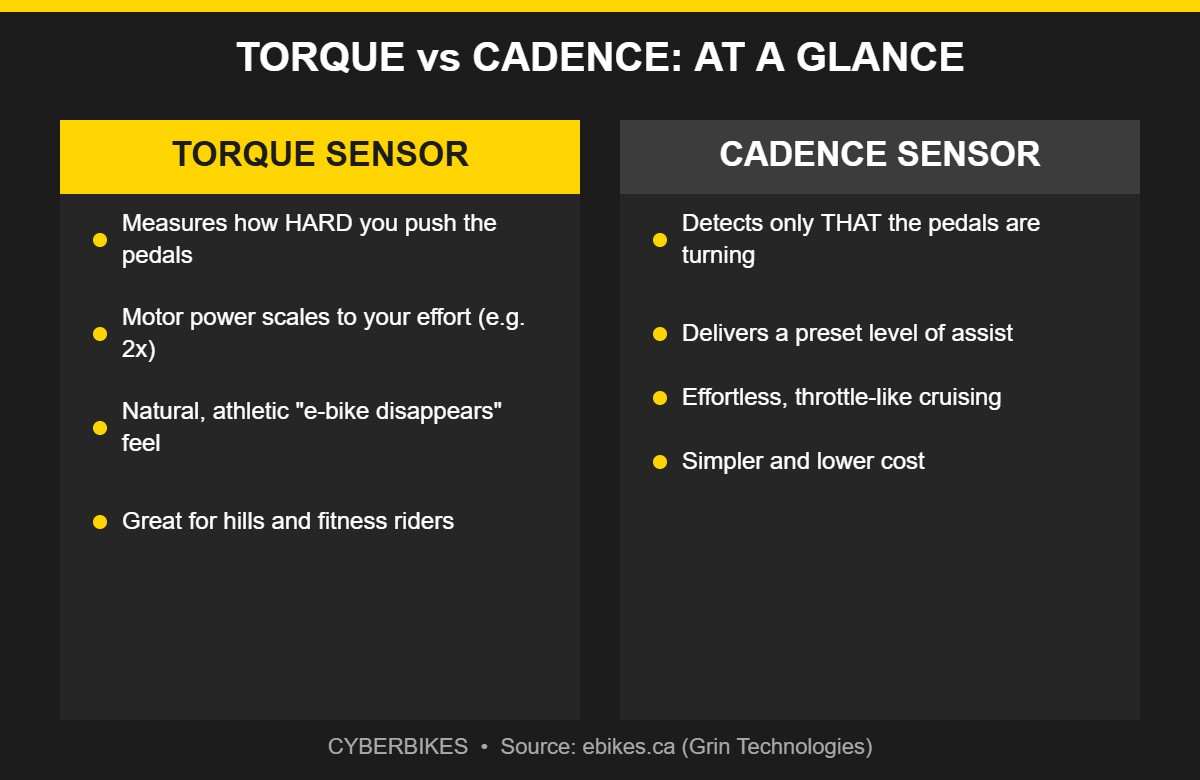
Grin’s honest answer is “it depends,” and we agree. A torque sensor directly couples motor power to your effort, so the ride mirrors a regular bike: you sweat going uphill and coast on the way down. If you want that connected, athletic feel, it is excellent. A cadence system does the opposite — it lets you decouple the terrain from your effort, so with a quick handlebar tap you can keep a steady, easy pace whether the road tilts up or down, because the motor makes up the difference.
| Feature | Torque sensor | Cadence sensor |
|---|---|---|
| What it measures | How hard you press the pedals (force) | Only that the cranks are turning |
| Power delivery | Proportional — pedal harder, get more | Preset level, roughly constant |
| Ride feel | Natural, athletic, responsive | Effortless, throttle-like cruising |
| Best for | Hills, fitness, a connected feel | Relaxed flat commuting, low effort |
| Typical cost | Higher (bottom bracket or hub) | Lower (simple magnet ring) |
| Response | Near-instant to effort | Depends on poles (12–24+ = faster) |
Which sensor suits Sydney riding?
It comes down to your route. In busy inner-city stop-start traffic, ebikes.ca warns that automatic assist can produce unwanted motor bursts every time you nudge the pedals — a good reason many city riders like the fine control of a well-tuned cadence system or a throttle. On the hillier runs out of the Inner West, a torque sensor shines, feeding in power exactly when the gradient bites. The Cyberbikes Centauro, our full-suspension commuter, runs a 250W rear hub motor and a 48V 25Ah (1200Wh) UL 2271-certified Samsung battery, with pedal-assist tuned to help you right up to the legal cut-off.
One rule applies whatever sensor you have: in NSW, a road-legal e-bike is limited to 250W of continuous motor power, with pedal-assist that must cut out at 25 km/h. The sensor changes how the assist feels — it never raises that legal top assisted speed.
The watts and safety behind the feel
Here is the engineering that ties it together: your power output in watts is torque multiplied by pedal speed (cadence). That is exactly why every torque sensor also carries a cadence signal — the controller needs both numbers to work out your true effort, and it uses pedal rotation as a safety check so the bike cannot lurch forward from a drifting signal when you are not actually pedalling. Grin also notes that a good torque sensor should flex no more than 5–10 mm at the crank under full load; any more and the drivetrain feels “squishy” and disconnected. If you want the bigger picture of how these signals become motor power, see our guide to how an e-bike motor controller actually works.
Can you upgrade a cadence sensor to a torque sensor?
Sometimes, but it is not always simple. On many conversion-style bikes you can swap in a torque-sensing bottom bracket if the frame uses a standard 68 mm threaded shell and your controller and display can read the analogue torque signal. On sealed, turn-key e-bikes the sensor is often integrated, so a swap may not be practical or cost-effective. If you are unsure, the team at Cyberbikes in Leichhardt can look at your bike and tell you what is realistic before you spend anything.
Does the sensor type change your range?
Indirectly, yes. A cadence system tends to deliver its preset power whenever you pedal, which can pull steady current even when you do not really need it. A torque sensor only draws power in proportion to your effort, so it often sips less on easy sections and can stretch range — though your battery size, terrain, tyre pressure and how hard you push still matter far more. If you like watching those numbers, our post on what the numbers on your e-bike display mean breaks down the watts, amps and assist levels you will see while riding.
See how assist levels and torque are tuned in practice on our channel, @cyberbikesau.
Frequently Asked Questions
Is a torque sensor better than a cadence sensor?
Not always. A torque sensor feels more natural and rewards effort, which suits hilly rides and fitness riders. A cadence sensor gives effortless, consistent assist that many commuters prefer. The better sensor is simply the one that matches how you ride.
How can I tell if my e-bike has a torque or cadence sensor?
If the power surges in proportion to how hard you pedal, it is a torque sensor. If you get the same steady push whenever the pedals move, regardless of effort, it is a cadence (basic PAS) sensor. The spec sheet will usually say torque sensor when one is fitted.
Does a torque sensor give more range?
Often, indirectly. Because a torque sensor only draws power in proportion to your effort, it tends to avoid the full-power bursts a cadence system can deliver, which can stretch battery range. That said, rider effort, terrain and wind matter more than the sensor alone.
Try both feels for yourself
The best way to settle the torque sensor vs cadence sensor debate is to ride one. Come in for a test ride at Cyberbikes, 281 Parramatta Road, Leichhardt, or browse the range at cyberbikes.com. Prefer to spread the cost? Ask about our rent-to-own plans from $99.99/week. Call us on 0491 794 668 or visit Tuesday to Saturday.
#Cyberbikes #eBikeSydney #TorqueSensor #CadenceSensor #PedalAssist #ElectricBike #Leichhardt #eBikeTech #Centauro