Most Sydneysiders don’t ride bikes for two unglamorous reasons: they don’t own one, and the ones who do don’t feel safe in traffic. In the 2025 National Walking and Cycling Participation Survey, 46.3% of NSW adults who hadn’t ridden in the past year said they simply don’t own a bicycle, and 18.4% said they feel unsafe riding in traffic. Bad weather? 1.2%. Takes too long? 1.7%. The excuses we get lectured about barely register. This is not a motivation problem. It is a supply problem and a road design problem, and both are things governments choose.
How many people in Sydney actually ride a bike?
More than you’d guess from the traffic. The 2025 survey puts NSW weekly cycling participation at 14.8% — around 1.26 million people on a bike in any given week. Across a full year, 33.9% rode at least once, roughly 2.9 million people.
The trend is where it gets uncomfortable. Weekly riding has barely moved in four years: 14.9% in 2021, 14.5% in 2023, 14.8% in 2025. Meanwhile yearly participation went backwards, from 37.8% in 2023 to 33.9% in 2025. The committed riders stayed put. The occasional ones — the people who’d ride if it were easy — quietly stopped. (The survey authors reweighted their historical figures, so these differ slightly from older published versions.)
What do people say is actually stopping them?
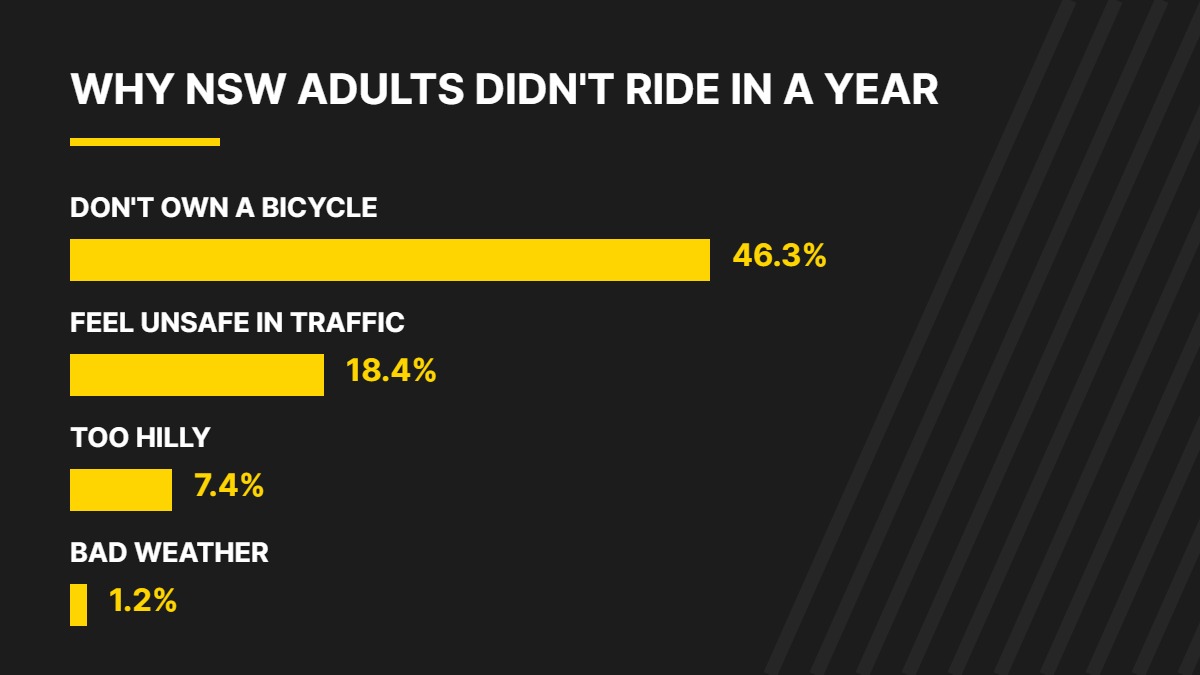
Read that list again, because the ranking matters. The number one barrier is access to a bike — a cost and ownership problem. The number two barrier is fear of traffic — a road design problem. Nothing else comes close. “Not interested” and “prefer other transport” sit at 15.6% each, well behind the two things that are actually solvable with money and paint-plus-concrete.
That first barrier is why weekly rent-to-own exists at all, and why we’d rather put someone on a bike for a few months than sell them a bike they’re not sure about. The second barrier isn’t ours to fix. It belongs to whoever draws the lane.
Why do twice as many men ride as women?
In 2025, 20.0% of NSW men rode in a typical week against 9.8% of women. Over a year it’s 41.3% versus 27.0%. That gap is not about confidence, fitness or interest, and anyone who tells you it is hasn’t read the research.
In the transport literature the share of riders who are women is treated as a diagnostic — a rough read on how safe a network feels to someone who isn’t willing to mix it with trucks on a 60 km/h arterial. A 2026 review of Sydney’s cycling network in Australian Planner frames the whole problem around the “interested but concerned” majority: people who would ride, and don’t, because the network asks them to be brave. A city with a 2:1 gender gap in riding is a city telling you its bike lanes aren’t finished.
Do bike lanes actually change the numbers?
Yes, and the City of Sydney has been counting it at the same 78 intersections since 2010. March 2025 produced a record 55,030 peak-hour bike trips, up 7% on 51,271 in March 2024 and up 187% on the 19,152 counted in March 2010, as Bicycle NSW reported from the council’s count data.
Eight of the ten busiest intersections have a cycleway. Trips at Goulburn and Castlereagh streets jumped 36% in the six months after the Castlereagh Street cycleway was extended four blocks north. Portman Street and Geddes Avenue rose 57% once the Ngamuru connection opened. This is the least mysterious finding in transport: build a separated, connected route and people use it. The riders were always there. They were waiting for somewhere to ride.
What would actually move the needle in the Inner West?
Finish the network, and fund it like it matters. The City of Sydney has built almost 27 km of separated cycleway since 2009. The Inner West Council area has about 5 km — roughly a seventh of the City’s density by land area, according to ABC News mapping of the two networks. Bicycle NSW puts active transport at under 1% of the state transport budget, against a UN recommendation of 20% that the NSW government accepted in principle after the 2025 parliamentary inquiry. That is the whole argument, in one number. It’s the same pattern we covered in how Sydney funds motorways before bike lanes.
The GreenWay is the counter-example sitting on our doorstep: 6 km of continuous separated path, opened December 2025, running Iron Cove to the Cooks River. One connected link does more for participation than ten disconnected ones.
An e-bike closes a different gap. It deletes the 7.4% who said Sydney is too hilly and it collapses the time penalty that makes people drive 4 km. Under e-bike laws in NSW, a legal e-bike has a maximum continuous rated power of 500 W with assistance cutting out at 25 km/h and any throttle-only function stopping at 6 km/h — and from 1 March 2029 the limit drops to 250 W with mandatory EN 15194 certification, per Transport for NSW. The Cyberbikes Centauro we build for exactly this job runs a 48V 25Ah (1200Wh) Samsung battery, quotes up to 120 km at 25 km/h on the flat with a 75 kg rider and no headwind, carries 150 kg of rider and cargo, and is certified to UL 2849, UL 2271, ISO 4210 and EN 15194. If you want the full picture of running one instead of a car, we wrote the long version on car-free e-bike commuting in Sydney.
None of this requires Sydneysiders to become different people. 2.9 million of them already rode a bike this year. They just need one to ride and somewhere safe to ride it.
Frequently Asked Questions
How many people in NSW ride a bike each week?
About 14.8% of people in NSW rode a bicycle in a typical week in 2025, which is roughly 1.26 million people. Over a full year, 33.9% rode at least once, about 2.9 million people, according to the 2025 National Walking and Cycling Participation Survey.
What is the biggest reason people in NSW don’t ride a bike?
Not owning a bicycle. Of NSW adults who had not ridden in the past year, 46.3% said they do not own a bicycle and 18.4% said they feel unsafe riding in traffic. Only 1.2% blamed bad weather.
Do you need a licence to ride an e-bike in Sydney?
No. A legal e-bike in NSW is treated as a bicycle, so no licence, registration or insurance is required. It must have a maximum continuous rated power of 500 watts, assistance that stops at 25 km/h, and any throttle-only function must cut out at 6 km/h.
Swap one car trip a week for an e-bike ride and see what changes. We’re Cyberbikes, 281 Parramatta Road, Leichhardt — come and argue with us about bike lanes any day of the week.
#CyberbikesLeichhardt #EbikeSydney #CyclingSydney #InnerWestSydney #BikeLanes #CarFreeSydney #ActiveTransport #SydneyCommute