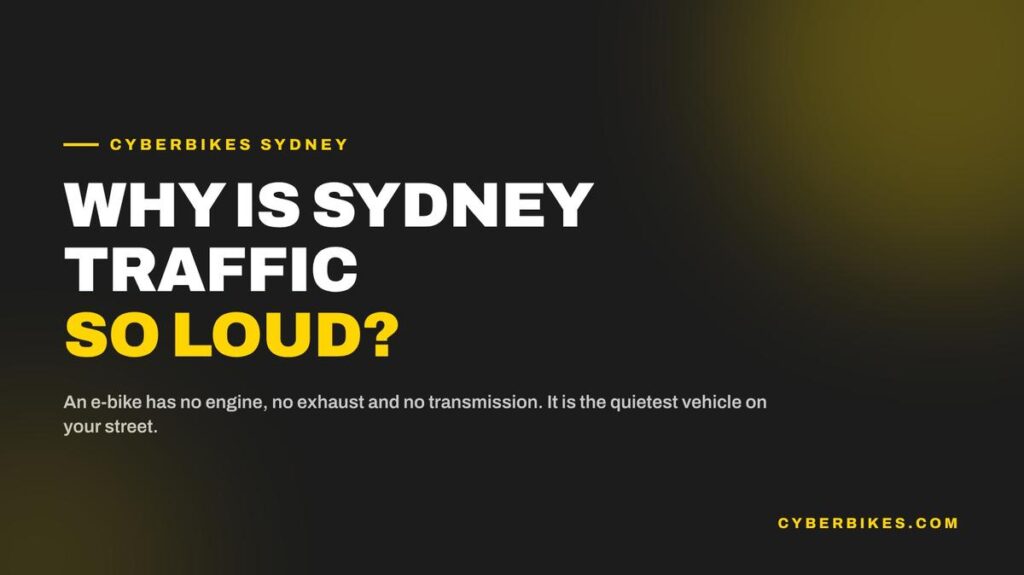
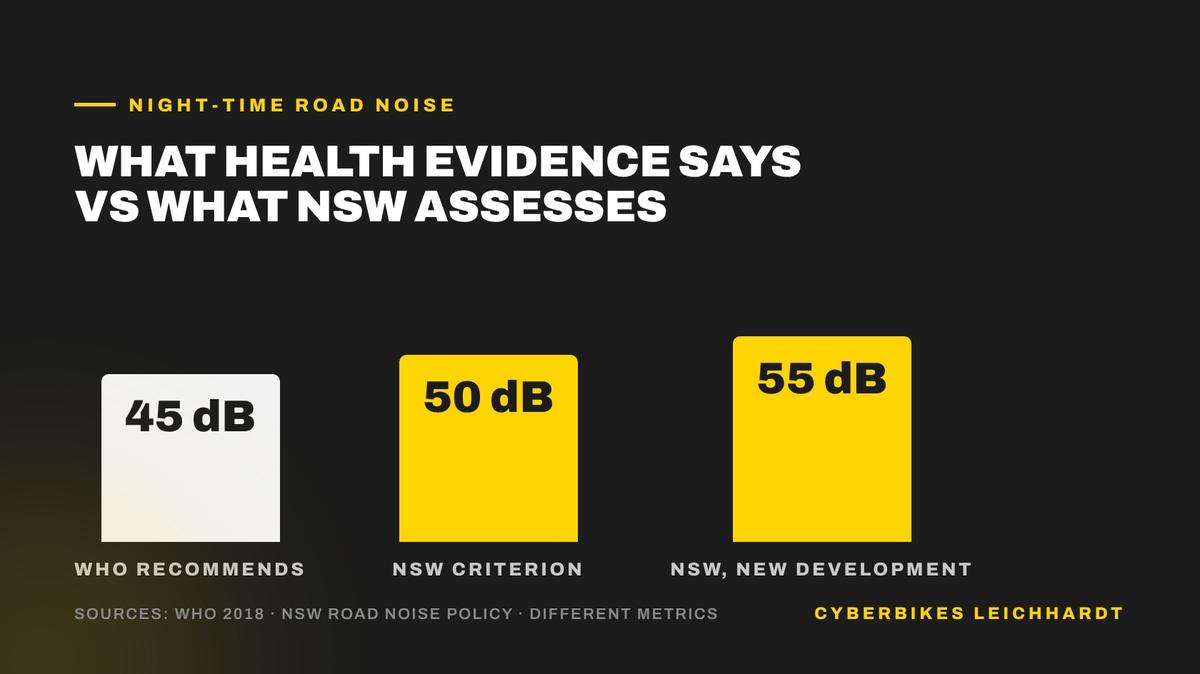
Sydney traffic noise is loud because the city was built to move as many vehicles as possible past as many bedrooms as possible, and then wrote its noise rules around that decision instead of against it. The World Health Organization’s 2018 environmental noise guidelines recommend road traffic noise stay below 53 dB Lden and 45 dB Lnight. The NSW Road Noise Policy assesses existing homes on a freeway, arterial or sub-arterial corridor against 55 dB(A) by day and 50 dB(A) at night — and stretches to 60 and 55 when the extra traffic comes from a land-use development. Different metrics, same message: the number we design to is the number above the one health evidence recommends. The roar outside your window is not a failure of the system. It is the system’s output.
How loud is too loud, according to the health evidence?
Below 53 dB Lden and 45 dB Lnight, per the WHO’s 2018 guidelines for the European Region. Those are not comfort thresholds. The WHO ties environmental noise above them to ischaemic heart disease and hypertension, sleep disturbance, annoyance, cognitive impairment and tinnitus, with growing evidence on adverse birth outcomes and mental health.
NSW’s own policy does not dispute this. It concedes that longer-term health effects are “more difficult to quantify” while drawing the link to cardiovascular outcomes, and it states plainly that there is evidence noise affects child cognition. Read that again: the state’s road noise policy acknowledges traffic noise can affect how children think, and then sets criteria that permit it.
What noise limits does NSW actually apply to its roads?
Criteria, not limits — and the difference matters. From Table 3 of the NSW Road Noise Policy, for residential land:
| Road type and situation | Day | Night |
|---|---|---|
| Freeway/arterial/sub-arterial — existing homes hit by a new corridor or road redevelopment | 55 dB(A) LAeq(15 hr) | 50 dB(A) LAeq(9 hr) |
| Freeway/arterial/sub-arterial — existing homes hit by extra traffic from a land-use development | 60 dB(A) LAeq(15 hr) | 55 dB(A) LAeq(9 hr) |
| Local roads — new corridor, redevelopment or extra traffic | 55 dB(A) LAeq(1 hr) | 50 dB(A) LAeq(1 hr) |
Two things jump out. First, the night-time criterion of 50 dB(A) sits above the WHO’s 45 dB Lnight recommendation — the metrics are measured differently, so it is not a like-for-like gap, but nobody is erring toward the quieter number. Second, look at who gets the 5 dB discount: when a development pours extra traffic onto your street, the acceptable noise goes up, to 60 by day and 55 at night. The person who has to live with it is not the person the criteria are written for.
Why won’t quieter cars fix Sydney’s noise?
Because the loudest part of a moving car is not its engine. The NSW Road Noise Policy credits the Australian Design Rules with cutting noise from engines and transmissions — that work has largely been done — while describing the reduction of tyre noise as “an ongoing challenge for tyre manufacturers.” Tyre-on-road is what remains, and it is what you hear from a window on Parramatta Road at 11pm.
Which is why swapping the fleet to electric is a partial answer at best. Same tyre, same asphalt, same speed, same contact patch — and in many cases a heavier vehicle pressing it. If the plan for a quieter Sydney is “wait for everyone to buy a new car,” the plan is to stay loud for another two decades.
What actually makes a Sydney street quieter?
Three levers, and only one of them is a product you buy:
- Lower speeds. The NSW Road Noise Policy lists reducing vehicle speed as source control delivering reductions that are “small but cumulatively significant.” Small per vehicle, across every vehicle, all night. This is the cheapest lever we have and we argue about it like it’s a tax.
- Fewer vehicle movements. Noise is a volume problem before it is a vehicle problem. Every trip that doesn’t happen in a car is a trip that makes no tyre noise at all.
- Street design that doesn’t funnel traffic past bedrooms. Barriers and double glazing treat the symptom at the receiver’s expense; not building the corridor through the suburb treats the cause.
Notice what’s missing from NSW’s standard toolkit: the option of moving fewer cars. We will fund a noise wall, a quieter pavement and a glazing retrofit before we’ll fund the bike lane that removes the trip. For the longer argument about replacing those trips, see our car-free Sydney e-bike commuting guide, and the case for slower streets in why Sydney’s speed limits are dropping to 40 km/h.
Does swapping car trips for e-bike trips actually help?
Yes, and in the most direct way available: it removes the source. An e-bike has no engine note, no exhaust, no transmission whine, and at urban assist speeds its tyre contact is a rounding error next to a 1.8-tonne vehicle’s. You cannot make a car quiet enough to match a bike that was never loud.
That is also the part of this problem an individual can act on this week without waiting for a policy review. At Cyberbikes in Leichhardt — on Parramatta Road, so we are not theorising about traffic noise — the bikes that replace the most car trips are the ones that carry the load. Our Centauro step-through e-bike runs a 48V 25Ah Samsung battery, full suspension for Sydney’s patched back streets, hydraulic brakes, a welded rear rack and GPS tracking. Legal NSW e-bikes assist to 25 km/h with a maximum continuous rated power of 500 W, per Transport for NSW, and helmets are mandatory.
Frequently Asked Questions
How loud is too loud for traffic noise?
The World Health Organization’s 2018 environmental noise guidelines recommend keeping road traffic noise below 53 dB Lden over the day-evening-night period and below 45 dB Lnight. Above those levels the WHO links road noise to ischaemic heart disease, hypertension, sleep disturbance, annoyance and cognitive impairment.
What traffic noise limits apply to roads in NSW?
The NSW Road Noise Policy sets assessment criteria rather than hard caps. For existing homes affected by new road corridors or road redevelopment on a freeway, arterial or sub-arterial road, the criteria are 55 dB(A) LAeq over the 15-hour day and 50 dB(A) LAeq over the 9-hour night, measured externally. Where extra traffic comes from a land-use development, the criteria rise to 60 day and 55 night. On local roads the criteria are LAeq(1 hour) of 55 day and 50 night.
Are electric cars quieter in city traffic?
Only partly. Australian Design Rules target engine and transmission noise, but the NSW Road Noise Policy describes reducing tyre noise as an ongoing challenge for tyre manufacturers, and tyre-road contact is what you hear most once vehicles are rolling. An electric car still puts the same tyre on the same road surface at the same speed.
Swap one car trip a week for an e-bike ride and see what changes — starting with how much quieter your own street gets. We’re at Cyberbikes, 281 Parramatta Road, Leichhardt, and the test rides are free.
#CyberbikesSydney #TrafficNoise #EbikeSydney #SydneyCycling #NoisePollution #CarFreeSydney #Leichhardt #UrbanPlanning #LiveableSydney #QuietStreets