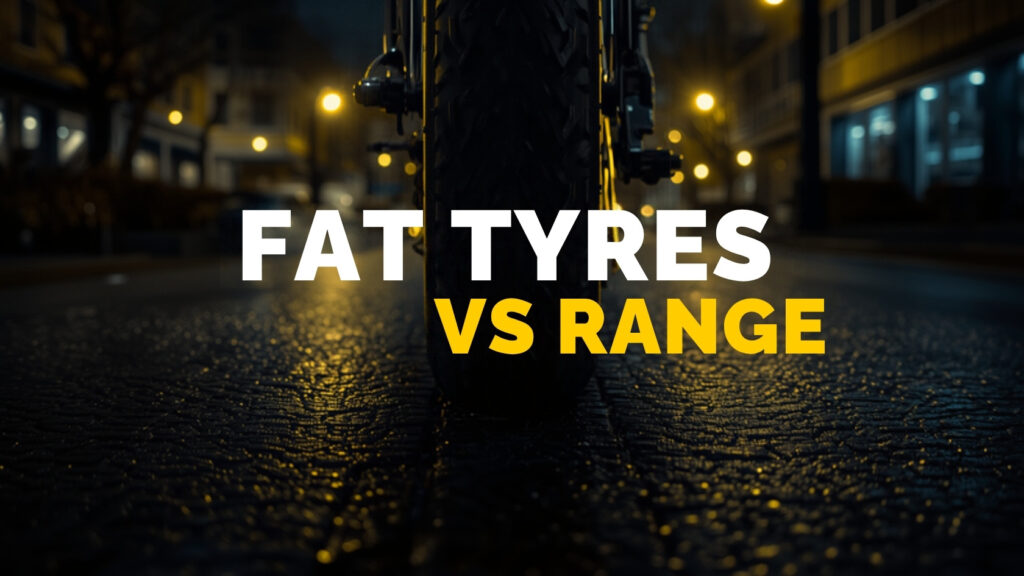
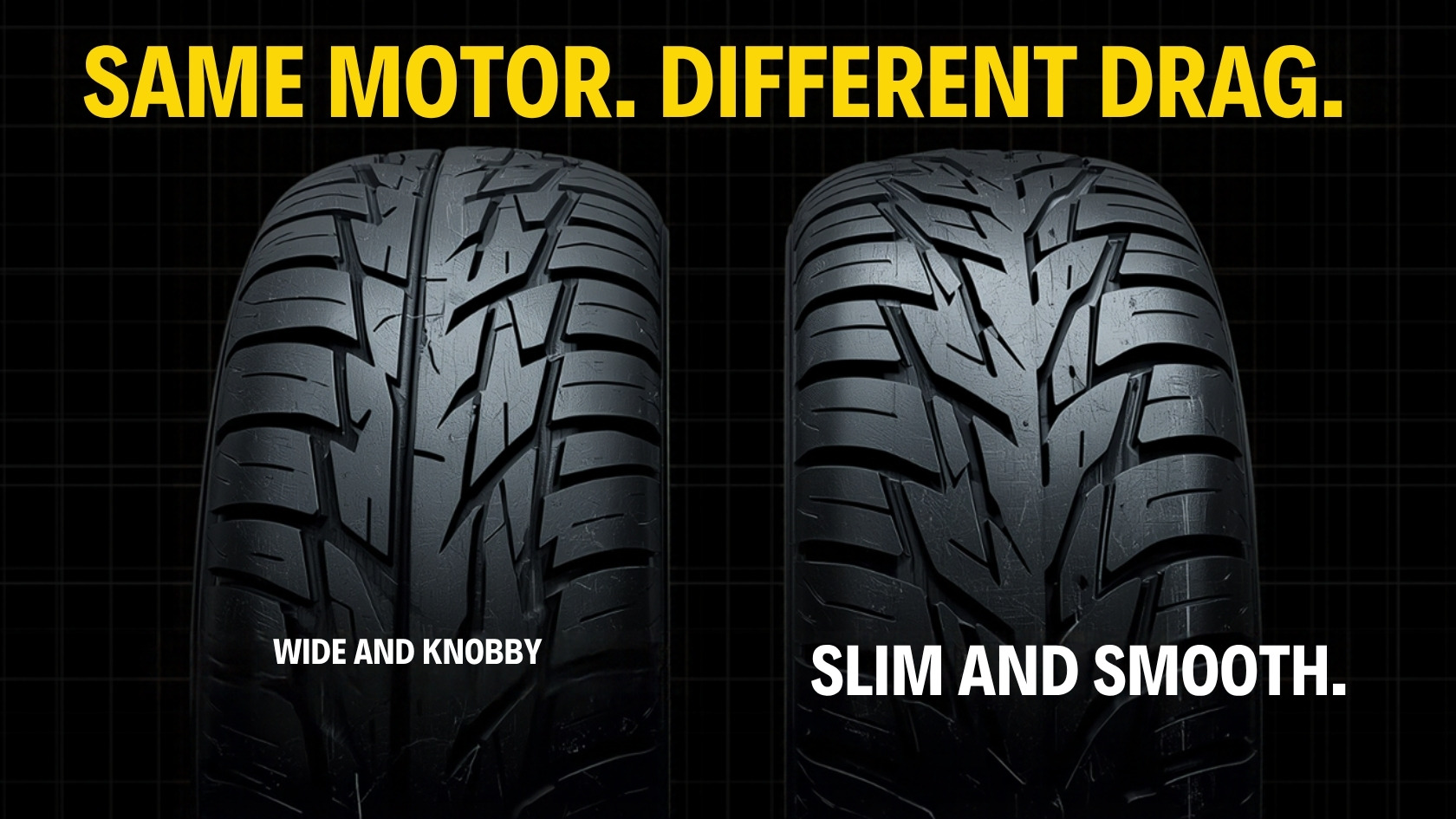
Yes, a draggier tyre costs you range — but width itself is almost innocent. What you actually pay for is rolling resistance, and on an e-bike whose assist cuts out at NSW’s 25 km/h limit, rolling resistance is the single biggest force you are buying watts to overcome. Raise your tyre’s rolling-resistance coefficient by half — the kind of jump you get going from a smooth commuting tread to a soft knobby one, or from a properly inflated tyre to a soggy one — and on the Centauro’s published numbers you lose roughly 12% of your range. That is about 14 km off a 120 km ride. Tread pattern, casing and air pressure do that damage. The extra millimetres of width barely rate.
Here is the engineering behind that, and what it means when you are riding Parramatta Road rather than a lab drum.
What actually slows an e-bike down?
Three forces take your watts, and they scale very differently with speed.
- Rolling resistance — a force of roughly Cr × m × g, where Cr is the tyre’s rolling-resistance coefficient, m is the total mass of bike plus rider plus cargo, and g is 9.81 m/s². The power it costs rises in a straight line with speed.
- Aerodynamic drag — a force proportional to the square of your speed, so the power it costs rises with the cube of speed. Double your speed and aero wants eight times the watts.
- Gravity on a climb — m × g × the gradient, and completely indifferent to your tyres.
That cube law is why tyre choice matters more on an e-bike than on a fast road bike. Grin Technologies’ motor simulator at ebikes.ca lets you set vehicle weight, grade, CdA (the aerodynamic term) and Cr (the rolling term) independently, and watch what each one does to the power curve. Push the speed up to 40 km/h and aero dominates everything. Hold it at the 25 km/h where NSW law stops the motor assisting, and rolling resistance is carrying a far bigger share of the bill.
Put real numbers on it. The 2026 Cyberbikes Centauro weighs 37 kg with its battery fitted and runs 26 × 2.4 tyres. Add a 75 kg rider and you are moving 112 kg. Its 48V 25Ah Samsung pack holds 1200 Wh, and the published range is up to 120 km at 25 km/h on flat road with no headwind. Divide one by the other: 10 Wh per kilometre, which at 25 km/h is a steady 250 W. That 10 Wh/km is the number your tyres are about to move.
How many watts does a draggier tyre really cost?
Take a fairly typical Cr of 0.008 for a decent e-bike tyre at sensible pressure. The rolling force is 0.008 × 112 × 9.81, which is 8.8 newtons. At 25 km/h — 6.94 metres per second — that force costs 8.8 × 6.94, or about 61 watts at the wheel.
Now make the tyre half again as draggy, Cr 0.012. The force becomes 13.2 N and the cost becomes about 92 W. You have added roughly 30 watts, permanently, for as long as you are rolling. Against a 250 W budget that is 12% more energy per kilometre: 10 Wh/km becomes about 11.2 Wh/km, and 1200 Wh of battery now takes you about 107 km instead of 120 km.
Thirty watts does not sound like much. It is more than your lights, your display and every parasitic draw on the bike combined, and it never switches off. It is also the cheapest 30 watts you will ever recover, because a tyre costs a fraction of a bigger battery. We go through that trade-off in more depth in our definitive guide to e-bike batteries and real-world range.
Does tyre width or tyre pressure cost more range?
Pressure and tread, almost always. A tyre loses energy two ways: the casing and rubber flexing as the contact patch deforms, and the whole bike being shaken by road texture. On smooth tarmac, more pressure means less casing flex and a lower Cr. On broken, patched, truck-chewed asphalt — which describes a good deal of inner-west Sydney — pumping a tyre rock hard starts feeding energy into vibration instead, and into your wrists.
That is the real case for a wide tyre on a city e-bike. A 2.4in casing at a sane pressure absorbs surface junk that a narrow, hard tyre would bounce off, and the Centauro’s 100 mm of front and 120 mm of rear travel does the same job for the bigger hits. Width is not what costs you the watts. A soft, knobby, heavily siped tread costs you watts, whatever width it comes in.
Honest caveat: the exact Cr of a specific tyre model is a measured number, not something you can reason your way to. We quote 0.008 and 0.012 above as a worked example of the arithmetic, not as a test result for any particular tyre. If a brand will not publish measured rolling-resistance data, treat its efficiency claims as marketing.
Does a heavier tyre hurt more than a draggier one?
On the flat, far less than people assume. Rolling force scales with total mass, so a tyre and tube pairing that is 1 kg heavier adds 1 kg to a 112 kg system — about 0.9% more rolling drag, or roughly half a watt. You will never feel it.
Hills are where mass bites. Lifting 112 kg up a 100 m climb takes m × g × h = 112 × 9.81 × 100 = 109,872 joules, which is 30.5 Wh — about 3 km of flat riding, spent on one hill. Stop-start traffic charges you the same way, in small instalments, every time you accelerate from a red light. If your commute is lumpy, a lighter wheel is worth more to you than it is to someone riding the flat run along the Cooks River. We compared the two biggest range thieves on their own in headwind or hill: which drains your e-bike range.
Does a draggier tyre cook your hub motor?
It can, and this is the part riders miss. Grin’s page on motor power ratings makes the point bluntly: it is torque, not power, that overheats a motor, and copper losses follow what it calls the I²R relationship — double the winding current and you quadruple the heat generated inside the motor. Grin’s own simulator estimates how long a motor takes to reach 150 °C and what its core temperature will be after two hours of running, because that is the failure mode that matters.
A draggier tyre raises the torque the motor must hold at every speed, and it raises it most where the motor is already struggling: low rpm, up a hill, fully loaded. Grin’s figures show how little output it takes — their example of a motor marketed at 5000 W hits 100 °C at 250 rpm while producing only about 800 W. Fit a soft off-road tread for an on-road commute and you are asking a 250 W continuous motor to run warmer, all day, for no benefit. Grin also notes that cooling modifications such as ferrofluid can lift continuous torque by around 40% without changing peak power — a useful reminder that heat, not watts, is the real ceiling. If the relationship between torque, current and heat is new to you, start with how e-bikes actually work: motors, sensors and controllers.
What should you actually run on Sydney roads?
- Check your pressure weekly, not seasonally. It is the only free range you will ever get. Stay inside the range printed on the sidewall and set it for your loaded weight, not the empty bike.
- Match the tread to the surface you actually ride. If 95% of your week is bitumen and shared path, a knobby tyre is costing you watts and motor heat for 5% of the riding.
- Do not chase narrow. On Sydney’s patched inner-west roads a wide casing at moderate pressure is usually both faster and far more comfortable than a narrow one pumped hard.
- Remember the law before you chase speed. Transport for NSW allows a maximum continuous rated power of 500 W, no motor assistance above 25 km/h, and throttle-only operation that cuts out at 6 km/h — and a bike over those limits is illegal even if the power or speed is restricted by software. From 1 March 2029 the limit drops to 250 W and only EN 15194 certified e-bikes will be allowed on NSW roads. The Centauro is built to 250 W continuous, 25 km/h assist and a 6 km/h throttle, which is why it will still be legal after that date.
Want to see the bike those numbers belong to? Our full Centauro walkthrough is on the Cyberbikes channel:
Frequently Asked Questions
Do fat tyres drain an e-bike battery faster?
Only if they are draggier, and width is not what makes a tyre draggy. Tread pattern, casing construction and air pressure set the rolling-resistance coefficient. On a 112 kg bike-and-rider at 25 km/h, raising that coefficient from 0.008 to 0.012 adds about 30 watts and costs roughly 12% of your range.
Does tyre pressure change e-bike range?
Yes, and it is the cheapest range you can buy back. An under-inflated tyre flexes more at the contact patch, which raises rolling resistance and the torque your motor has to hold. Set pressure inside the sidewall range for your loaded weight and check it weekly rather than seasonally.
Can the wrong tyre overheat an e-bike motor?
It can make overheating more likely. Grin Technologies notes that torque, not power, is what cooks a motor, and that copper heating follows an I squared R relationship, so doubling the winding current quadruples the heat. A draggier tyre raises torque demand at every speed, and most where the motor is already hottest: low rpm, loaded, on a climb.
Come and feel the difference instead of reading about it. Test rides are free at Cyberbikes Leichhardt, 281 Parramatta Road — bring your own bike and we will check your tyre pressure and tread while you are here, or roll the 2026 Centauro on its 26 × 2.4 tyres and 100/120 mm of suspension over the worst road in the inner west. Call us on 0491 794 668 to book a time.
#CyberbikesAU #EbikeSydney #EbikeRange #ElectricBikeLeichhardt #CentauroEbike #EbikeTyres #RollingResistance #EbikeTech #SydneyCommute #CargoEbike