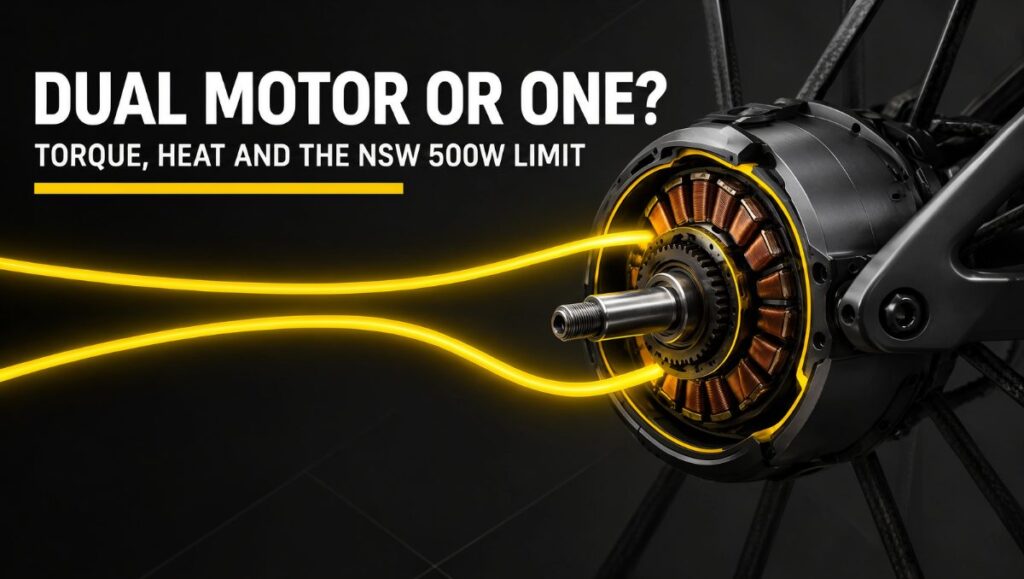
A dual motor e-bike adds torque, not range, and it almost never stays legal in NSW. Two hub motors genuinely double the torque available at the wheels, which is why Grin Technologies builds dual-drive kits for cargo bikes and multi-person machines. But in NSW the legal ceiling is 500 W of continuous rated power for the whole bike, and two motors count together — so a dual motor e-bike with 2 × 500 W is simply an illegal vehicle, software limits or not. For almost every rider on Parramatta Road, the cheaper win is one well-matched motor, the right gearing and a bigger battery.
Does a second motor actually double your climbing torque?
At the wheel, yes — torque adds. Two identical hub motors pulling the same current produce roughly twice the tractive force of one, and that is exactly the use case Grin Technologies describes on its dual-motor drive page: situations where “one motor alone doesn’t have enough torque,” such as cargo bikes and multi-person bikes. Grin also lists traction control on loose surfaces and system redundancy as real benefits.
What does not double is the power your battery can deliver. Mechanical power is torque multiplied by rotational speed — in practical terms, torque (Nm) × rpm × 0.104 ≈ watts, per Grin’s power-ratings explainer. Electrical input is just as blunt: watts = volts × amps. A 48 V pack pushing 20 A delivers about 960 W into the system, and splitting that across two motors gives each one roughly 480 W. You have not created power; you have shared it. The climb gets easier only because each motor is working further inside its comfortable range.
That distinction matters when you read a spec sheet. Grin is blunt that there is no standardised “rated watt” at all — a motor’s output depends on load, controller current and assumed rpm, so the same motor can be honestly described as 250 W or dishonestly marketed as 5000 W. Two motors multiply that ambiguity rather than resolving it.
Why does splitting the current keep both motors cooler?
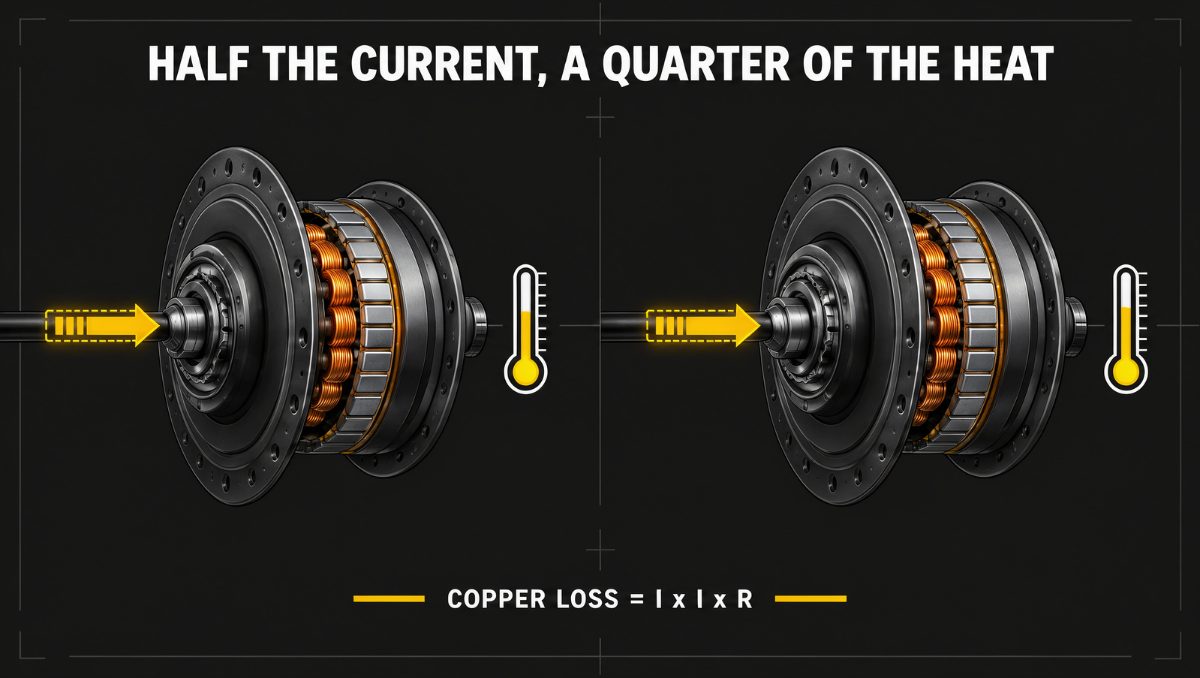
This is the strongest engineering argument for two motors, and it comes straight out of the physics of copper. Winding heat follows I²R — current squared times resistance. As Grin puts it, doubling the current quadruples the copper heating. Run that backwards and the result is striking: halve the current through each motor and each one generates a quarter of the heat it would have alone, so the pair produces about half the total winding heat for the same job.
Heat is what sets continuous power in the first place. Grin’s own measurements show a motor marketed at 5000 W reaching 100°C at roughly 800 W of output at 250 rpm, and notes that a hub motor typically takes one to two hours to reach thermal equilibrium. Cooling changes the number, not the physics: adding ferrofluid to the stator raised continuous output by around 40% in Grin’s example without changing peak power or efficiency at all.
So if your problem is a motor that gets heat-soaked crawling up Norton Street with 40 kg of shopping, two motors genuinely solve it. If your problem is that the bike feels slow off the lights, the cause is usually controller current, gearing or assist tuning — and we cover how those interact in our guide to how e-bikes actually work: motors, sensors and controllers.
What does a dual motor do to your range?
It costs you range three times over, and none of the three is dramatic on its own.
- Weight. A second hub motor, controller and wiring is real mass on a bike that is already heavy. The 2026 Cyberbikes Centauro weighs 37 kg with its battery fitted, so you are adding to a 37 kg starting point, not a 15 kg road bike.
- Drag. A direct-drive hub spins against its own magnets whenever the wheel turns. Two of them means two lots of unpowered drag on every descent and every coast down Parramatta Road.
- Controller overhead. Two controllers mean two sets of standby and switching losses, drawn from the same pack.
The arithmetic that matters is simple. Energy stored is watt-hours = volts × amp-hours: the Centauro’s 48 V 25 Ah Samsung pack is 1200 Wh, which Cyberbikes rates at up to 120 km at 25 km/h on flat road with a 75 kg rider and no headwind. That works out to roughly 10 Wh per kilometre. Divide watt-hours by your real Wh/km and you have your range — so a setup that pushes consumption from 10 to 13 Wh/km turns 120 km into about 92 km. Grin’s motor simulator lets you model that for two different drive systems side by side before you spend a cent; pack voltage and capacity set the ceiling, and nothing about a second motor raises it.
Is a dual motor e-bike legal in NSW?
Usually not. Transport for NSW sets the current limits as 500 W maximum continuous rated power, motor assistance that stops above 25 km/h, and throttle-only operation that cuts out at 6 km/h. From 1 March 2029 the limit drops to 250 W and only EN 15194 certified e-bikes will be allowed on NSW roads. Transport for NSW states plainly that bikes exceeding any of these limits are illegal, and that software, app or switch restrictions do not make an over-limit bike legal. New seizure powers took effect on 21 August 2026, letting police and authorised officers seize and dispose of illegal e-bikes used on NSW roads and road-related areas.
Read that against a dual-motor build. The rating applies to the vehicle, not to each motor, so two 250 W motors sit right on the 500 W line today and over the line from 2029. Two 500 W motors are double the limit. And a dual-drive conversion is a modification, which makes EN 15194 certification of the finished bike effectively impossible — the point of that standard is the complete, tested system. The Centauro is built to the NSW figures as sold: 250 W continuous, 25 km/h pedal assist, 6 km/h throttle, with UL 2849 system certification, UL 2271 battery certification and an ISO 4210 frame. Bolt a second motor onto anything and you own the legal consequences, not the manufacturer. If the state-by-state mess is what is confusing you, we untangled it in our complete guide to e-bike laws in NSW and Australia.
When is a second motor worth it, and when is gearing the better answer?
Grin’s own advice is that multi-motor systems add significant complexity and cost and are best left to experienced builders, who historically needed custom wiring and a deeper understanding of e-bike electronics than a kit assumes. The practical details are fiddly: depending on the splitter used, both controllers switch on and off together and the speed, motor-temperature and battery-voltage signals come from one nominated controller, while on simpler splitters the throttle and regen signals are shared but only one motor responds to the pedal-assist or torque sensor. Get that wrong and you have a bike that lurches, or a display that reports half the power you are actually drawing.
So the honest shortlist for a second motor is narrow: heavy cargo work, trikes and tandems, deep sand or mud where traction control earns its keep, and expedition builds where redundancy matters more than simplicity. Everything else is better solved one layer down — a slower-wound motor, a smaller-diameter wheel for more torque at the rim, more controller current, stator cooling, or simply pedalling in a lower gear so the motor stays at healthier rpm. We compared the current side of that in phase amps or battery amps: which makes torque.
In the Leichhardt workshop the pattern is consistent. Riders who come in asking for two motors almost always have a single-motor bike that is geared wrong, under-powered at the controller, or carrying a tired battery that sags under load. Fixing one of those three is cheaper than doubling the drivetrain, and it keeps the bike road-legal.
Frequently asked questions
Does a dual motor e-bike go faster than a single motor?
Not in NSW. Top speed is set by the law and the controller, not the number of motors: assistance must stop above 25 km/h regardless of how many motors are fitted. A second motor adds torque for climbing and hauling, which you feel on hills and under load rather than on the flat.
Do two motors use twice the battery?
No. Two motors doing the same total work draw roughly the same battery current as one, because watts equal volts times amps and the pack sets the limit. Range still drops a little from the extra weight, the extra unpowered drag of a second hub and a second controller’s losses.
Can I legally convert my e-bike to dual motor in Sydney?
Only if the finished bike still meets the NSW limits of 500 W maximum continuous rated power, assistance cutting out at 25 km/h and throttle-only cutting out at 6 km/h. Because the rating applies to the whole vehicle, most dual-motor builds exceed it, and from 1 March 2029 NSW will require EN 15194 certification that a modified bike cannot hold.
Thinking about more torque for hills or cargo? Come and ride the single-motor answer first. Book a free test ride on the 2026 Cyberbikes Centauro — 250 W, 48 V 25 Ah Samsung battery, 50 kg welded rear rack — at Cyberbikes Leichhardt, 281 Parramatta Road, or call us on 0491 794 668 and we will tell you honestly whether your current bike needs a second motor or just a better setup.
#CyberbikesLeichhardt #EBikeSydney #DualMotorEBike #CentauroEBike #EBikeTech #SydneyCommute #HubMotor #EBikeLawNSW