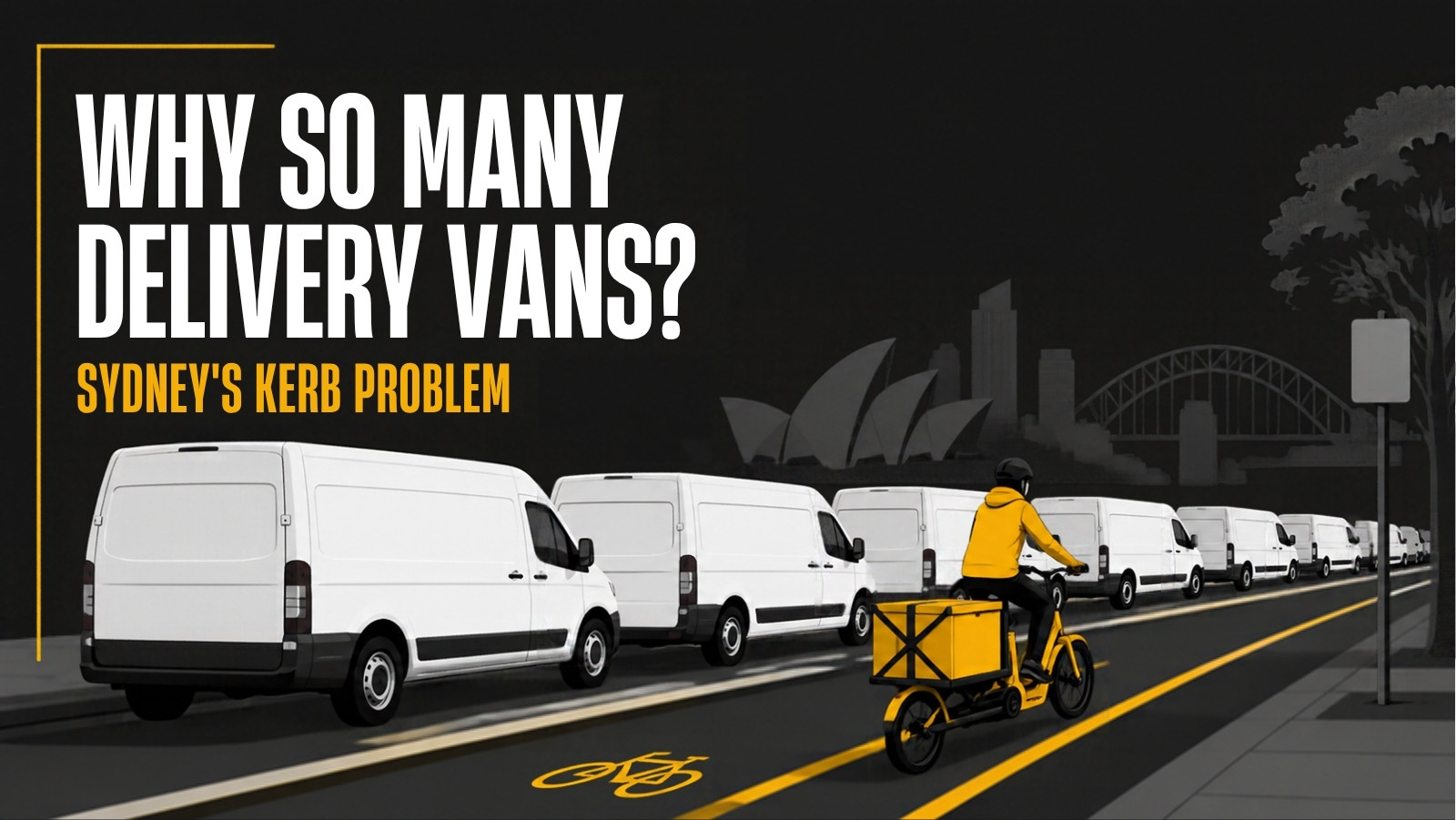

Share e-bikes in Sydney fix one real problem and dodge the bigger one. There were more than 1.94 million share bike trips in the City of Sydney alone in 2024 — almost double the year before, on track for around 3 million in 2025, according to Bicycle NSW. That is a city telling you, two million times a year, that it wants to ride. The new state rules tidy up where those bikes get parked. They do not add one continuous metre of protected lane to ride them on.
Yes, share schemes fix access. No, they do not fix what actually limits riding here — road space. Here is what changed, what the data says, and where car-free commuting and rent-to-own in Sydney still beats renting by the minute.
What did NSW actually change for share e-bikes?
NSW gazetted its first sharing-scheme regulation on 14 August 2026, with operator applications opening that day and compliance and enforcement commencing in summer 2027 (NSW Government). Operators now need approval from Transport for NSW and authorisation from each council.
- Zones: councils can set no-go, go-slow and mandatory parking zones and bays; operators must comply.
- Standards: safe devices, helmets available, insurances, device ID, and trip and incident data to Transport.
- Fleet caps: tied to demand and performance.
- Penalties: up to $55,000, plus $5,500 per day for ongoing non-compliance (Bicycle Network).
- Funding: a capped per-trip fee feeds a $6.6 million Sharing Scheme Grant Program, with councils able to get up to $200,000 for bike parking.
Credit where due: bikes dumped across a footpath are a real accessibility problem, and mandatory bays with actual penalties are the right tool. But look at the shape of the spend — $200,000 per council for parking is a rounding error beside one kilometre of separated cycleway. We are funding the tidying, not the network.
How many trips are share bikes really doing?
1.94 million trips in one local government area in 2024, roughly double 2023, heading for about 3 million in 2025. Two details matter more than the headline.
First, 22% of those trips ran between 7pm and midnight. That is not tourists doing harbour laps — that is people getting home after a shift, in a city whose off-peak public transport thins out badly.
Second, Bicycle NSW cites an estimate that around 20% of shared bike trips replace car travel nationally. Applied to that 2024 figure, roughly 390,000 car trips removed from one council area in a year — our arithmetic on their estimate, not a measured count. Exactly the short, cold-start trips that do the most damage per kilometre.

Why regulate the bike harder than the road?
The current state rules for any e-bike: 500 watts maximum continuous rated power, pedal assistance cutting out at 25 km/h, throttle-only cutting out at 6 km/h. From 1 March 2029 that becomes 250 W and only EN 15194 certified bikes will be allowed on the road. A bike above those limits is illegal even if an app or switch restricts it, and since 21 August 2026 police have expanded powers to seize and dispose of non-compliant machines (Transport for NSW).
We are not against standards — EN 15194 is a good certification and bikes should meet it. We are pointing at the asymmetry. A 25 kg vehicle capped at 25 km/h now attracts a seizure regime, a certification deadline and a power ceiling in regulation, while the road it shares is still designed around two tonnes at 50 or 60 and the cycleway still stops mid-block. The road-safety literature is consistent about what kills people: speed, road design, vehicle standards and enforcement. Wattage on a pedal-assist bicycle is nowhere near the top of that list.
The City of Sydney made a similar point in its submission: the reforms “don’t go far enough to solve the problems the community is experiencing.” It asked for state-led fleet limits, council enforcement powers, fair funding for public-space impacts and an 18-month review before expansion (City of Sydney).
Share bike or your own — which suits a commute?
Straight answer: share for occasional trips, your own for a routine. With real numbers, not a sales pitch.
| Factor | Share scheme | Your own bike |
|---|---|---|
| Short trip | $2.75 up to 20 min on the LimePrime tier, plus $4.99/month (FutureFive, Nov 2025) | About 40c a full charge |
| Availability | Only if one is near you and charged | Always, in your hallway |
| Where you leave it | Mandatory bays, no-go zones | Any legal bike parking |
| Shopping or a kid | Not designed for it | Rated rack and basket loads |
| After a year | You own nothing | You own the bike |
The honest part: if you ride twice a week, a share scheme is cheaper than any form of ownership, and we would rather you rode a Lime than drove. The case for your own machine is not that it undercuts a rental on a spreadsheet — it is certainty, carrying capacity and cost per kilometre once riding is the default.
The energy maths, since people ask. The Cyberbikes Centauro runs a 48V 25Ah Samsung pack — 1,200 Wh, or 1.2 kWh, claiming up to 120 km at 25 km/h on a flat road with a 75 kg rider and no headwind. Sydney’s Ausgrid usage rate for 2026–27 is 33.1c per kWh under the AER Default Market Offer effective 1 July 2026 (suntariff.com.au). A full charge is 1.2 × 33.1c ≈ 40 cents — about 33 cents per 100 km. No rego, no excise, no parking, no tolls.
It is certified to UL 2849 (system) and UL 2271 (battery), with an ISO 4210 frame and a 250 W continuous motor, and carries 150 kg of rider and cargo, with 50 kg on the rear rack. That is the gap between a vehicle you rent for ten minutes and one that replaces car trips. If your problem is the last two kilometres from a station, we have covered whether an e-bike can solve Sydney’s last-mile problem separately.
So what would actually fix it?
Keep the schemes — two million trips a year in one LGA is demand no city should waste. Then spend on the deferred part: continuous, physically separated lanes that do not stop at the hard intersection. The City of Sydney has 133 footpath parking areas holding four to ten bikes each and 17 on-street bays approved, the first at Haymarket in February 2025. Bays are cheap. Lanes are the expensive, unglamorous thing that actually moves mode share — and reallocating road space is the only lever here that shifts the number.
Share schemes proved the appetite. The network is still the bottleneck.
Frequently Asked Questions
Do you need a helmet on a share e-bike in Sydney?
Yes. Helmets are mandatory for every bicycle and e-bike rider in NSW, securely fitted and fastened. Under the sharing-scheme rules operators must make helmets available, and authorities can penalise operators for devices left without one attached.
What is the legal power limit for an e-bike in NSW?
A maximum of 500 watts continuous rated power, with pedal assistance cutting out at 25 km/h and throttle-only at 6 km/h. From 1 March 2029 the limit drops to 250 W and only EN 15194 certified bikes are allowed. A bike above those limits is illegal even if an app or switch restricts it.
Can councils decide where share bikes are parked?
Yes. Under the sharing-scheme regulation gazetted on 14 August 2026, councils and state land managers set no-go zones, go-slow zones and mandatory parking bays, and operators must comply. Councils also authorise which operators may run locally, with enforcement provisions commencing in summer 2027.
Are share bikes replacing car trips in Sydney?
Partly. Bicycle NSW cites an estimate that around 20% of shared bike trips replace car travel nationally. Applied to the City of Sydney’s 1.94 million trips in 2024, that implies roughly 390,000 car trips avoided in one council area in a year — an estimate applied to trip counts, not a measured survey.
Swap one car trip a week for a ride and see what changes. If you want to talk it through, we are Cyberbikes, 281 Parramatta Road, Leichhardt — and if you would rather try before committing, the Centauro is available on rent-to-own from $99 a week.
#ShareEBikes #eBikeSydney #Cyberbikes #CentauroEbike #SydneyCycling #CarFreeSydney #InnerWest #Leichhardt #Micromobility #RentToOwnEbike