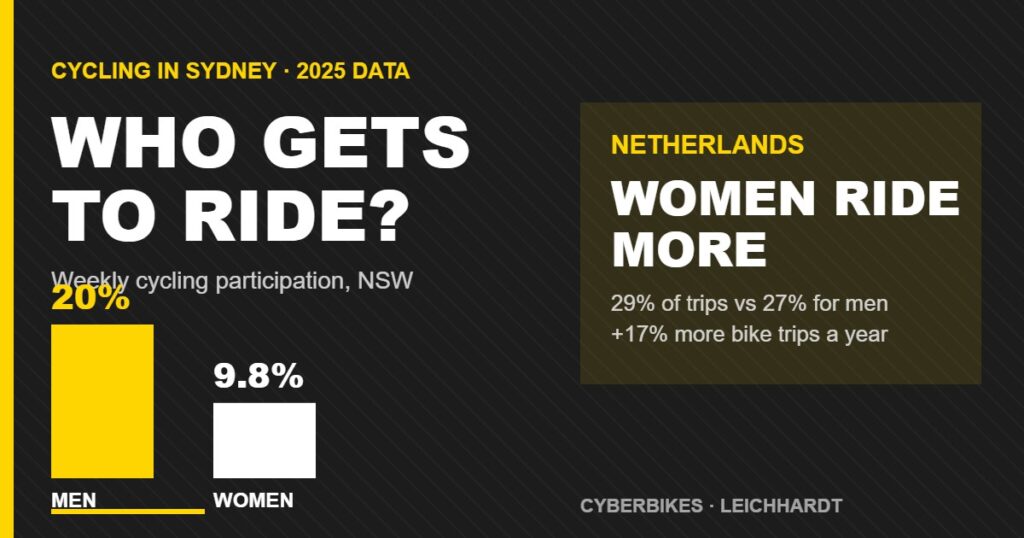
Twice as many men as women cycle in Sydney: in 2025, 20% of NSW men rode a bike in an average week against 9.8% of women, from a state-wide weekly participation rate of 14.8%. That is not a difference in taste. It is a readout on the streets we built — and the proof sits in the Netherlands, where women make more bike trips than men.
Do twice as many men really cycle in Sydney?
Yes, and the gap is measured, not guessed. The 2025 National Walking and Cycling Participation Survey put NSW weekly cycling participation at 14.8% — about 1.26 million people, riding an average of 2.9 days a week. Split by gender, it is 20% of men and 9.8% of women. Metro and regional NSW barely differ (14.2% versus 16%), so this is not a city-versus-country story. One number splits the state in half, and it is not postcode.
Here is what makes the figure interesting rather than depressing: 34% of NSW residents rode at least once in the past year, and 40% of NSW riders now name commuting or errands as their main reason for riding, up from 28% in 2023. Sydney is already using the bike as transport. It is just using it with half the city missing.
Is this about preference, or about street design?
Design. The cleanest evidence is the Dutch national travel data in the KiM report Cycling Facts: Dutch women account for roughly 17% more bicycle trips a year than Dutch men — 2.4 billion against 2.0 billion — and the bicycle’s share of all trips is 29% for women and 27% for men. On e-bikes the gap is wider still: 456 million trips a year by women against 245 million by men.
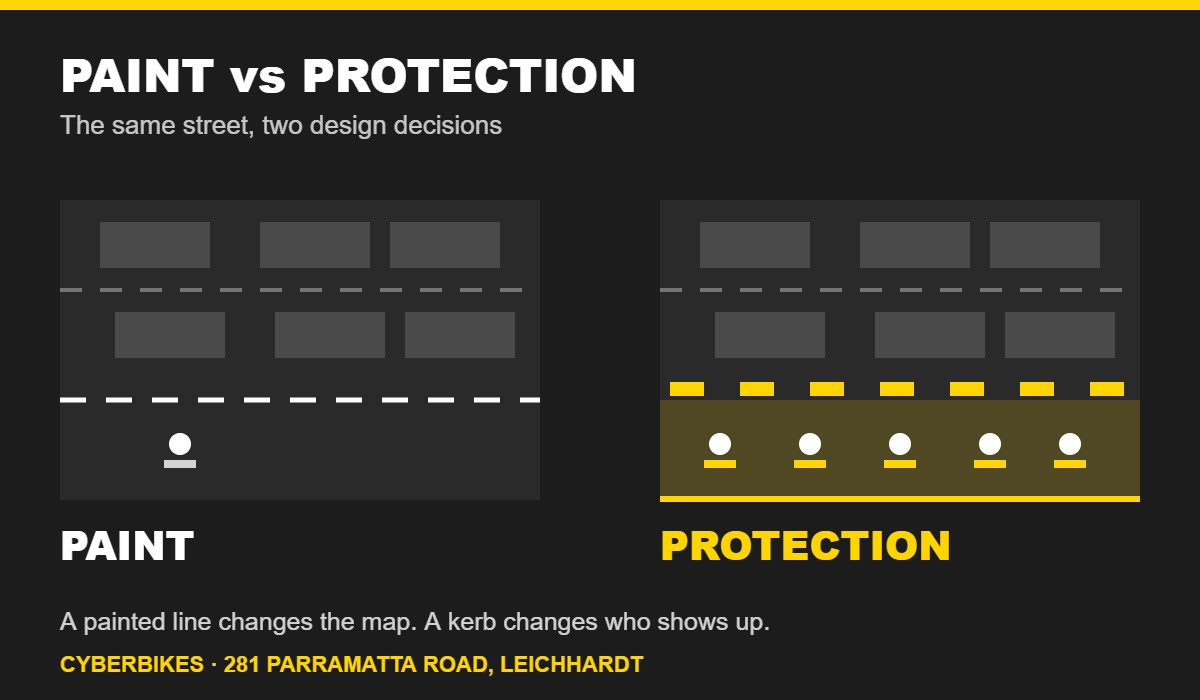
Same species, opposite result. Dutch women are not braver than Sydney women; they are riding on separated infrastructure, through 30 km/h streets, on a network that connects without dumping you into four lanes of traffic. When the road design changes, who rides changes with it. That is the whole argument for building protection instead of paint, and it is why a car-free Sydney e-bike commute is an infrastructure question before it is a bike question.
What does “interested but concerned” actually mean?
It is a measurement category, borrowed from the four-types-of-cyclist research of Dill and McNeil (2016), and in NSW it is the biggest group on the board. Among NSW women, 44.2% land in “interested but concerned” — they would ride more if they felt more comfortable — against 39.3% of men. At the other end, 8.6% of NSW men call themselves highly confident (“I’ll ride no matter what”) against 2.5% of women.
And comfort is not abstract. Among NSW people who rode in the past year, 20.7% of women said they feel uncomfortable riding in their own local area, against 8.8% of men — a 2.4x gap, from the same survey. Riders aged 25 to 29 report 26.1%, the worst of any age band under 80. The demand already exists; it is sitting in the “interested but concerned” column waiting for a street it can survive.
Nothing in that data points at the riders. It points at the design decisions around them: lane width, kerb separation, intersection treatment, speed limits, and whether the cycleway actually goes anywhere. Those are choices made in a traffic engineering office, and they can be chosen differently.
What would put more Sydney riders on the road?
The survey asked. Secure bike storage came up for 30% of NSW respondents — somewhere safe to park — and an e-bike incentive scheme drew 16.2%. E-bikes are already doing quiet work here: e-bike ownership has reached 6% of NSW households, and the survey’s own authors credit “growth in e-bike use and post-2020 infrastructure upgrades” with enabling more diverse riders to take up cycling for transport. An e-bike flattens the two excuses Sydney hands out most often — hills and sweat — but it cannot flatten a stroad.
So the fix list is short and boring, which is how you know it is real: separated cycleways that connect, 30 km/h on local streets, bike parking at stations and shops, and an end to cycleways that stop 200 metres short of the destination. Sydney does not have a participation problem. It has a protection problem, and the 9.8% is the invoice.
What are the NSW rules for the e-bike you would buy?
Read live from Transport for NSW: a road-legal e-bike has a maximum continuous rated power of 500 W, motor assistance that stops at 25 km/h, and any throttle-only function cutting out at 6 km/h. Bikes over those limits are illegal even if an app or switch restricts them, and from 1 March 2029 only EN 15194-certified e-bikes at 250 W will be allowed. Helmets are mandatory, and if you are 16 or over and not supervising a child, the footpath is off limits. Our own Cyberbikes Centauro is built to those NSW limits: a 250 W rear hub motor, a 48V 25Ah (1200Wh) Samsung battery, an ISO 4210-compliant frame, 4-piston hydraulic brakes and a frame-welded rack rated to 50 kg — a step-through you can get on in work clothes, which matters more than it sounds. The full detail on power limits and penalties sits in our guide to e-bike laws in NSW and Australia.
If you want the broader version of this argument, we have also asked why more people don’t ride bikes in Sydney.
Frequently asked questions
How many women cycle weekly in NSW?
In 2025, 9.8% of NSW women reported cycling in an average week, against 20% of NSW men, from a state-wide weekly participation rate of 14.8%, according to the National Walking and Cycling Participation Survey.
Do women cycle more than men anywhere?
Yes. In the Netherlands women make about 17% more bicycle trips a year than men (2.4 billion against 2.0 billion), and the bicycle’s share of all trips is 29% for women against 27% for men, according to the KiM Cycling Facts report.
Does an e-bike help close the gap?
It helps with hills, distance and carrying loads, and Dutch women make 456 million e-bike trips a year against 245 million by men. But 20.7% of NSW women who rode last year still feel uncomfortable riding locally, so separated infrastructure and lower speeds do the work an e-bike cannot.
If you’re ready to be part of a car-lighter Sydney, come see us at Cyberbikes, 281 Parramatta Road, Leichhardt — bring the route you are nervous about and we will ride it with you.
#CyclingSydney #EbikeSydney #Leichhardt #BikeInfrastructure #WomenWhoRide #CarLighterSydney #Cyberbikes #ActiveTransport